

By the time most women in a Thane village had grandchildren old enough to carry school bags, they had lost all hope of becoming literate. Then one afternoon in 2016, they picked up the bags themselves.
A Village, a Teacher, and an Unusual Idea
Phangane is a small, orderly village roughly 120 kilometres from Mumbai in Maharashtra’s Thane district. Seventy or so families live along its mud roads, tending kitchen gardens and subsistence farms. For generations, the rhythms of life here followed a familiar pattern: girls married young, women kept the house, and education remained the business of men and children.
Yogendra Bangar, a primary school teacher from the same village, had seen this pattern long enough. The women he saw daily, many of them grandmothers, had never learned to read a medicine label, sign their own name on a bank form, or decipher a bus route board. Not because they lacked the ability, but because no one had thought it necessary to teach them.
On International Women’s Day, March 8, 2016, Bangar opened a school for them. He called it Aajibaichi Shala, which means Grandmothers’ School in Marathi. With the backing of the Motiram Dalal Charitable Trust and the cooperation of local teacher Sheetal More, he started giving classes in More’s front room. The first students were women aged sixty and above. Some were in their nineties.
What the Classroom Looks Like
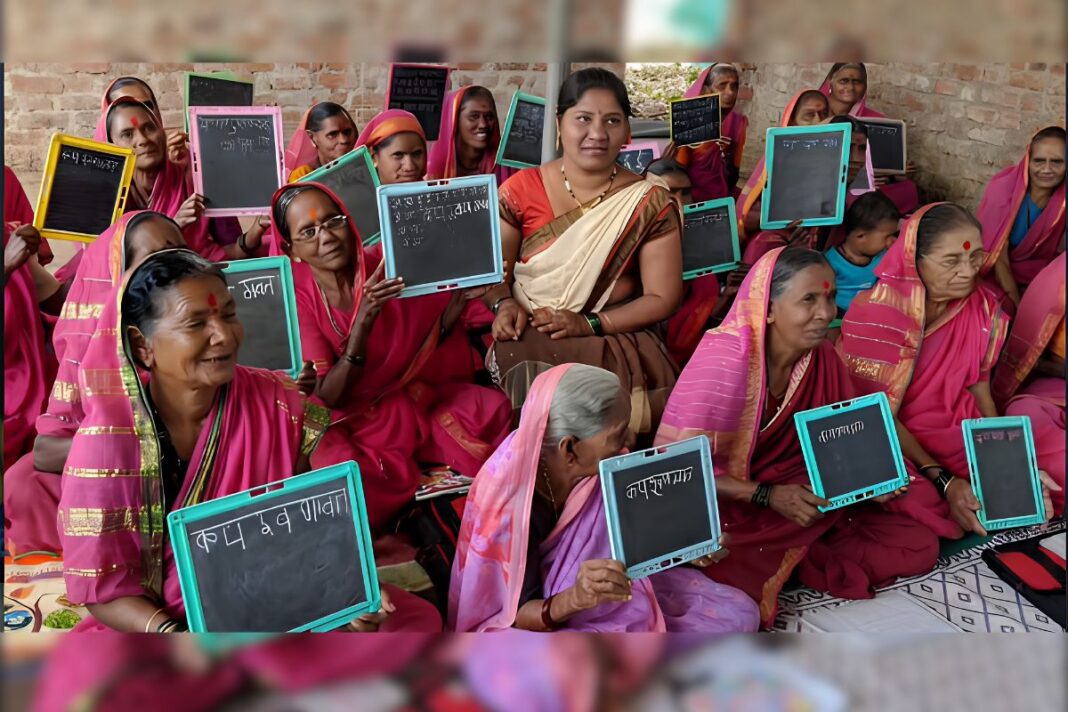
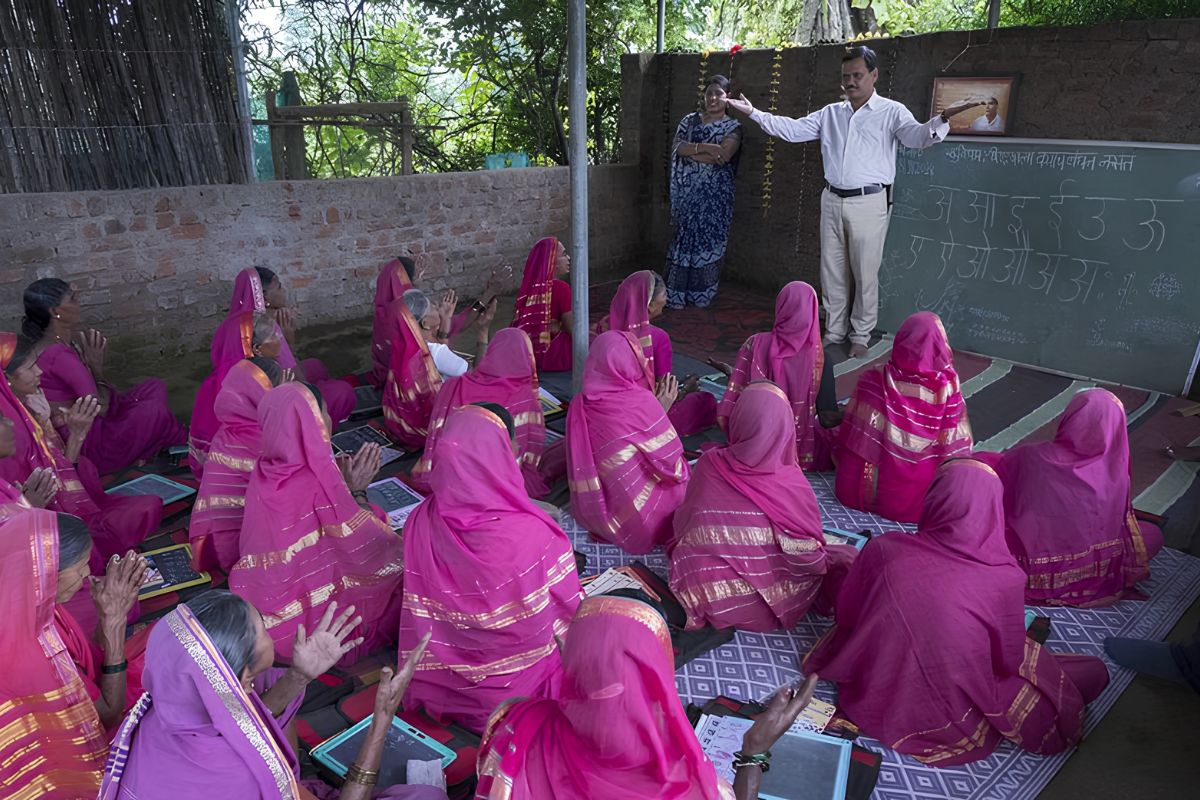
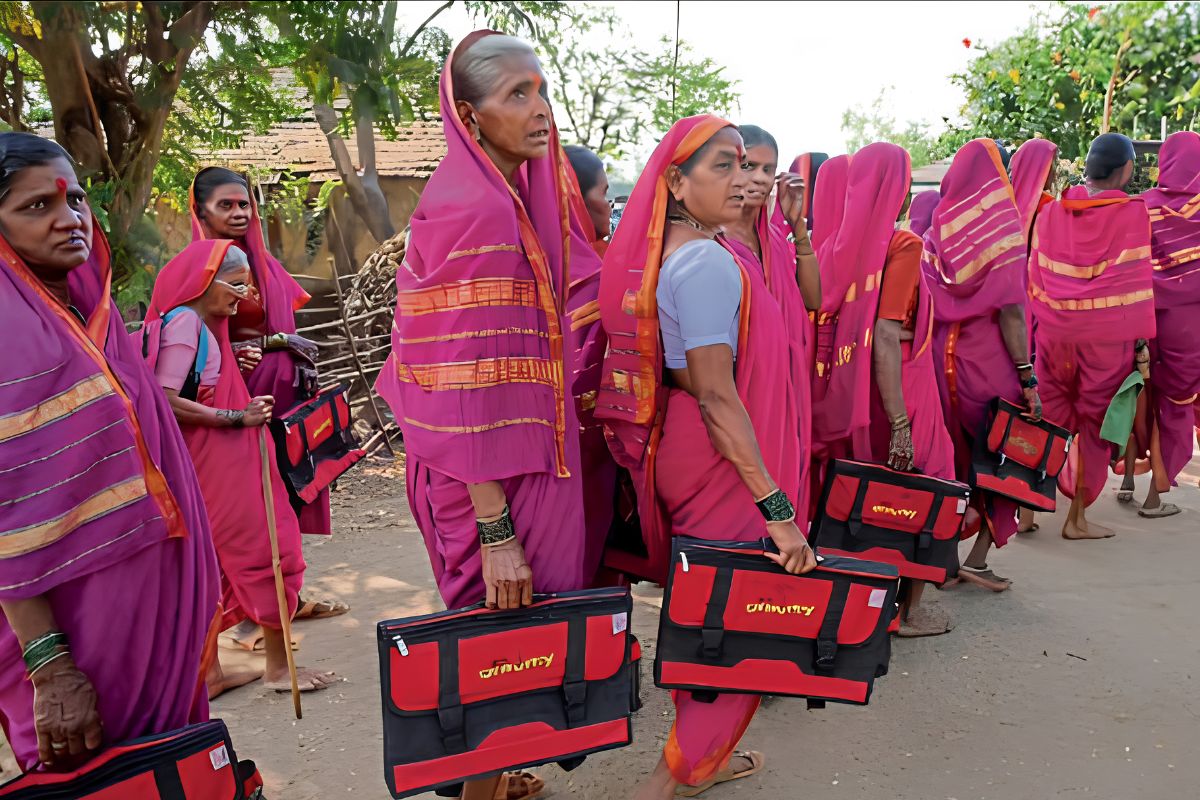
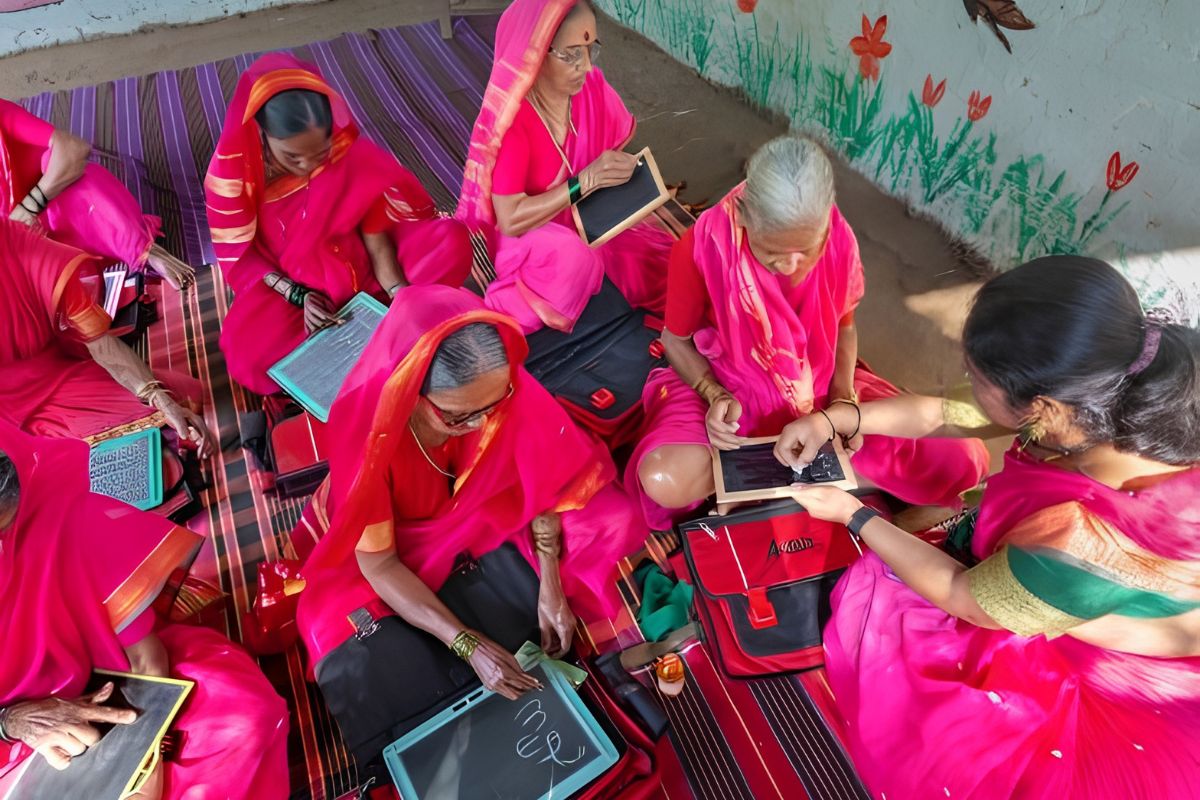
The school has since moved to a decorated hut in More’s backyard, partly shaded by a mango tree. By 2 pm on most days, 20 to 30 women arrive in fuchsia pink sarees, the school uniform. They carry small satchels containing notebooks, pencils, and chalk slates. They sit cross-legged on cotton rugs, arrange themselves in rows, and wait for the lesson to begin.
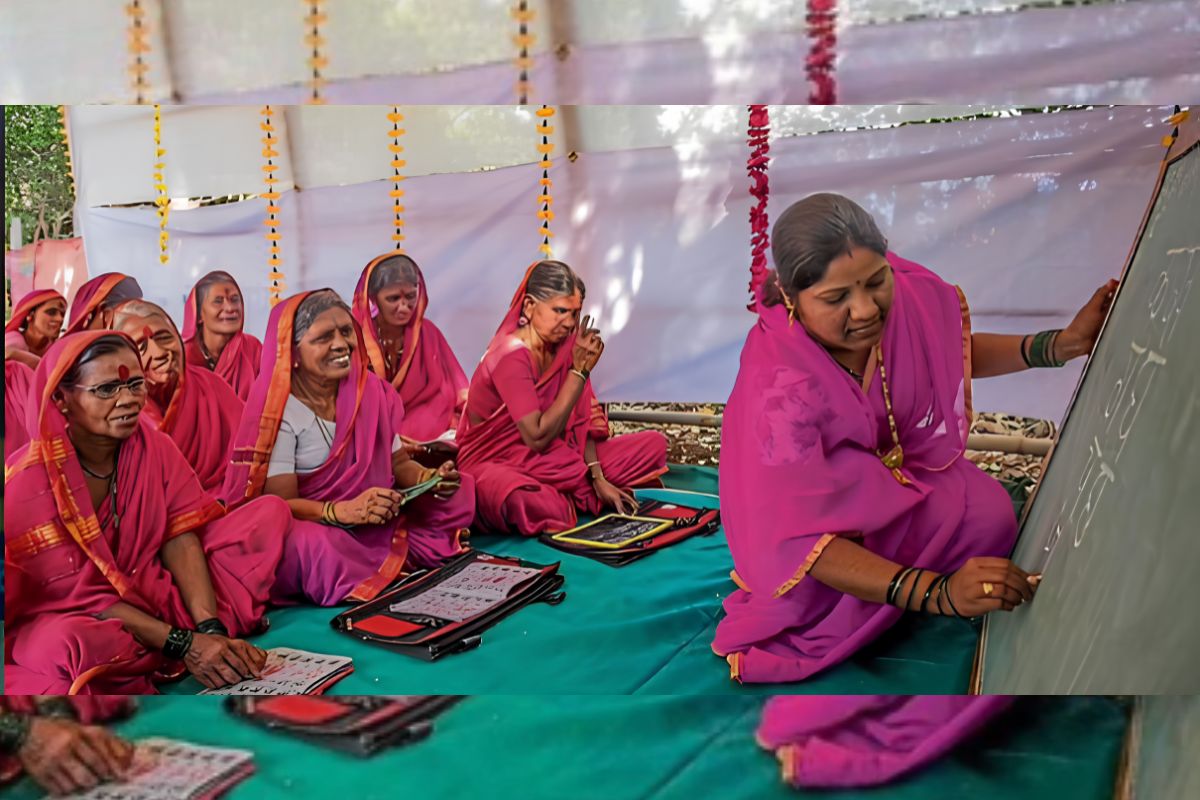
Classes run for two hours. The curriculum covers the Marathi alphabet, basic arithmetic, the writing of one’s own name, and nursery rhymes used as memorisation tools. Sessions open with a prayer and a roll call, proceed through slate exercises and group recitation, and close with a round of arithmetic. The setting is, by all accounts, something between a primary school and a village gathering.
The uniforms, bags, slates, and chalk are provided at no cost, funded by the charitable trust. There are no fees, no entry requirements, and no examinations to pass.
The Women Who Show Up
Kamal Keshav Tupange, one of the students, was married at the age of 12. She is now sixty-eight. Her knees cause her difficulty when she sits on the floor, but she still attends every afternoon. She has learned to write her own name, which gives her a quiet satisfaction. “I like going to school,” she said. “I have learned the alphabet.”
Anusuya Kokedar, 65, spent her childhood attending to household duties. Education was not discussed as a possibility for girls in her family. She now reads basic words and has conversations with classmates she would not otherwise have spent much time with. “It feels good to learn with other older women,” she said.
Sunanda Kedar, in her early seventies, had one wish before she died: to write her own name. She has since accomplished it. “I have no regrets now,” she said, speaking in a voice that has grown faint with age. “It was my only desire.”
Parvati Maruti Kedar does not know her age because no record was kept at her birth, a circumstance not uncommon among rural women of her generation. She signed her name on a ration card for the first time after joining the school. She described the moment as one in which she felt proud in a way she had not felt before.
Nirmala Kedar is in her eighties. She joined Aajibaichi Shala with one clear intention: she did not wish to die without being able to read. “I couldn’t go to school as a child,” she said. “But now I’ll carry words with me.”
Sheetal More and the Practical Business of Teaching
Sheetal More was in her early thirties when she became the school’s first and, for a time, sole instructor. She was unsure intially. Teaching women, including her own mother-in-law, required a certain composure she had to develop over time.
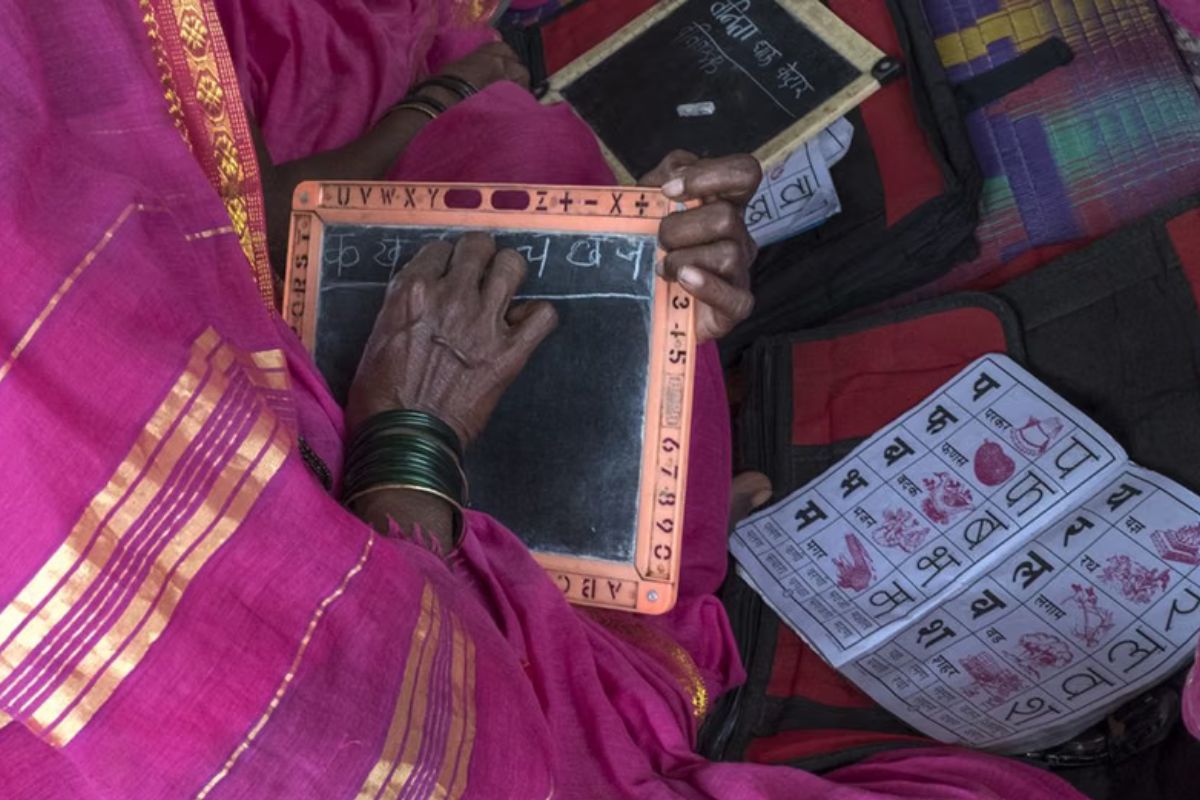
Her methods are practical rather than formal. She uses prayer songs to establish routine, group chanting to build familiarity with letters, and short arithmetic drills conducted with enough lightness that the women do not feel burdened. The goal, as Bangar has stated more than once, is not university preparation. It is the quiet dignity of a woman who can sign her own documents, read a letter from her son, or identify her medication without asking for help.
More says her students arrive with a degree of enthusiasm that younger pupils can rarely match. “They behave like eager children,” she said. “It is a rare thing to see.”
What This Reflects About India More Broadly
India’s rural female literacy rate stands at roughly 59 per cent, compared with 79 per cent for men, according to government data. According to UNICEF, nearly half of rural girls in earlier decades were married before the age of 18, which effectively ended any prospect of formal schooling. The women at Aajibaichi Shala belong to that generation and older. Their absence from classrooms was not accidental. It was, in most cases, a direct result of marriage arrangements, domestic obligation, and the assumption that literacy was not a practical necessity for women managing households.
India’s Right to Education Act, passed in 2009, applies to children up to the age of 14. There is no equivalent legislation for adults who were denied education in their youth. Aajibaichi Shala does not fill any official policy gap. It exists because one teacher in one village decided the gap was worth filling anyway.
A Decade On
The school has not expanded into a chain of institutions. It remains, by design and by circumstance, a single hut in Phangane. The COVID-19 period saw significantly reduced weekly sessions. Physical limitations, particularly joint pain and reduced mobility, continue to pose difficulties for students in their eighties and nineties. The village infrastructure itself- water sourced from wells nearly three kilometres away, poor sanitation, and no public transport- places practical pressure on daily attendance.
And yet the school continues. Current enrollment stands between twenty-eight and thirty students. The oldest attendees in recent years have been in their mid-nineties. The viral attention the school received through international media, including coverage by Reuters and a feature by the World Economic Forum, has sustained donations without fundamentally altering the school’s character.
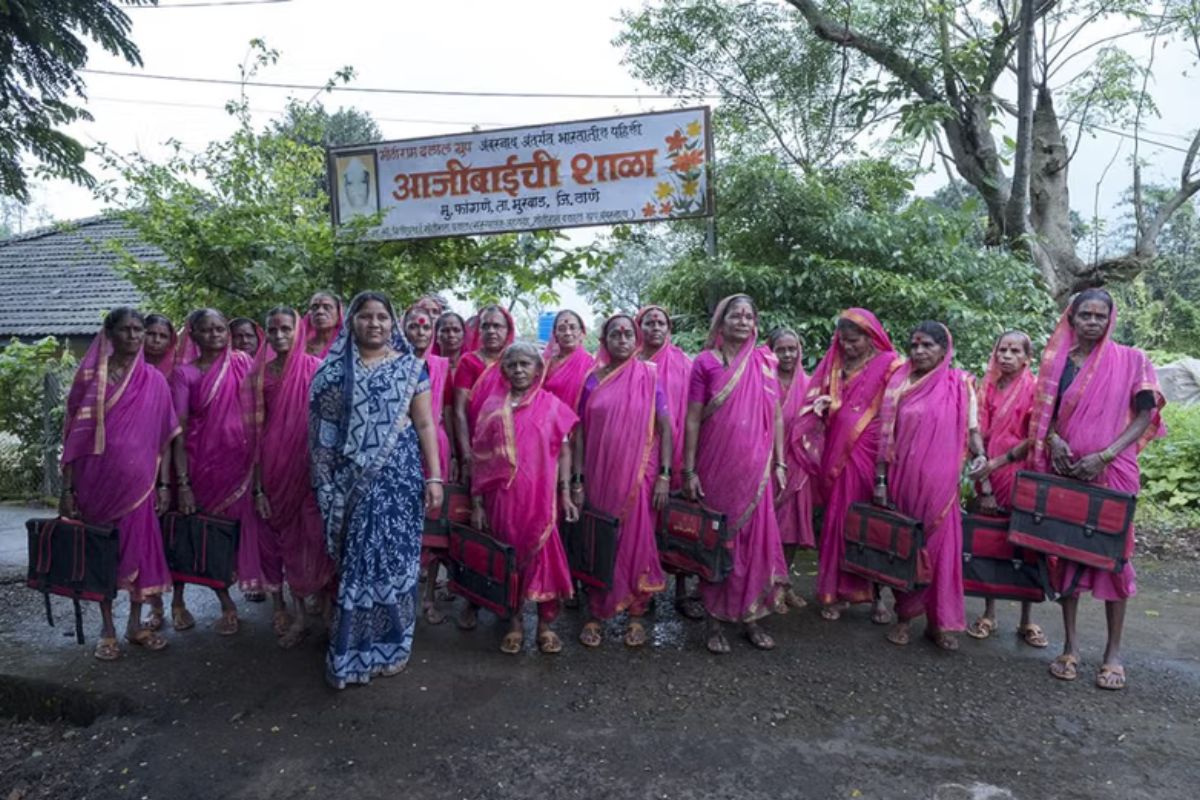
Families in the village take pride in enrollment. Grandchildren sit with their grandmothers in the evenings to go over lessons. Husbands who were once indifferent or resistant to the idea have grown openly supportive.
What Remains
There is a particular quality to the ambition of a woman in her eighties who decides she will learn to read before she dies. It is not the ambition of someone building a career or seeking advancement. It is the ambition of someone who wants to know, before the end, what the words say.
The grandmothers of Phangane, in their pink sarees with their chalk-dusted slates, are not making a political statement, though their existence makes one. They are attending school because they were told, for decades, that school was not for them. One day, they stopped believing that. That is, in the end, the essence of the story.
Also Read:Bihar’s Rooftop School Built by a Vegetable Seller
You can connect with DNN24 on Facebook, Twitter, and Instagram and subscribe to our YouTube channel.