

The clay oven that fed the Indus Valley now feeds the planet, and it took a refugee, a partition, and one accidental gravy to get there.
A Vessel Older Than the Pyramids
Somewhere around 2600 BCE, in the well-planned urban settlements of the Indus Valley, someone placed raw dough against the inner wall of a cylindrical clay oven and waited. What came out was bread. What eventually emerged over the following four millennia was butter chicken, dal makhani, naan, and a global restaurant industry worth billions.
The tandoor is not a modern invention dressed in ancient clothing. Archaeologists working at Kalibangan, a major Harappan site in Rajasthan, recovered physical evidence of these ovens from pre-Harappan layers structures built roughly when the Egyptians were raising the first pyramids. Food historian K.T. Achaya documented the presence of tandoor traces across Harappan settlements, confirming that the technology was not incidental but central to daily life in one of history’s earliest urban civilisations.
The word itself is ancient in every direction. “Tandoor” traces through Hindustani tandūr, from Persian tanūr, and finally arrives at the Akkadian tinūru, a compound of tin, meaning mud or clay, and nuro, meaning fire. The Akkadian form appears in the Epic of Gilgamesh, placing this cooking vessel among the oldest documented technologies in recorded literature.
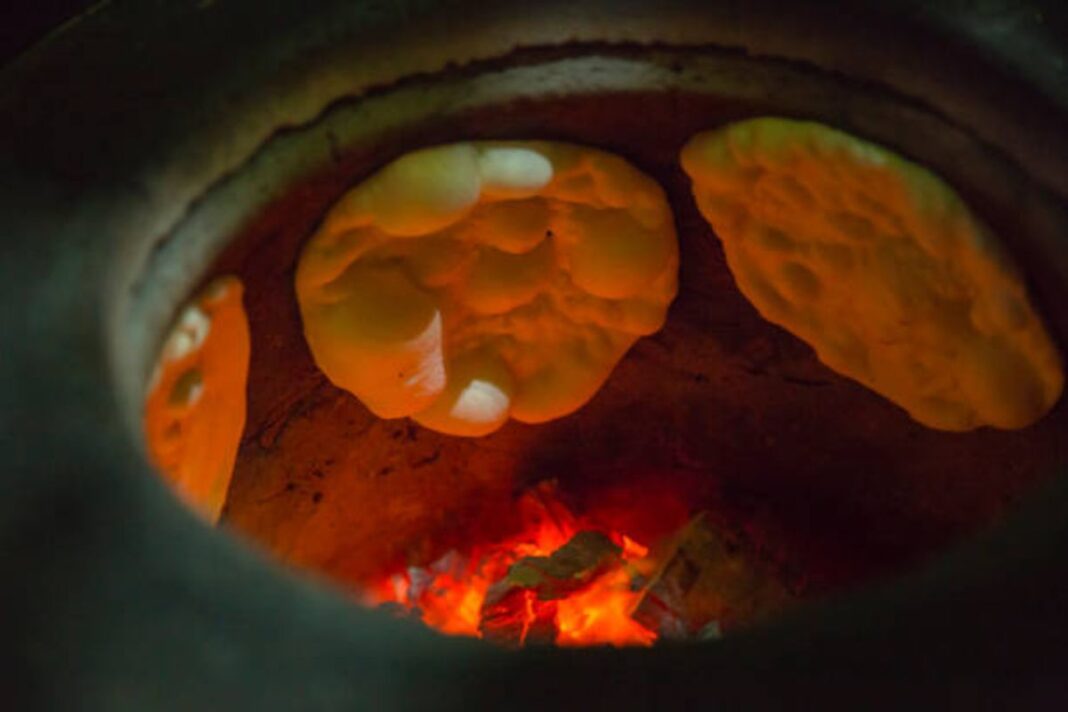
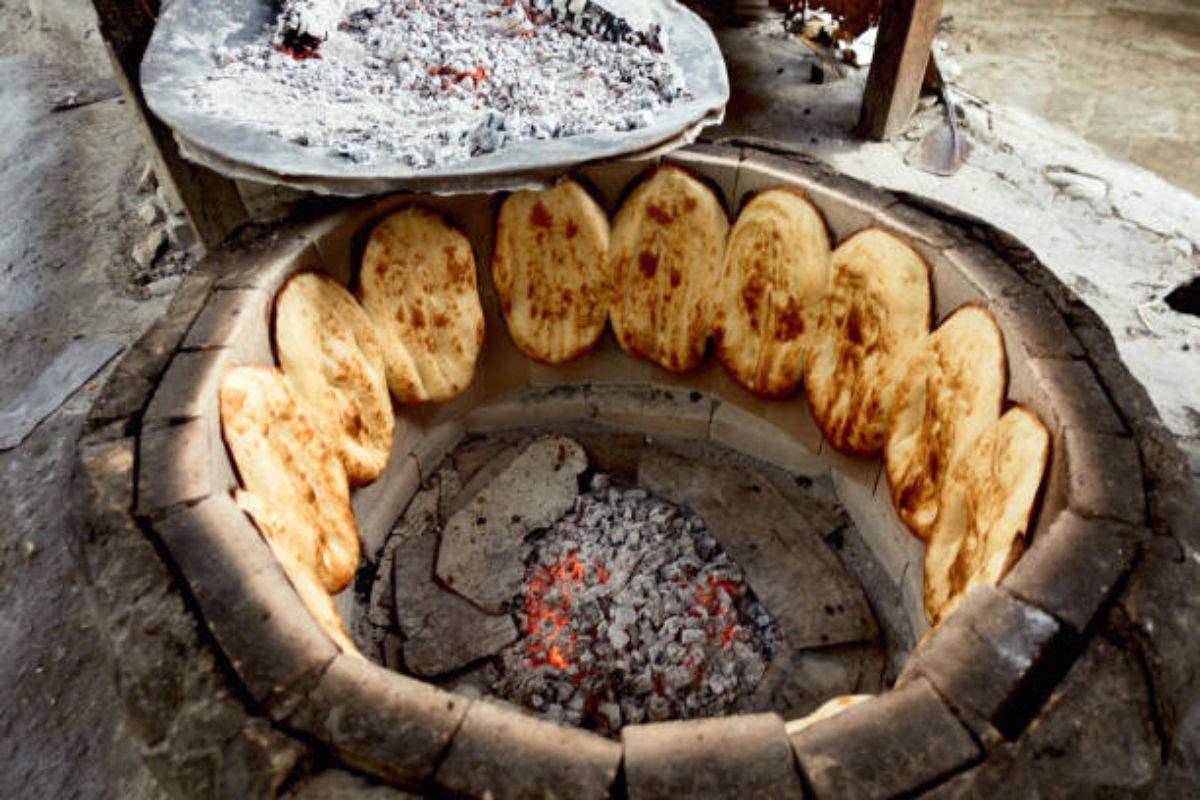
The oven’s design was not elaborate, but its physics were formidable. A vase-shaped clay cylinder, typically standing over a metre tall, could sustain temperatures of 480 degrees Celsius. Food cooked inside it was acted upon simultaneously by radiant heat from the clay walls, convection from the rising hot air, and the particular flavour introduced by smoke. This combination of mechanisms, conduction, convection, and radiation, produced results that no flat pan or open fire could replicate.
The Long Centuries Before Delhi
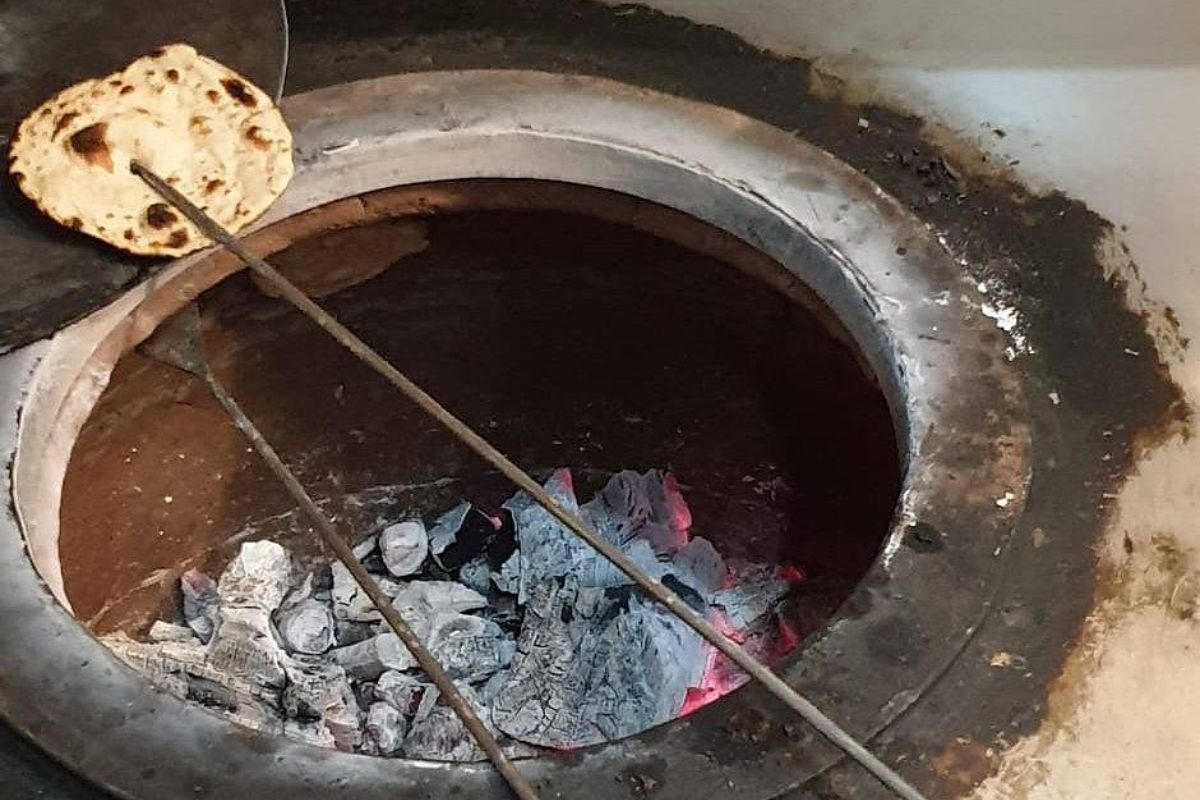
For most of its recorded history, the tandoor was a bread oven. In rural Punjab before 1947, communal tandoors sat at the centre of village life. Neighbours gathered around them. Flatbreads were passed along. The oven belonged to everyone, as a well or a threshing floor did.
In ancient Armenia, the equivalent vessel, called a tonir, carried a ceremonial weight beyond cooking. It was placed at the centre of households and associated with the sun descending into the earth, a domestic cosmology in which the act of making bread held spiritual significance.
The Mughal period brought refinements. During the reign of Emperor Jahangir in the sixteenth and seventeenth centuries, portable tandoors were developed for military campaigns, extending the reach of the ovens beyond a single settlement. However, even then, tandoori cooking remained largely a northern and western regional practice. Delhi, as late as the early twentieth century, remained a city whose culinary prestige rested on Mughlai traditions: slow-cooked curries, aromatic pulao, the restrained complexity of shabdegh. The tandoor was present but not dominant.
That changed in 1947.
Peshawar to Daryaganj: The Making of an Icon
Kundan Lal Gujral was born around 1902 in Chakwal District, undivided Punjab. By his early twenties, he was working at a small eatery called Moti Mahal in Peshawar’s Gora Bazaar, owned by Mokha Singh Lamba. It was there, in what is now Pakistan’s Khyber Pakhtunkhwa province, that Gujral began an experiment no one had attempted at that scale: he marinated chicken pieces in yogurt and spices, threaded them on skewers, and lowered them into the tandoor.
The tandoor has been used to cook bread for thousands of years. It had no cooked chicken. The results, by any measure, were significant. The high heat caramelised the marinade quickly, charring the surface while the interior remained moist. The smoke entered the meat in a way no other method permitted. Tandoori chicken was born not from a recipe book but from a practical curiosity, a man wondering what else the oven could do.
When Partition came in 1947, and the subcontinent was divided along religious lines, Gujral crossed the border with his family. He carried his knowledge and the tradition of that clay oven. Settling in Daryaganj in Old Delhi, he acquired a small premises through a Rehabilitation Conveyance Deed issued by the President of India and reopened Moti Mahal in the new country.
Necessity and the Birth of Butter Chicken
The early years in Delhi were not comfortable. Resources were limited, and the practicalities of running a small restaurant without reliable refrigeration created problems that required solutions. Leftover tandoori chicken, if unsold by the following day, would dry out and become unsellable. Gujral’s answer was to add a tomato, butter, and cream gravy to the dried tikkas, softening them for the next service.
This was not culinary philosophy. It was resourcefulness. The dish that resulted, murgh makhani, is now the most widely ordered curry on the planet. It appears on menus in New Zealand, Canada, the United Kingdom, and the United States. Its origins were not abundance but a shortage.
Dal makhani followed through a similarly practical route. One evening, a customer arrived just as the dal was nearly gone. Gujral combined what remained with rajma, added butter, and served it. The texture and richness that resulted became a standard. Both dishes were, as culinary historian Anoothi Vishal has described them, forms of easy sustenance, the first fast food of Delhi’s rapidly expanding post-Partition population.
A Restaurant That Shaped a Capital
Within a year of reopening, Moti Mahal had outgrown its original space. Gujral and associates purchased the adjoining property and eventually expanded it into a restaurant seating four hundred. The location in Daryaganj drew a particular clientele.
Prime Minister Jawaharlal Nehru ate there. Indira Gandhi was a regular. President Dr. Zakir Hussain visited. Raj Kapoor and Nargis Dutt were among the actors who passed through its dining room. Soviet leader Mikhail Gorbachev, on a state visit to India, was brought to Moti Mahal. It was through Mr. Khanna, one of Nehru’s associates, that tandoori chicken first reached the Prime Minister’s table, and when Nehru asked who was responsible for the dish, Kundan Lal Gujral was brought forward.
The restaurant had moved well beyond survival. It had become, without anyone quite planning for this, a point of national cultural pride.
The Science the Ancient Potters Understood
Traditional clay tandoors require conditioning before first use. The temperature must be raised gradually over several sessions, allowing hairline fractures to form in the clay. These small cracks are not damage, they are necessary. They allow the clay to expand and contract with heat without splitting, and they enable the oven to breathe, as a properly fired ceramic must.
At full temperature, the physics that made the tandoor useful in 2600 BCE still apply. Bread dough slapped against the interior wall adheres through moisture and starch, then dries rapidly as the surface temperature rises. The bread bakes from the clay side and steams from its own interior. A piece of naan, properly made, blisters and chars at its peaks while remaining soft at the centre, a result that no modern electric oven, for all its precision, can reliably produce.
Marinated meat on skewers suspended vertically in the oven loses fat downward, into the fire, producing smoke that rises and re-enters the meat. The marinade caramelises at the surface before the interior overcooks. The result is the charred exterior and tender interior that defines tandoori chicken.
From One Oven to One Hundred and Fifty Branches
In the 1970s, Gujral’s son Nand Lal expanded Moti Mahal to South Delhi. In 2003, Gujral’s grandson Monish Gujral formalised the franchise model under Moti Mahal Delux Management Services. The chain now operates more than 150 franchises internationally.
The tandoor itself has changed in form without altering its principles. Modern commercial versions may be constructed from stainless steel with clay linings, fitted with gas burners, or adapted for electric heat. The temperatures remain comparable to those of the traditional wood-fired original. The bread is still slapped against the wall. The skewers still hang vertically. The smoke still enters the meat.
What the Clay Carries
The tandoor’s passage from Kalibangan to Daryaganj to restaurant kitchens across four continents is not a straightforward story of culinary progress. It is a record of displacement, adaptation, and the particular stubbornness with which people carry their way of eating across borders.
Kundan Lal Gujral arrived in Delhi as a refugee with no property and no capital. He left behind a cuisine. The oven he brought from Peshawar produced dishes that are now eaten daily by hundreds of millions of people who have never heard his name.
That is not a minor footnote to Indian culinary history. It is the central fact of it. The tandoor is not merely old. It is consequential in the specific, documentable way that very few objects in human material culture ever become clay cylinders, fired with charcoal, that change what the world eats for dinner.
Also Read:Santiniketan: Tagore’s Dream Campus
You can connect with DNN24 on Facebook, Twitter, and Instagram and subscribe to our YouTube channel.