
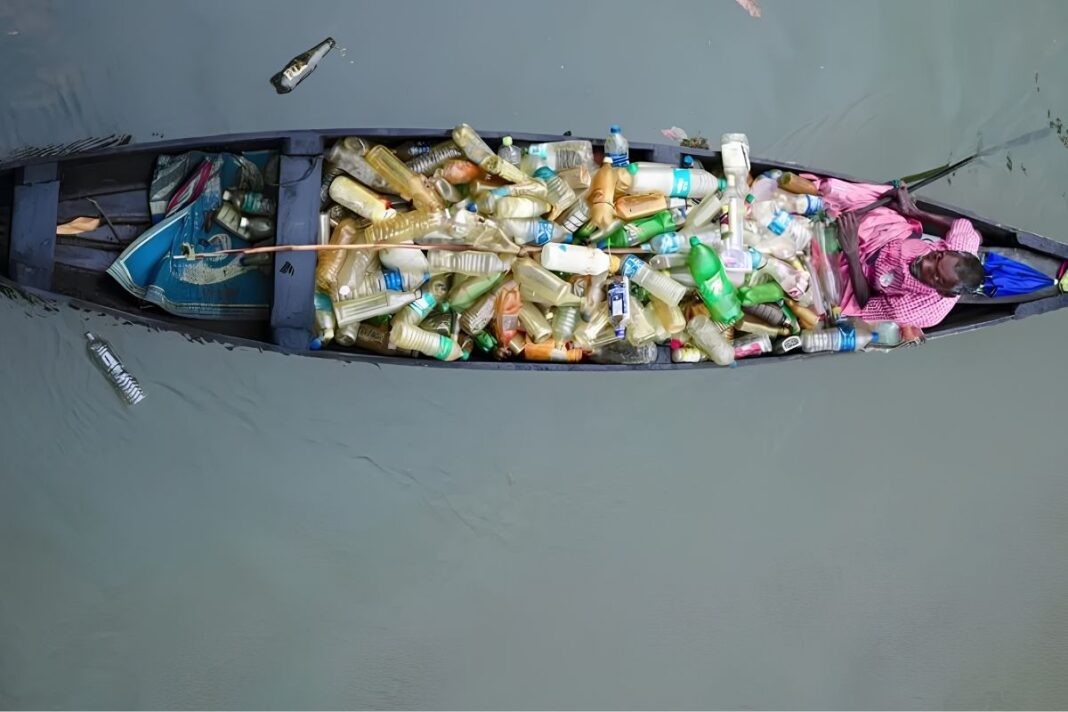

A quiet afternoon on Kerala’s Meenachil River was all it took. A young photographer paused on a bridge, looked down at the brown water below, and saw something that most people had long trained themselves not to notice. A man, alone in a small wooden boat, was pulling plastic waste from the river with his hands. The man was not young. He moved slowly, and not entirely on his feet. His name is N. S. Rajappan; he is sixty-nine years old, and he has been doing this, quietly and without much fuss, for years.
Nobody asked him to. Nobody pays him. He hires the boat himself.
The river nobody was watching
Meenachil is a river in Kerala’s Kottayam district. It drains into Vembanad Lake, one of India’s largest freshwater lakes, which has been in ecological distress for years. Reports on water quality in the region describe a depressingly common pattern: waste from households and settlements collecting along the banks, plastic entering the water with every monsoon, and a slow, cumulative degradation that no single event caused and no single cleanup can reverse.
Rajappan has known this river most of his life. He is a local man who watched the water change. At some point, he stopped watching and started working.
He was paralysed below the knees some years ago. He cannot stand in the conventional sense. To board his boat each morning, he crawls or pulls himself forward using his arms. Once in the boat, he rows out into the water, leans over the side, and collects what he finds: plastic bottles, wrappers, bags, debris of the kind that accumulates when a river becomes a convenience rather than a commons. He gathers it, bags it, and returns. Then he does it again the next day.
The bridge, the camera, and the consequence
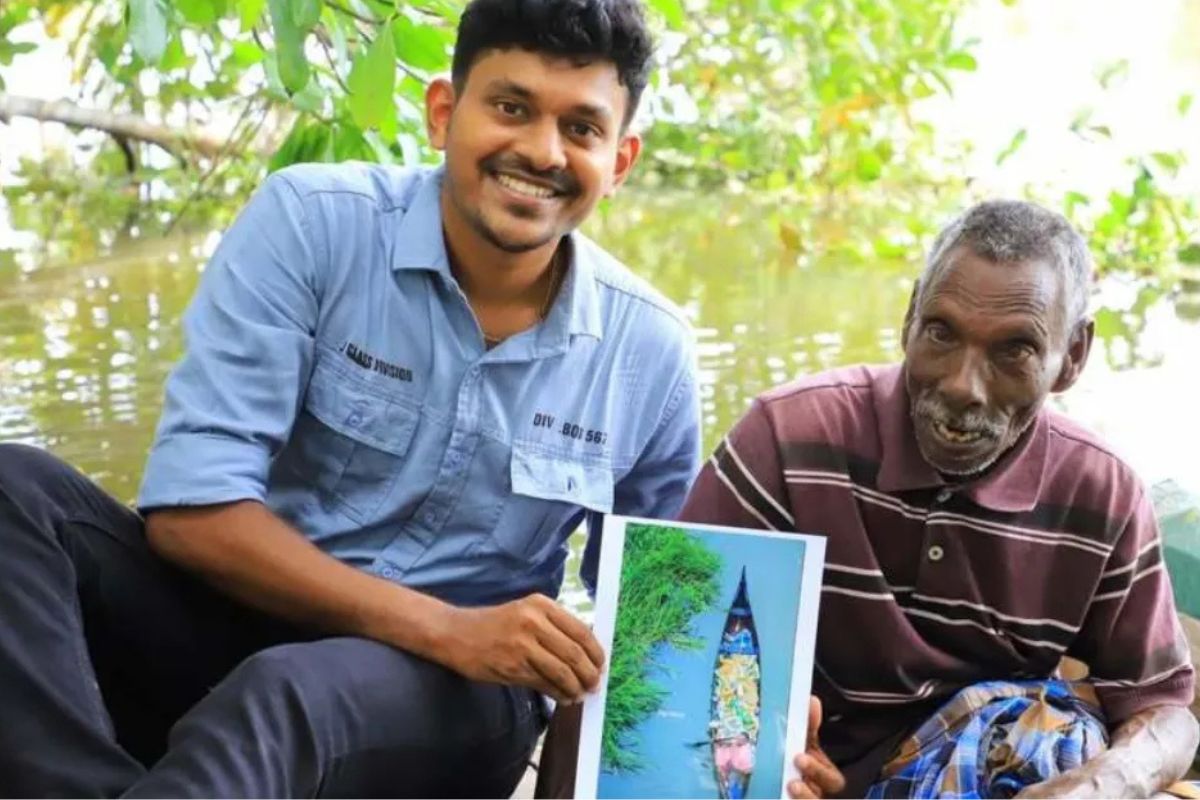
The photographer who spotted him was crossing the bridge above the Meenachil River when the scene below caught his attention. By most accounts, Rajappan was doing nothing different from what he does every morning. He was there, in the water, doing the work. However, the photographer stopped and recorded what he saw, resulting in a short video or image that circulated widely on social media and brought Rajappan’s story to a public that had never heard of him.
That kind of attention can feel accidental, and in some ways it was. However, it also had a logical basis. The image carried something that written descriptions of pollution rarely manage: a face, a posture, a person. Abstract arguments about plastic waste and degraded waterways often fail to move people because they are abstract. A single man in a small boat, pulling garbage from brown water with his bare hands, is not abstract at all. The photographer did not create Rajappan’s conviction. He only made it visible.
Why one person matters
There is a tendency, when writing about figures like Rajappan, to reach for words like ‘heroic’ or ‘inspirational’ and to arrange the facts into a story of triumph. That approach, however well-intentioned, misses something important. What makes Rajappan’s situation genuinely worth attention is not that he has triumphed. It is that he has continued.
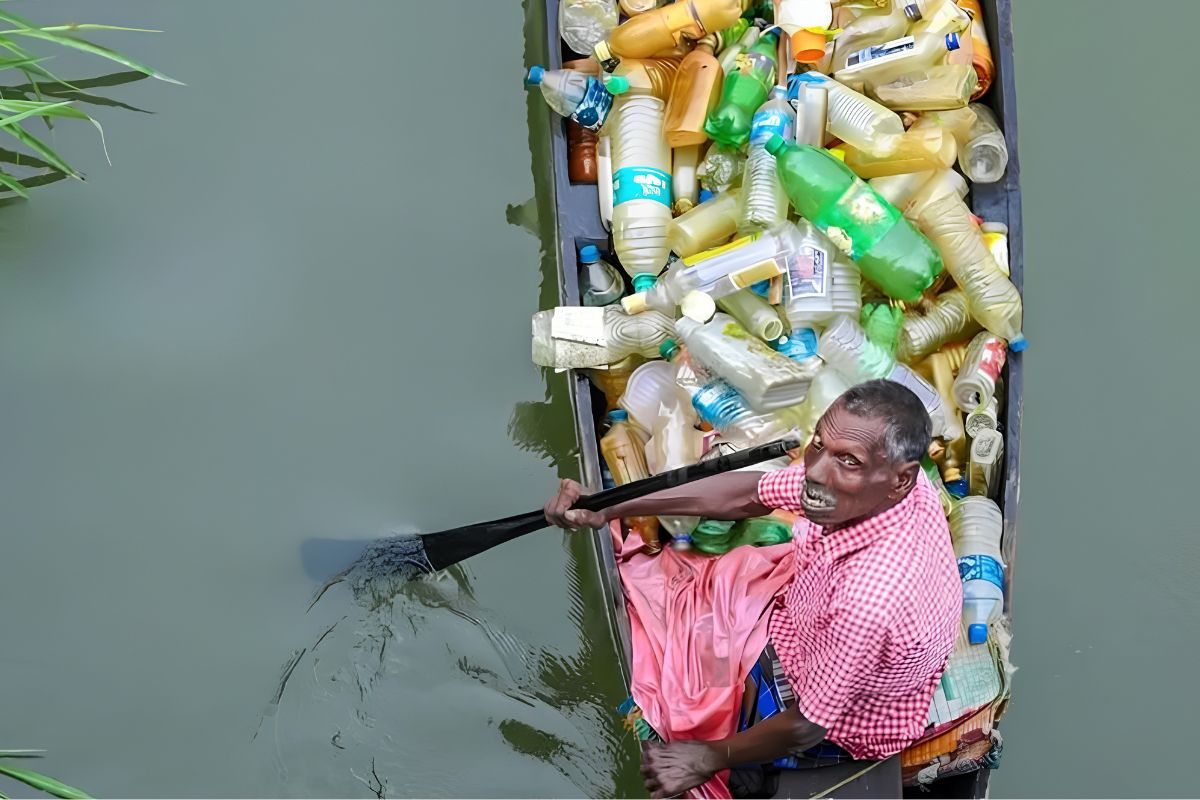
Environmental damage of the kind that has accumulated in Vembanad Lake and along the Meenachil River is not the result of one bad decision. It is the result of thousands of ordinary decisions, repeated over decades, by people who reasoned that one more plastic bag thrown in the water made no real difference. Rajappan’s response to that reasoning is also ordinary and has been repeated over decades. He apparently reasons that one more boatload of waste removed from the water makes a difference. Moreover, he acts on that reasoning every morning.
The physical conditions in which he does this work are not incidental. A man with full use of his legs, rowing out each day to collect rubbish, would already be doing something most people do not do. A man who must use his arms to board the boat before he can begin that work is doing something that most people, confronted with the same limitations, would probably not do. He has removed the excuse that most people accept without question: that the problem is too large, that one person cannot make a dent, that someone else should handle it.
Rajappan has not solved the Meenachil River. He has not reversed the decline of Vembanad Lake. However, he has established, through repetition, that the work is worth doing.
What the coverage did, and what it did not do
When the story spread, it generated considerable goodwill and public commentary. Rajappan was praised. His photograph was shared. Articles were written, including this one, and people who had never been to Kottayam expressed admiration for a man they had never met.
What the coverage did not do, at least not directly, was change local environmental policy. There is no ordinance named after Rajappan, no cleanup programme that cites his work as its origin. The connection between a viral story and formal policy change is rarely so straightforward, and it would be misleading to claim otherwise.
What the coverage may have done is harder to measure. Public stories about pollution can shift the environment in which policy gets made. They can make it more difficult for local officials to treat waste management as a low priority. They can encourage residents to think of a river not as an open drain but as something worth protecting. These effects are real, even if they are slow and indirect.
Whether that kind of pressure eventually yields stronger measures around Vembanad Lake will depend on many factors unrelated to Rajappan. However, his story is now part of the public record for that region, and that is nothing.
The man, not the symbol
It is worth being careful about what stories like this are asked to carry. Rajappan is a sixty-nine-year-old man with a damaged body and a boat, and a commitment he has apparently honoured without much concern for whether anyone was watching. He is not a symbol assembled for public consumption. He is a person who decided, some years ago, that the water near his home deserved better treatment than it was getting, and who has acted on that decision every day since.
The bridge on which the photographer stopped was, in the end, just a bridge. Rajappan was not waiting to be discovered. He was doing the same thing he does every morning.
That is, finally, the plain fact at the centre of this story. Not a metaphor, not a lesson arranged for effect. Just a man in a boat, doing the work, in the place where he lives.
Also Read: Tamil Nadu Engineer Burns Portraits With Sunlight Only
You can connect with DNN24 on Facebook, Twitter, and Instagram and subscribe to our YouTube channel.