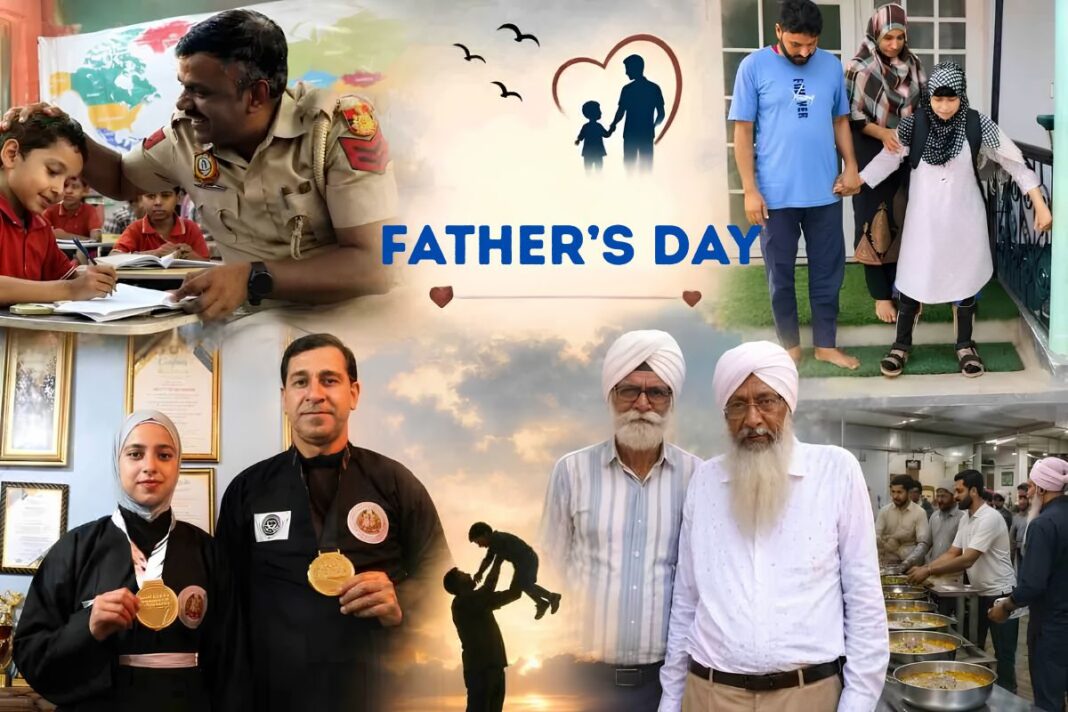

Every year, Father’s Day arrives with flowers, greeting cards, and well-worn sentiments about strength and sacrifice. These gestures are sincere enough. However, somewhere between the celebration and the cliche, a more honest question gets passed over: what does fatherhood actually mean, and does it require biology at all?
Four stories from across India suggest that the answer is more complicated, and more generous, than most people allow. They come from Kashmir and Delhi, from sports fields and classrooms, from family homes and community kitchens. Taken together, they offer a quieter, more durable portrait of what a father does and who gets to be one.
The Father Who Refused to Look Away
Aamina Qayyum grew up in Kashmir at a time when a girl choosing sport as a career was treated not as an ambition but as an anomaly. The questions came quickly and often. Why this path? How far could she really go? What was the point?
Her father did not share these doubts. When others questioned the practicality of what she was doing, he did not soften his support to accommodate their scepticism. He treated her goals as worth pursuing simply because she had chosen them. That, in itself, was the thing he gave her.
Aamina went on to build a genuine career in sport. She became, for many young women in the region, proof that the path was possible. Behind every such achievement, there is usually more than one person’s effort. In her case, one of those people was a father who understood that the most damaging thing he could do was to agree with the world when it told his daughter to slow down.
The quiet courage of that position is easy to undervalue. It required him to hold his ground repeatedly, over the years, without fanfare. That is what fatherhood looked like in that house.
When Father and Daughter Competed as Partners
Also from Kashmir comes the story of Sajjad Muqdoos and his daughter, whose lives have been shaped around pencak silat, a martial art that demands discipline, precision, and sustained effort.
What makes their story unusual is not just that both father and daughter practice the same sport. It is that their relationship inside the sport resembles a partnership more than a hierarchy. Sajjad did not simply point his daughter toward a discipline he valued. He trained alongside her, prepared with her, and stood beside her at competitions. The distinction matters.
In many families, a father’s encouragement takes the form of instruction delivered from a safe distance. What Sajjad offered was something different: he remained present as an equal participant in the same pursuit. This transformed what might have been a conventional father-daughter dynamic into something more like collaboration between two people who had chosen the same difficult thing.
For other families watching from the outside, the effect of that example was clear. It demonstrated that trusting a daughter with serious ambitions is not merely a noble gesture. It is, when done fully, a form of working together.
The Constable Who Kept a School Running
Head Constable Than Singh of the Delhi Police was not looking for recognition when he started teaching children in his neighbourhood. He had noticed something straightforward and troubling: several children in the area were spending their days on the street because no one had made school accessible to them. Some lacked money. Some lacked support at home. Most lacked someone willing to take the trouble.
Then Singh took the trouble. He began holding informal classes, which came to be known as Than Singh Ki Pathshala. The name was affectionate and accurate. It was his school, built from his time and his willingness to show up.
Over the years, that willingness accumulated into something larger than any single lesson. The children who passed through his classes did not merely learn to read or calculate. They encountered an adult who treated their futures as worth investing in. In many cases, he was the first such adult they had met outside their own families. For some, he was the first such adult they had met at all.
Fatherhood, in its most functional sense, involves protecting children from the conviction that they do not matter. Then Singh did this for hundreds of children who were not his own. Whether or not anyone called it fatherhood, the work was the same.
The Organisation That Kept a Father’s Values Alive
In 1989, a man named Trilochan Singh founded an organisation in Delhi called Veer Ji Da Dera. He was not especially wealthy or politically connected. What he had was a clear sense of what he was for: serving people who needed it. He built the organisation around that principle and kept building it until the end of his life.
He also raised two sons, Brigadier Premjit Singh and Kamaljit Singh, in the same conviction. This turned out to be his most consequential act.
When Trilochan Singh died, the organisation did not slow down. His sons continued the work with a seriousness that could only have come from watching their father do it for years. The values had been transferred not through documents or formal instruction but through the daily evidence of a man who meant what he said.
More than three decades after Veer Ji Da Dera was founded, it continues to operate on the same terms. The people it serves change. The staff changes. What does not change is the underlying purpose that Trilochan Singh and his sons chose to honour.
Fathers are often remembered for what they provided in material terms. Trilochan Singh provided something harder to quantify and longer lasting: a way of being in the world that his children adopted as their own. The organisation he built is now, in a genuine sense, both his legacy and theirs. That is a rarer achievement than it might sound.
The Shape of Real Fatherhood
These four stories do not share a geography, a profession, or a form. Aamina’s father stood firm against social pressure so his daughter could pursue sport. Sajjad Muqdoos trained alongside his daughter as a collaborator rather than a coach. Then Singh extended care to children the city had largely forgotten. Trilochan Singh built an organisation on the principle that service to others is not optional, and then raised sons who shared that belief.
None of these men operated on the assumption that their role was limited to the provision and protection of the immediate family. Each of them understood, in his own way, that the reach of a father’s influence depends on the generosity of his attention.
Father’s Day is, at its best, an occasion to notice that. Not just to thank the men who raised us, but to recognise what they were actually doing: choosing, day after day, to remain present and useful in someone else’s life. That choice is what makes a father. The biology is incidental.
Also Read: The Eternal Union: How Yoga’s Ancient Indian Roots Transformed the World
You can connect with DNN24 on Facebook, Twitter, and Instagram and subscribe to our YouTube channel.