
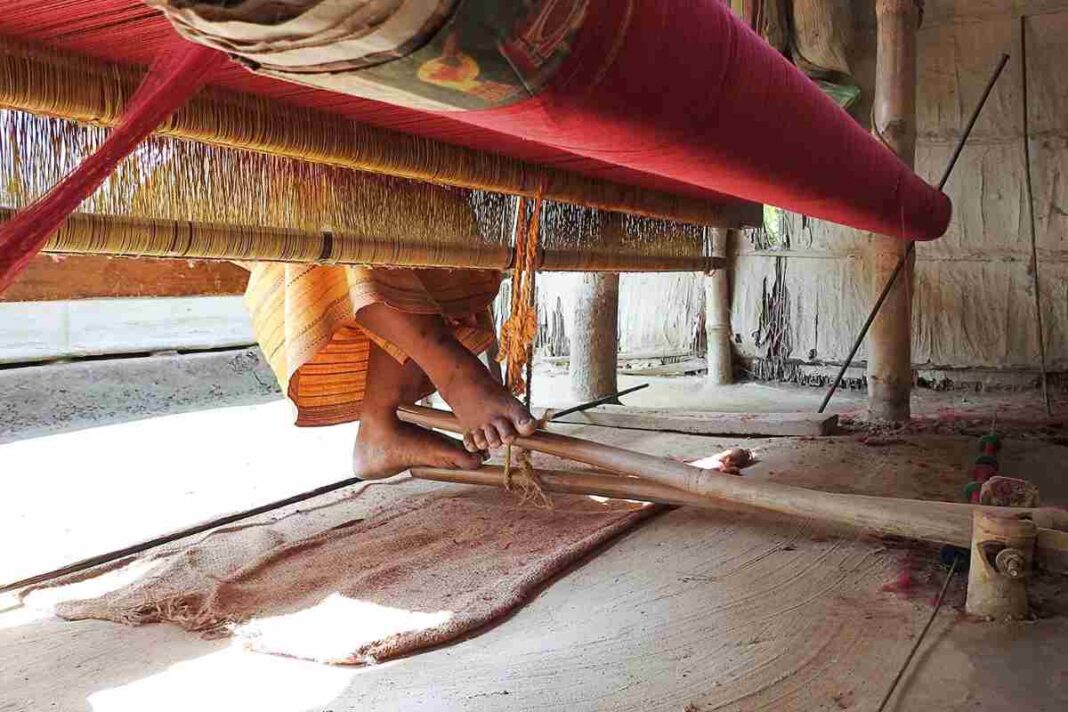

In central Assam’s Nagaon and Morigaon districts lies Jajori, an Indigenous Assamese Muslim-dominated village. Mahatma Gandhi’s profound words, “Assamese women are born weavers, they can weave fairy tales in their cloth,” echo through the intricate threads of this village. The essence of these words resonates deeply, defining the very livelihood of Jajori’s villagers.
The Weaving Roots
Jajori’s historical roots trace back to the tumultuous Burmese invasions between 1817 and 1826. The village settled during these invasions and embraced weaving as more than a craft—it became a way of life.
Weaving Through Adversity
Weaving wasn’t just a source of income in Jajori; it evolved into a resilient response to foreign domination. During India’s freedom struggle in 1905, Mahatma Gandhi’s call to boycott foreign goods gave momentum to weaving in the village. Today, Jajori thrives as an entire community dependent on this ancient craft.
The Fabric Palette
Jajori’s looms bring fabrics like Cotton, Muga, Pat (mulberry silk), and Eri (end) to life. The weavers craft various textiles, from shawls and saris to furnishings and bedspreads, primarily using pure Assamese cotton. The traditional Chadars and Mekhalas, worn by indigenous Assamese women, are also woven with care and skill.
Threads of Tradition
Beyond commerce, Jajori’s Muslim women weave the fabric of tradition itself. The Gamosha, a white towel adorned with red patterns, symbolizes respect and love, gifted on various occasions.
Cooperative Resilience
In the 1960s, local elders organized the artisans into the Jajori Muslim Village Weaving and Cutting Cooperative Society. Led by Nechima Begum since 1980, this cooperative has been a cornerstone in sustaining the weaving heritage.
Craftswomen’s Triumph
Gulnaha Begum, a skilled craftswoman, exemplifies the empowerment woven into Jajori’s fabric. Through her craft, she educated her sons and arranged her daughter’s marriage. Other village stalwarts like Chimim Sultana, Nazima Begum, Runu Begum, Maria Nesa, Alea Begum, and Punang Begum have similarly contributed to the weaving legacy.
Challenges and Triumphs
While the state government’s financial support remains limited, Jajori’s weavers stand resilient. Abdul Khayer Ahmed, a prominent social worker, emphasizes how, in 1905 the village artisans responded to Gandhi’s call by weaving their clothes—a testament to the enduring spirit of Jajori’s weaving community.
For a detailed story, please visit: Awaz the voice
Also Read: NTCA and Sankala Foundation’s Artistic Celebration of Tribal-Wildlife Harmony
You can connect with DNN24 on Facebook, Twitter, and Instagram and subscribe to our YouTube channel.