

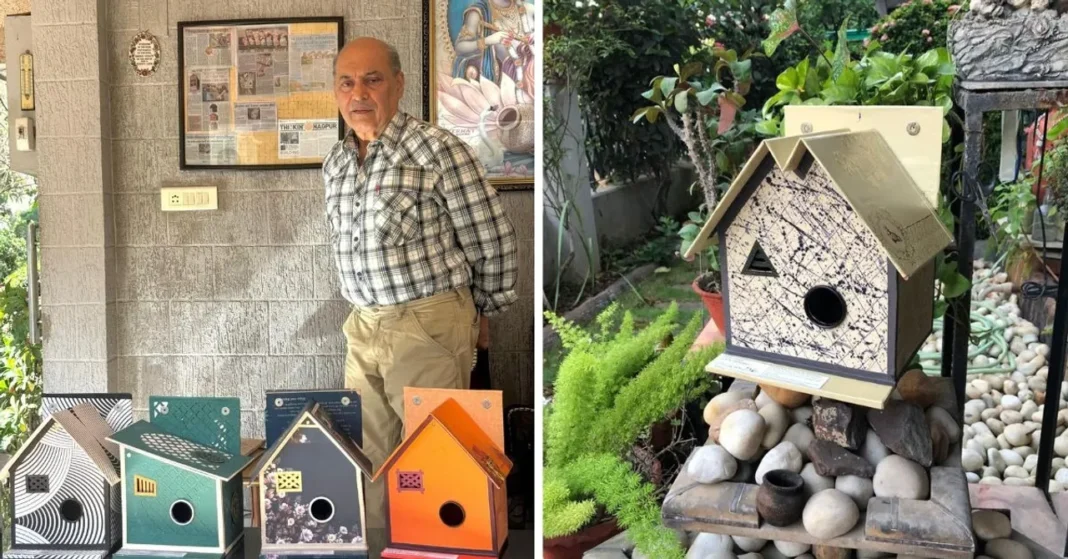

A 74-year-old retiree in Nagpur has turned his modest home workshop into an unlikely conservation station. Ashok Tewani spends his mornings surrounded by stacks of discarded wedding invitations, glue sticks, and cardboard scraps. His mission is straightforward but urgent: building artificial nests for house sparrows, a bird species that has quietly disappeared from most Indian cities over the past two decades.
More than 2,000 handmade nests have emerged from this cluttered workspace since 2014. Each one measures exactly 14 by 18 centimetres. Each one costs 40 rupees. And each one represents a small act of resistance against the vanishing of a bird that once filled every Indian courtyard with its chirping.
The Banker Who Became a Birdman
Tewani retired from the Bank of India in January 2012 after a long career managing accounts and transactions. Retirement left him restless. He needed a project, something with meaning beyond the daily routine of morning walks and afternoon newspapers.
The answer came to him in 2014 through an article in Twinkle Star, a local children’s magazine published in Nagpur. The piece described how house sparrows were disappearing from Indian cities at an alarming rate. The bird that had nested in every thatched roof and ventilator shaft was becoming rare. In some cities, it had vanished completely.
Tewani decided to act. He began experimenting with cardboard boxes, cutting and folding them into small structures that might serve as sparrow homes. His first design worked. Within two days of installation, a pair of sparrows moved in and began building their nest inside his prototype.
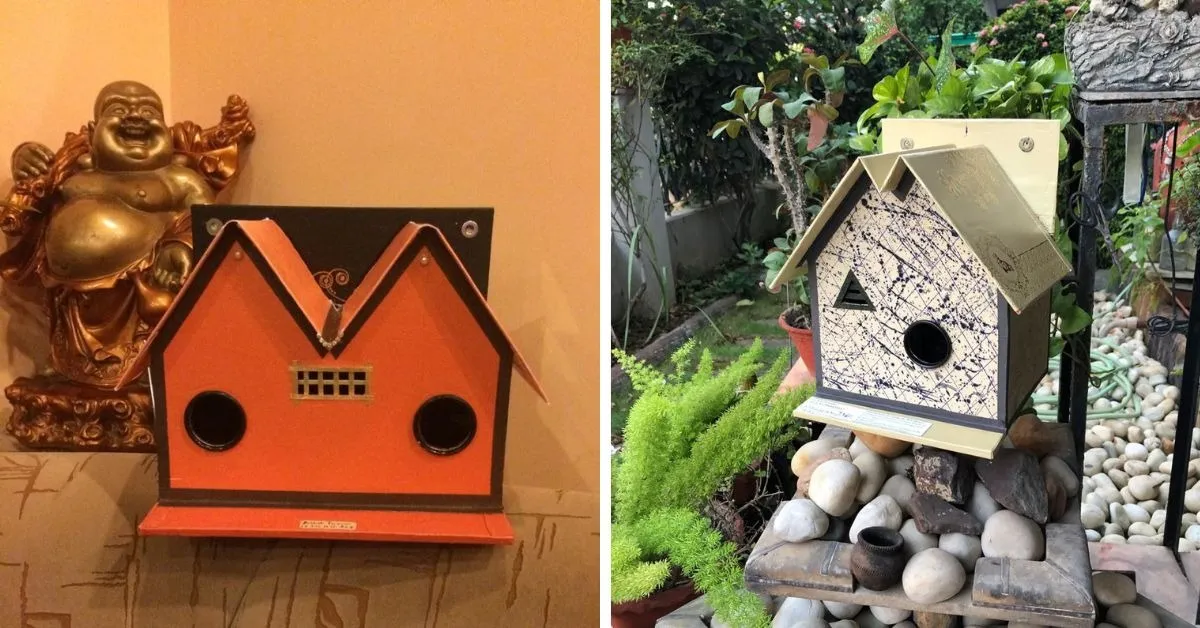
That success launched a decade-long effort. Today, neighbours drop off their old wedding invitations at his door. Tewani collects them in piles, then transforms the ornate cards into functional birdhouses. The process is meditative and precise. He works at a table covered with magazines, invitation cards, and measuring tools. One nest takes about an hour to complete. He makes at least one every day.
Why Sparrows Vanished
The house sparrow once thrived across India. It nested in the gaps between roof tiles, in the space over ceiling fans, and inside ventilator shafts. The bird adapted easily to human habitation and seemed almost impossible to eradicate.
But modern construction changed everything. New buildings came with sealed walls and airtight windows. Air conditioning units replaced open ventilators. Smooth glass and steel surfaces offered no crevices for nesting. The Bombay Natural History Society noted that modern apartment buildings, with their high ceilings and compact layouts, did not offer the shallow nooks sparrows prefer for nesting.
A 2018 survey by the Royal Society for the Protection of Birds documented the scale of the crisis. House sparrow populations had declined by more than 60 per cent across India. In Andhra Pradesh, the decline reached 80 per cent. Thiruvananthapuram reported complete disappearance by 2003.
Urban pollution added another factor. Pesticides killed the insects that sparrows fed to their young. Fewer trees meant fewer insects overall. Tewani saw these changes in his own neighbourhood. The birds that once nested in every corner had grown scarce. Their morning chorus had faded into silence.
Building a Better Nest Box
The nests that Tewani produces are engineered for practicality. They measure 14 by 18 centimetres because the size matches sparrow preferences. The cardboard is thick enough to last seven or eight years outdoors. Each design includes multiple entry holes, allowing several sparrow families to nest in a single structure.
The materials come entirely from waste. Wedding invitations form the primary building blocks. These cards are already made from sturdy cardboard, and their decorative surfaces do not bother the birds. Old magazines provide additional material when needed. Nothing is purchased new. Everything is recycled.
Tewani initially gave the nests away for free. This approach failed. Some recipients treated them as curiosities rather than functional conservation tools. One friend installed a nest in his living room as decoration. The sparrows, naturally, showed no interest. So Tewani put a price on them- 40 rupees per nest. The modest price ensured that buyers took the project seriously. It also helped fund the ongoing work, covering glue and other supplies. At local exhibitions, he sometimes sells 50 nests at once.
The response has been strong. Buyers report that sparrows move into the installed nests within days. Balconies that had been silent for years suddenly fill with bird activity. The simple cardboard boxes, positioned correctly on an exterior wall, provide exactly what the sparrows need.
Conservation Through Everyday Action
Tewani does not run a formal organisation. He does not seek government grants or corporate sponsors. His operation remains deliberately small-scale and personal. One man, one workshop, one nest at a time. He estimates that he has created more than 2,000 nests since 2014, though the exact figure is uncertain. What matters is not the precise count but the sustained commitment. Twelve years of daily effort. Twelve years of converting discarded wedding cards into sparrow homes.
Local media in Nagpur began calling him the Birdman. The nickname stuck. Videos of his work spread through regional news outlets and social media channels. His methods have inspired others to use local resources and personal initiative to address a national environmental problem. This approach carries its own power. It demonstrates that meaningful conservation does not require institutional backing or professional expertise. It requires attention, consistency, and a willingness to repurpose what others discard.
Every installed nest becomes a small lesson in ecology and waste reduction. It reminds residents that urban spaces can still support wildlife. It shows that conservation can happen on a balcony, not just in a forest reserve.
Also Read:Palace on Wheels: A Taste of the Royal Life
You can connect with DNN24 on Facebook, Twitter, and Instagram and subscribe to our YouTube channel.



Please send me contact details of Ashokji
I wanted to send wedding cards which I have in collection for his project
Pratima Kamath
0091 9004184251 (whats app )
0091 82774 03764 (call)