

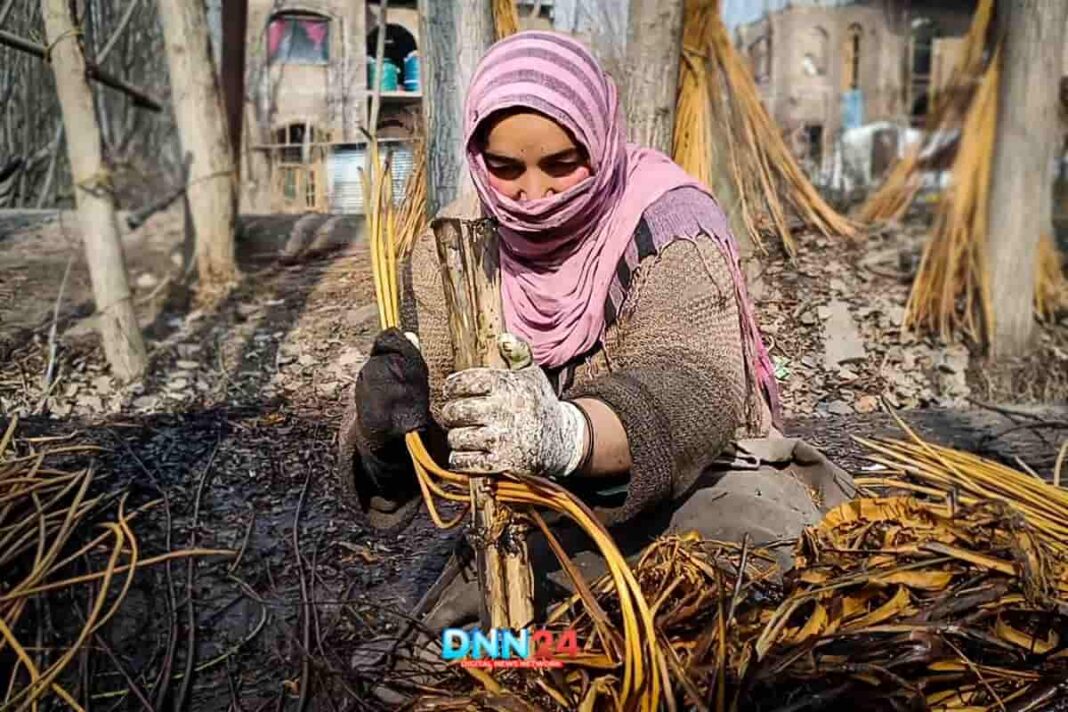

Wickerwork is an ancient craft still practiced in many parts of the world, including the Kashmir region of India. The process begins with planting saplings in the field, harvested from mid-October to November.
A community boiling chamber boils the twigs for at least 24 hours to soften them and make them easier to work. The boiling process softens the twigs and makes them more comfortable to perform.

Source Of Income For Rural Women
After boiling, the process of de-skinning, typically done by hand, readies the twigs. Parveena Bano, a Kashmiri woman, and her daughter Snowber Bilal spend their days peeling the willow wicker twigs, working from 9 am to 5 pm. They remove the outer bark of the twigs to reveal the soft, flexible inner fibers used to make baskets and other wicker products.
The willow-wicker art of Kashmir holds great significance and importance. It is not just a source of livelihood but also a part of the region’s cultural heritage. The process of planting, boiling, and peeling the twigs is a time-honoured tradition passed down through generations. The end product, the wicker baskets, serves as functional and beautiful art pieces.
Willow-wicker art is a cornerstone of the region’s cultural heritage
The wicker twigs can grow up to 8 feet, and peeling them has become a source of income for many Kashmiri women like Parveena Bano and her daughter Snowber Bilal.
Once the twigs have been de-skinned, they are wrapped in bundles and placed in the sunlight to dry. Once dry, they are ready to create a wide range of wicker products, from baskets and trays to furniture and other decorative items.
The willow-wicker art of Kashmir is a source of income for local artisans and a cultural treasure passed down from generation to generation. The tradition of planting, boiling, and peeling the twigs continues to be practiced today. The end product, the wicker baskets, serves as functional and beautiful pieces of art that uphold the critical significance of the craft.
Also Read; Preserving Cultural Tradition: The Art Of Willow Wicker With Ghulam Mohammad Magray
You can connect with DNN24 on Facebook, Instagram, Twitter, and subscribe to our YouTube channel.