
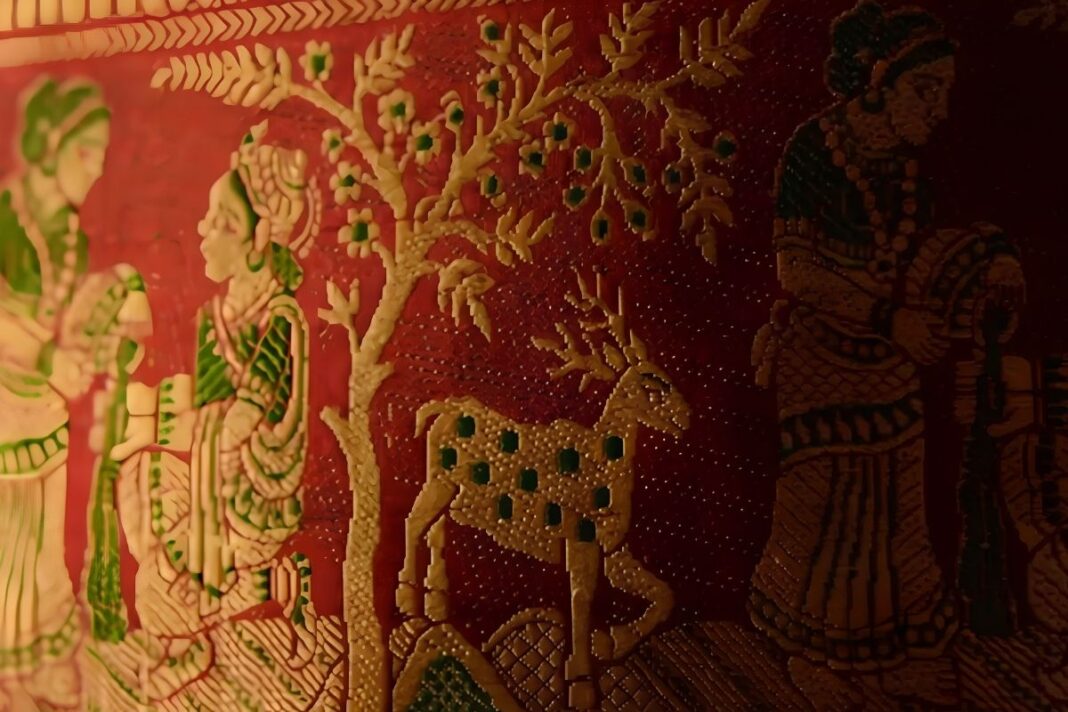

The Baluchari saree is more than an elegant piece of clothing. Woven into its silk are stories of Bengal’s cultural past, royal courts, mythology and generations of extraordinary craftsmanship. Its elaborate pallus can resemble illustrated manuscripts, depicting characters and scenes rather than relying only on conventional floral or geometric patterns.
Originating in Bengal, the Baluchari tradition is now closely associated with Bishnupur in West Bengal. Its name, however, comes from Baluchar, a village in the Murshidabad region where the weaving tradition flourished before shifting elsewhere. Over time, the saree developed a distinctive visual language in which silk became a canvas for storytelling.
From Murshidabad to Bishnupur
The history of Baluchari is intertwined with Bengal’s changing political and cultural centres. During the eighteenth century, Murshidabad emerged as an important centre of power, commerce and luxury crafts. Skilled silk weavers working in and around Baluchar developed richly patterned textiles influenced by the sophisticated tastes of Bengal’s elite.
The craft later declined in its original centre, with changes in the course of the Ganga and flooding traditionally associated with the disappearance of Baluchar as a major weaving settlement. Eventually, Baluchari weaving found a new home in Bishnupur.
This relocation also influenced its artistic vocabulary. Bishnupur, once ruled by the Malla kings, is famous for terracotta temples covered with intricate narrative panels. Scenes from Hindu epics, everyday life, royal processions, musicians and social gatherings appear across these temples. Similar storytelling traditions became an important part of Baluchari saree designs.
A Saree That Tells Stories
The most remarkable feature of a Baluchari saree is its pallu. Instead of serving merely as a decorative end-piece, it often becomes a narrative canvas.
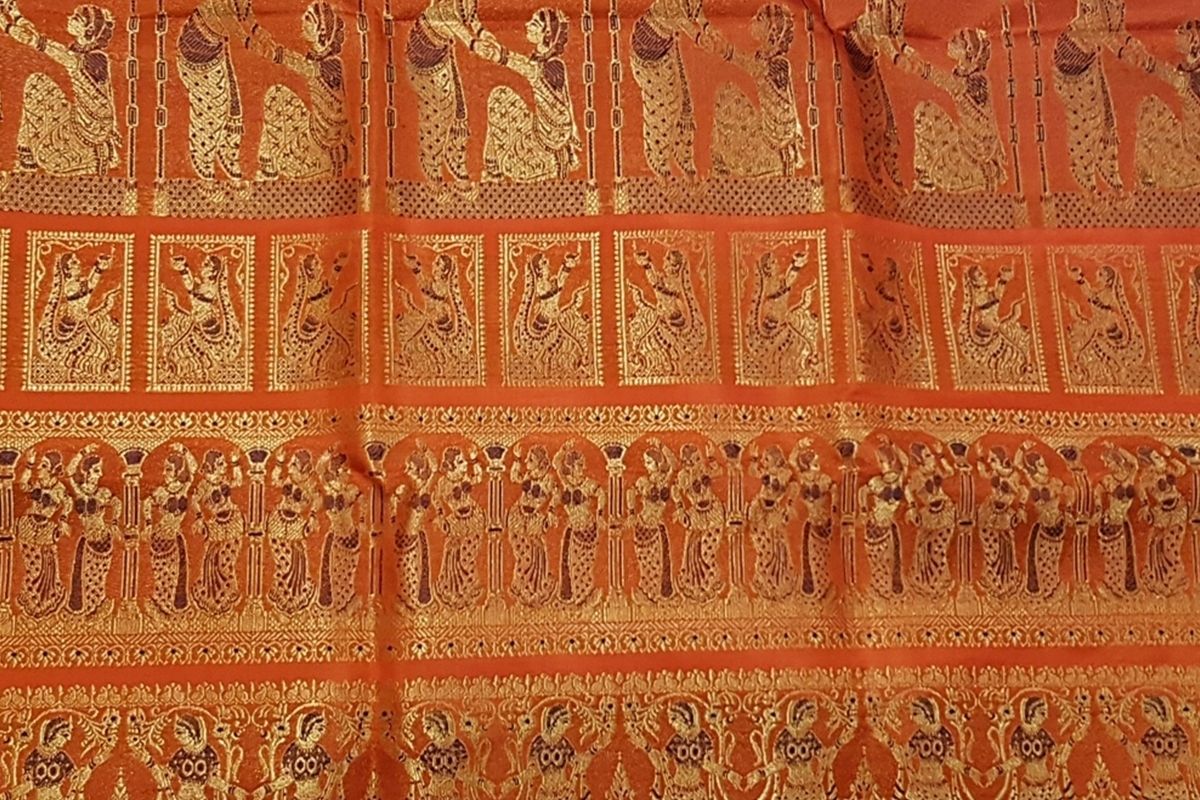
Episodes inspired by the Ramayana and Mahabharata, Krishna legends, royal processions and scenes from aristocratic life can appear in carefully woven panels. Figures riding horses or elephants, musicians, noblemen and women in courtly settings are among the imagery historically associated with Baluchari textiles.
This narrative quality distinguishes Baluchari from many other celebrated Indian silk traditions. The saree does not simply display ornamentation; it can communicate an entire scene through woven figures.
How Baluchari Sarees Are Made
Historically, Baluchari weaving involved highly skilled patterning methods such as the jala technique. Creating complicated figurative designs required enormous precision and coordination between the pattern and the loom.
During the twentieth century, efforts were made to revive the declining craft. Artist Subho Thakur played an important role in this revival and encouraged the use of Jacquard technology. With Jacquard looms, designs could first be translated onto graphs and then encoded through punched cards that controlled the movement of threads during weaving.
The process made complex patterns easier to reproduce while preserving the storytelling character that defines Baluchari.
Even with technological assistance, producing an elaborate Baluchari remains a labour-intensive exercise requiring experienced hands and careful attention to detail.
Silk, Colour and Swarnachari
Baluchari sarees appear in several styles. Traditional versions use silk threads to create motifs against a contrasting silk background. Meenakari-style Balucharis introduce additional colours into the motifs, producing richer and more detailed compositions.
Among the most opulent variations is Swarnachari, distinguished by the use of metallic zari. Gold or silver-toned threads give the narrative motifs greater brilliance and make these sarees especially popular for weddings and ceremonial occasions.
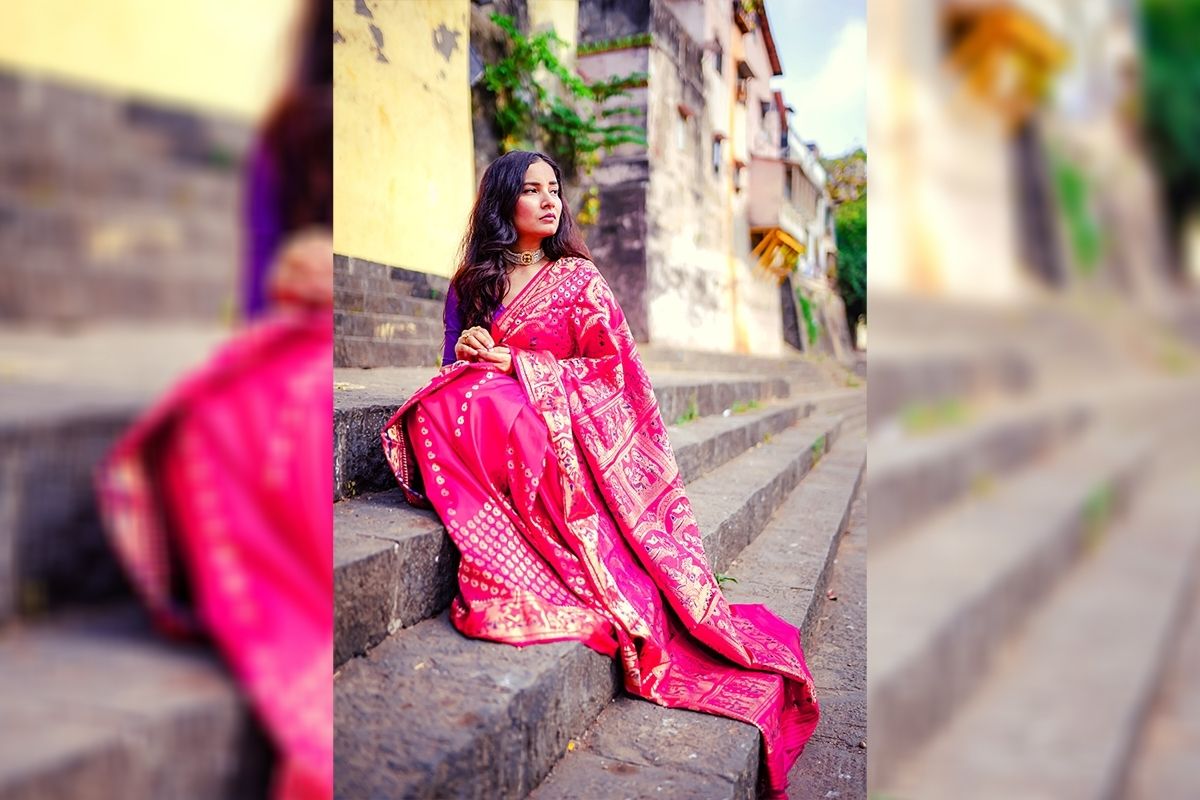
Contemporary weavers have also expanded the colour palette. Alongside traditional deep reds, blues and purples, Baluchari sarees can now be found in softer shades and modern colour combinations designed for changing tastes.
Heritage Woven for a New Generation
Baluchari weaving survived periods of decline because craftspeople, designers and cultural organisations recognised its artistic importance. Its Geographical Indication recognition has further strengthened the identity of Baluchari as a distinctive textile tradition associated with West Bengal.
Yet its greatest value cannot be measured by recognition alone. Every Baluchari represents the knowledge of weavers who must translate detailed visual narratives into thousands of carefully arranged threads.
Today, the saree stands at the meeting point of history and contemporary fashion. Traditional epic scenes can appear alongside evolving motifs and colours, allowing the craft to remain relevant without abandoning its distinctive identity.
To wear a Baluchari is therefore to carry something larger than silk. It is to carry fragments of Bengal’s temples, courts, mythology and weaving heritage. Every pallu becomes a storyteller, transforming an ordinary length of silk into a textile archive of a living civilisation.
Also Read: From Guns to Glamour: Surrendered Naxal Women Walk Fashion Ramp
You can connect with DNN24 on Facebook, Twitter, and Instagram and subscribe to our YouTube channel.