
Inside the elite U.S. military education system, officers learn to become global strategists through rigorous study, unscripted wargaming, and civilian partnerships.
When we think of military training, we often conjure up images of boot camps with muddy cadets going through physical training or rifle drills. There is, however, another side to military education: the classroom, where a lot of intellectual preparation happens as an integral part of Professional Military Education (PME).
Defense analyst Ramakrishnan Ramani tracked these structural frameworks during a recent U.S. State Department International Visitor Leadership Program (IVLP) titled “We the People: Military Education in America.” Ramani, who teaches defense and strategic studies at the SRM Institute of Science and Technology and the University of Madras, Chennai, used the opportunity to study the curriculum design and institutional links behind the American PME system. He participated in specialized PME seminars, joined a hands-on wargaming session, and interacted with military education experts and government representatives in multiple cities.
“As in all professional armies, in the United States too, PME is a career-long ladder designed to transform tactical experts into strategic thinkers,” says Ramani. This system treats strategic thinking as a skill that needs to be sharpened constantly. “Hence, classroom sessions are a core part of an officer’s job, not a side hobby,” he adds.
Foundations of military leadership and joint service
This comprehensive education begins early, introducing students to strategic frameworks long before they enter active military service.
Ramani witnessed this firsthand at Pensacola High School and the Colorado Military Academy, both of which host Air Force Junior Reserve Officers’ Training Corps (JROTC), a federal program sponsored by the U.S. Armed Forces in high schools across the United States. “Students of Grade 8 and higher are introduced to basic military science, history, fundamentals of world affairs and relevant technologies, such as drone fabrication and piloting, satellite navigation and so on, in addition to parade drills,” Ramani notes.
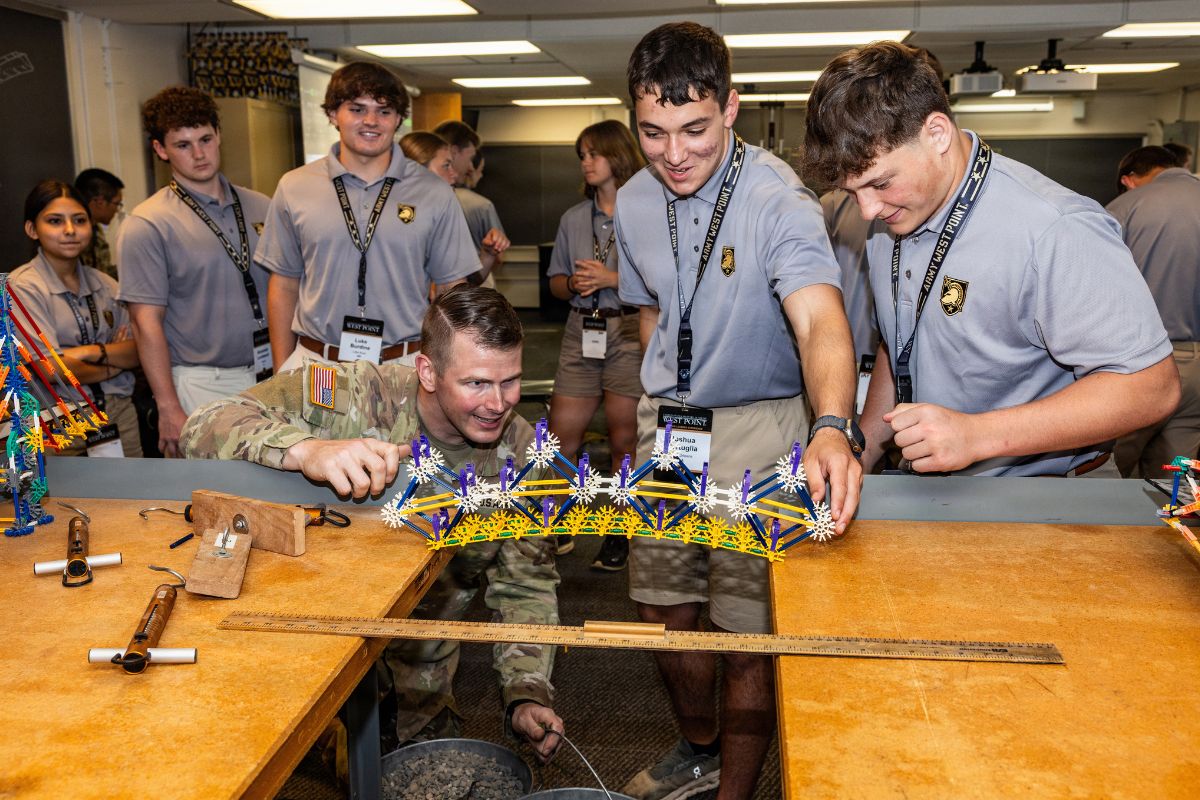
As these students progress into higher education, they join specialized university pipelines. “Typically, young high school graduates enter service academies such as West Point or college students join the Reserve Officers’ Training Corps (ROTC),” says Ramani.
As officers move up the ranks, the educational system shifts gears. In the initial years, the focus remains tactical and field-based, ensuring a newly commissioned officer knows how to lead a platoon safely through a mission. After a few years of service, typically around the rank of Major, personnel return to the classroom environment.
“It is during this phase that they learn how different branches of the military work together in sync to achieve more strategic outcomes,” says Ramani.
Inside the U.S. War Colleges and National Defense University
The true impact of this institutional structure becomes apparent as officers transition into the highest levels of defense leadership. That’s when they are eligible to enter the prestigious War Colleges. This is when, Ramani says, “they have to drop the battlefield mindset and pick up a statesman’s hat.”
This senior layer operates as a highly coordinated network of service-specific branches and joint institutions culminating at the National Defense University in Washington, D.C.
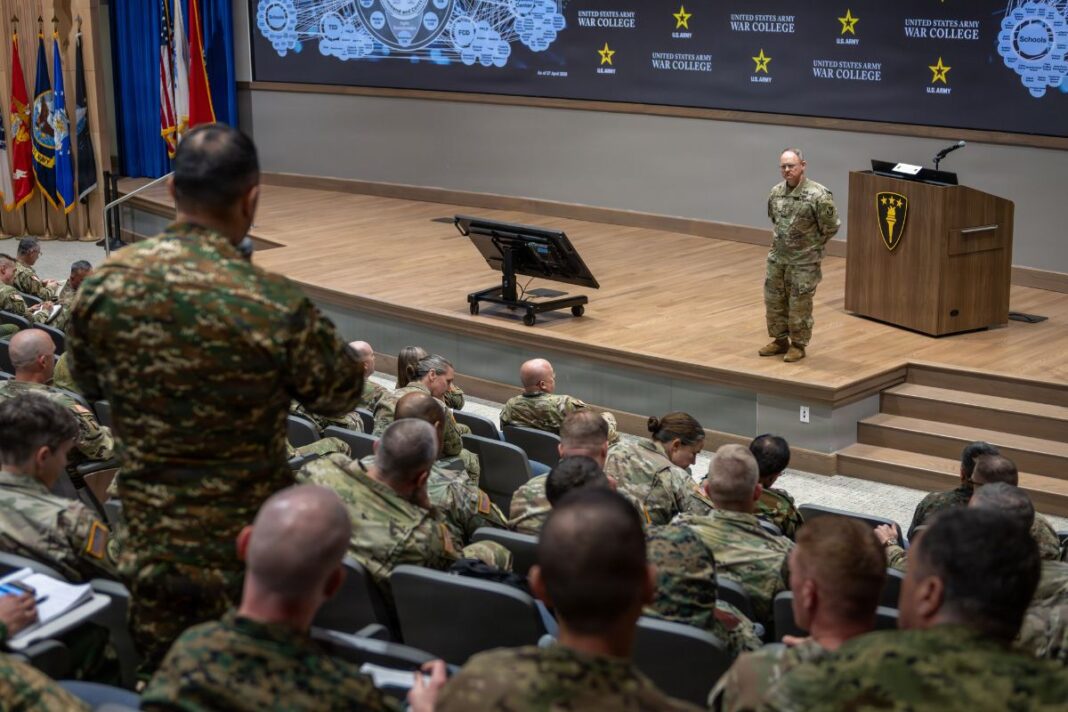
“In institutions such as the U.S. Army War College, the goal is to develop leaders who can tackle unstructured problems and provide military advice to the country’s civilian leadership,” explains Ramani, noting that an inquiry-driven study of economics and international relations teaches officers that the military is just one of the tools in a country’s toolkit.
To connect these defense strategies to national objectives, the war colleges use a collaborative academic environment. “They share classrooms with civilian officials from various government agencies and increasingly with international officers from allied friendly nations,” Ramani says. “This diverse mix ensures they learn to solve complex global problems together.”
Bridging military PME and civilian universities
The national security education system operates as a dual-track ecosystem, balancing structured military instruction with diverse, decentralized civilian academic expertise. Graduate schools such as Johns Hopkins School of Advanced International Studies (SAIS), Harvard Kennedy School, and the Princeton School of Public and International Affairs act as intellectual engines for national security, and high-performing military officers are routinely sent to these universities as National Security Fellows to bring critical intellectual diversity into conventional military logic.
Similarly, having civilian faculty members at war colleges brings in academic rigor and broader perspectives. “A significant portion of the faculty at top war colleges consists of civilian Ph.D.s holding chairs in military history, international relations, and strategic studies,” says Ramani.
This academic integration also extends to specialized joint degree initiatives and deep research networks. For example, the U.S. Space Force partners with SAIS to run the Schriever Space Scholars Program, allowing personnel to earn a master’s degree in military strategy within a civilian setting.
The role of unscripted wargaming
As officers rise into senior management, the curriculum shifts toward joint, interagency, intergovernmental, and multinational programs to cut across institutional silos.
One of the most dynamic tools Ramani observed firsthand was the use of interactive simulation to translate theory into real-world readiness. He was able to join a brief session himself. “PME uses complex, unscripted wargaming where students are placed in highly fluid, crisis-level scenarios where they must counter simulated adversarial moves,” he says.
Through these exercises and analytical methodologies, senior officers are trained to anticipate modern asymmetric threats. “At institutions like the National War College, student officers study precedents, intelligence analysis, and geopolitical drivers to evaluate the capabilities and intentions of global actors, with a heavy emphasis on asymmetric threats such as cyber warfare, disinformation, and economic coercion” Ramani explains. “Exercises such as ‘Red Teaming’ are conducted to challenge students’ own assumptions, identify blind spots in operational plans, and stress-test emerging doctrines.”
Interagency coordination and defense diplomacy
By design, this entire educational framework fosters a “whole-of-government” approach. At the curriculum level, modules are explicitly structured to showcase how the military operates as a supporting element to civilian leadership during deployments. “For instance, officers study how the National Security Council synthesizes intelligence and coordinates actions between the Pentagon, Department of State, law enforcement agencies, and other departments during domestic crises or international operations, especially in areas of counterterrorism.”
This interagency focus scales all the way up to senior executive training, where high-level field studies simulate coordination across different government branches. “At senior levels, leaders participate in capstone courses, which feature intense field studies that simulate direct interaction with ambassadors, intelligence directors, and law enforcement,” Ramani says.
Human capital as the ultimate asset
For nations looking to modernize their armed forces, the structural design of the U.S. PME model offers an enduring blueprint. “When we look at how countries build robust defense preparedness, we often focus on standard hardware,” says Ramani. “But the U.S. PME system shows that a nation’s ultimate strategic asset is actually its human and intellectual capital. It treats cognitive development as a core capability.”
Ultimately, true defense preparedness depends as much on developing people as it does on acquiring technology. By building an adaptable cadre of leaders through a rigorous academic ecosystem, nations can ensure they remain fully prepared for the unpredictable realities of future global conflicts.
What resonated most with Ramani was this structural push for analytical adaptability over rigid doctrine. “The U.S. PME model offers a blueprint for cultivating leaders who can navigate today’s unpredictable security landscape,” says Ramani. “By investing in education and strategic thinking, nations can build leaders who aren’t just prepared to fight the wars of today, but are fully equipped to anticipate, adapt to, and shape the strategic landscape of tomorrow.”
By Syed Sulaiman Akhtar, SPAN Magazine
Also Read: Sports Diplomacy in Action: Basketball Connects India and the United States
You can connect with DNN24 on Facebook, Twitter, and Instagram and subscribe to our YouTube channel.