
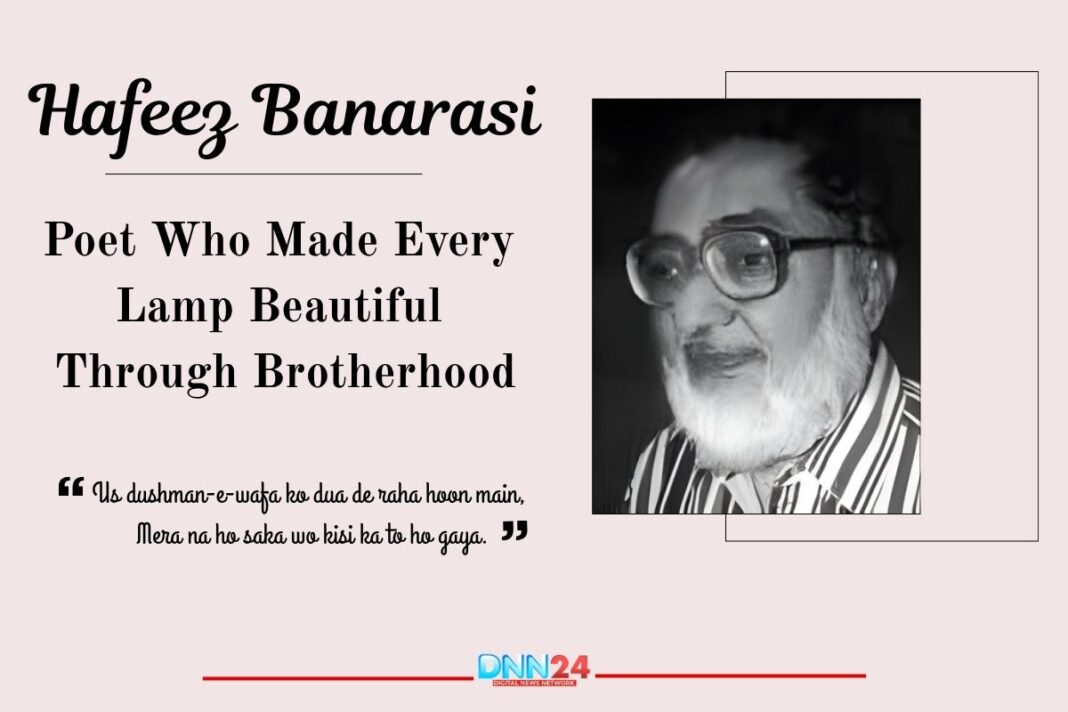

Muhammad Abdul Hafeez, remembered as Hafeez Banarasi, was born in 1933 in Banaras, a city where communal harmony was not a slogan but a way of life. His poetry became a living testament to India’s Ganga-Jamuni tehzeeb, the beautiful tradition where Hindu and Muslim cultures blend like two rivers meeting in one sacred flow. Every line he wrote carried the essence of brotherhood.
Dushmanon ki jafa ka khauf nahin,
Hafeez Banarasi
Doston ki wafa se darte hain.
His verses did not preach unity through grand declarations. Instead, they whispered it through simple images of lamps, prayers, and festivals shared between neighbours. Hafeez grew up watching temple bells and azaan coexist in perfect rhythm over the Ganges. He saw Hindus and Muslims celebrate each other’s joys and comfort each other’s sorrows. This became the foundation of his poetic mission.
Ek Sita ki rifaqat hai to sab kuch paas hai,
Hafeez Banarasi
Zindagi kehte hain jis ko Ram ka banbas hai
His collections like Bada-e-Irfan, Qaul-o-Qasam, Darakhshan, and Safeer-e-Shahr-e-Dil reflected a life dedicated to keeping the flame of communal understanding alive. Recognition came late, struggles were many, but Hafeez never abandoned his belief that poetry could bridge divides. He lived, taught humbly, and wrote with a sincerity that touched hearts across religious boundaries.
Chale chaliye ki chalna hi daleel-e-kamrani hai,
Hafeez Banarasi
Jo thak kar baith jaate hain wo manzil pa nahin sakte
Brotherhood Learned in the Lanes of Banaras
Banaras taught Hafeez Banarasi what textbooks could never explain about communal harmony. His childhood was filled with moments that shaped his understanding of brotherhood. On Diwali nights, young Hafeez helped his Hindu neighbours decorate their homes with diyas. The glow of those earthen lamps stayed in his memory forever. When Eid arrived, those same neighbours brought sweets to his doorstep, their children playing together without knowing or caring about religious differences.
Gumshudgi hi asl mein yaaro rahnumai karti hai,
Hafeez Banarasi
Raah dikhane wale pehle barson raah bhatakte hain.
These were not exceptional acts of tolerance. They were the normal rhythm of life in the Banaras of his youth. Hafeez absorbed this culture of mutual respect like air he breathed. He listened to bhajans floating over the Ganges at sunrise and the call to prayer rising from minarets at dusk. These sounds did not compete in his ears. They harmonised like instruments in an orchestra, only Banaras knew how to conduct.
Sabhi ke deep sundar hain, humare kya tumhare kya,
Hafeez Banarasi
Ujala har taraf hai, is kinare us kinare kya.
This lived experience of communal harmony became the soul of his poetry. He did not have to imagine what brotherhood looked like. He had seen it, touched it, lived it every single day. His verses later became mirrors reflecting this beautiful reality to a world that was slowly forgetting how Hindus and Muslims once lived as one family under different names.
Kabhi khirad kabhi diwangi ne loot liya,
Hafeez Banarasi
Tarah tarah se humein zindagi ne loot liya.
The Compassion That Defined His Brotherhood
One story about Hafeez Banarasi captures the depth of his commitment to communal harmony and human brotherhood. During a devastating flood in Banaras, when water destroyed homes and left families homeless, Hafeez himself was struggling financially. He had just published a book and received a modest payment for it. Any sensible person would have kept that money for personal needs. But Hafeez did something that turned into legend.
Tadbeer ke dast-e-rangin se taqdeer darakhshan hoti hai,
Hafeez Banarasi
Qudrat bhi madad farmati hai jab koshish-e-insaan hoti hai.
He donated every rupee to the local temple’s relief efforts. When questioned why a Muslim poet would give his earnings to a Hindu temple’s charity work, his response revealed the man’s soul. He said softly that the Ganga does not ask who is Hindu or Muslim before she saves them from drowning. Pain belongs to everyone. Compassion knows no religion. This single act spoke louder than a thousand speeches about communal harmony. It showed that brotherhood is not about grand gestures or public declarations.
Kis munh se karein unke taghaful ki shikayat,
Hafeez Banarasi
Khud humko mohabbat ka sabaq yaad nahin hai.
It lives in quiet acts of kindness that cross religious boundaries without hesitation. Hafeez later wrote that those who guide others have themselves wandered lost in darkness. Perhaps he was remembering his own struggles with rejection, poverty, and silence from publishers who did not recognise his worth. Yet these hardships never made him bitter or narrow. They deepened his empathy and strengthened his resolve to write poetry that united rather than divided.
Wafa nazar nahin aati kahin zamane mein,
Hafeez Banarasi
Wafa ka zikr kitabon mein dekh lete hain
Poetry as a Bridge Between Communities
Hafeez Banarasi’s most significant contribution to communal harmony came through his poetry itself. His famous verse “Sabhi ke deep sundar hain, hamare kya tumhare kya” became the anthem of brotherhood in Urdu literature. By saying that every lamp is beautiful regardless of who lights it, he erased the walls between communities. He suggested that Diwali diyas and Eid lamps both belong to the same divine light, to humanity itself.
Jo pardoon mein khud ko chhupaye hue hain,
Hafeez Banarasi
Qayamat wahi to uthaye hue hain.
His Diwali poems celebrated the festival not as a Hindu occasion but as a universal moment of light defeating darkness. Similarly, his Eid verses spoke of compassion and generosity as values shared by all faiths. In one moving couplet, he mourned how fear had replaced friendship in modern times, how people now hesitate before embracing across religious lines. Yet he never lost hope that love could restore the old bonds of brotherhood.
Maine abaad kiye kitne hi veerane Hafeez,
Hafeez Banarasi
Zindagi meri ek ujad hui mehfil hi sahi.
Another poem, “Paighaam-e-Eid,” connected the message of Eid with India’s broader festival culture, describing both Diwali diyas and Eid moons as reflections of one truth. His lesser-known work “Hum sab ka Banaras” expressed pride in his city’s culture, where Hindus and Muslims coexisted like the Ganges and Jamuna flowing together. The imagery of temple bells blending with azaan portrayed an unbroken bond between traditions. Through these poems, Hafeez transformed everyday acts of kindness into spiritual gestures, proving that communal harmony is not a political goal but a natural state of human decency.
Mile fursat to sun lena kisi din,
Hafeez Banarasi
Mera qissa nihayat mukhtasar hai.
A Legacy of Unity That Lives On
Hafeez Banarasi passed away in 2008, but his message of communal harmony and brotherhood continues to resonate across India. His poetry is still recited at mushairas and cultural gatherings where Hindus and Muslims come together to celebrate shared heritage. Rare recordings from his 1993 mushaira appearance exist online, showing him reciting verses of peace and mutual respect that capture Banaras’s cultural unity.
Ye kis maqam pe laayi hai zindagi humko,
Hafeez Banarasi
Hansi labon pe hai, seene mein gham ka daftar hai
Modern poetry events like the 2025 Chicago Mushaira titled “A Night of Verse and Solidarity” carry forward his influence, with poets referencing his unity-inspired works while celebrating Urdu as a shared cultural bond across faiths. Cultural organisations continue organising mushairas on the theme of love, peace, and unity through literature, often citing Hafeez Banarasi’s Diwali and Eid verses as perfect examples of poetic bridges between religions.
Ishq mein marka-e-qalb-o-nazar kya kahiye,
Hafeez Banarasi
Chot lagti hai kahin, dard kahin hota hai.
Digital platforms and archives have made his work accessible to new generations, discovering that communal harmony is not weakness but strength, not compromise but completion. Hafeez believed that festivals existed to light hearts together rather than divide them. He turned the simple act of lighting a lamp into a profound statement about human brotherhood. His life itself was a living example of the unity he preached.
Samajh ke aag lagana hamare ghar mein tum,
Hafeez Banarasi
Hamare ghar ke barabar tumhara bhi ghar hai.
He remains the glowing soul of Banaras, a poet whose verses remind us that love, empathy, and shared culture shine brighter than any division. In times when communal tensions threaten the fabric of society, Hafeez Banarasi’s poetry offers a gentle reminder that Hindus and Muslims once lived as neighbours, friends, and family, and can do so again if they choose compassion over conflict.
Also Read: Bilqis Zafirul Hasan: The Poet Who Found Her Voice in Silence
You can connect with DNN24 on Facebook, Twitter, and Instagram and subscribe to our YouTube channel.