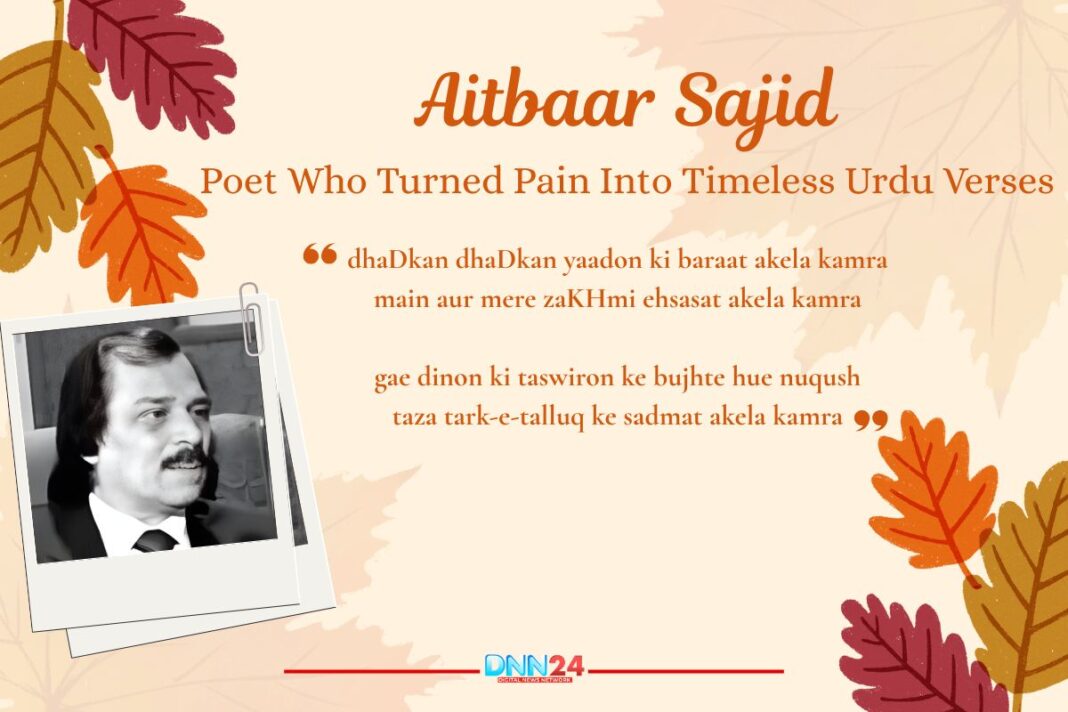

Born on 1 July 1948, in Multan’s scorching lanes, Aitbaar Sajid arrived in a world where poetry flowed through evening gatherings, and words carried the weight of centuries. Punjab’s soil cradled this boy whose eyes held galaxies and whose heart carried melodies waiting to escape. His family knew modest means, but they could not have imagined that their son would one day voice the silent aches of millions through verses that pierce straight through pretence into raw human emotion.
tumhein jab kabhi milen fursaten mere dil se bojh utar do
Aitbaar Sajid
main bahut dinon se udas hun mujhe koi sham udhaar do
Those early years in Multan, later shifting to Sargodha, planted seeds that would blossom into ghazals recited across borders. Imagine a child walking barefoot through fields, picking up rhythms from the wind, storing them like treasures for future mushairas. Poverty marked his childhood with harsh lessons, yet within that struggle grew a determination that would define his entire journey. Stories say he once stood beneath a banyan tree, making a solemn promise to his own reflection that his words would someday heal wounds the world preferred to hide.
mujhe apne rup ki dhup do ki chamak saken mere KHal-o-KHad
Aitbaar Sajid
mujhe apne rang mein rang do mere sare rang utar do
Friends from those days recall a boy who found music in rejection, who turned every closed door into an open verse. The 1980s mushairas saw him emerge as the poet with a voice that made audiences hold their breath, a handsome face illuminated by dim lights, weaving magic that young admirers waited for with beating hearts. Behind that charm lived a man who knew hunger intimately, who understood how heartbreak tastes, whose family migrations from Multan to Rawalpindi taught him that roots matter less than the strength to grow anywhere.
jo KHayal the na qayas the wahi log mujh se bichhaD gae
Aitbaar Sajid
jo mohabbaton ki asas the wahi log mujh se bichhaD gae
Teaching at H-9 College in Islamabad, he secretly mentored struggling students, slipping them poems that ignited their own creative fires, proving that greatness shares itself quietly. His debut collection arrived in 2002 after years of patient waiting, but the journey there tested every ounce of his resolve.
band dariche suni galiyan an-dekhe anjaane log
Aitbaar Sajid
kis nagri mein aa nikle hain ‘sajid’ hum diwane log
The Fields and Floods That Forged a Voice
Multan’s heat shaped young Aitbaar in ways textbooks never capture. Picture 1952, possibly Sargodha too, where a small boy chased kites across open fields, each soaring paper bird representing freedoms he yearned to grasp. His home held no luxuries, just parents who worked under merciless sun while their son dreamed in corners, scribbling verses on whatever scraps he could find. One tale rarely told involves a village fair where floodwaters swallowed his only notebook of poems.
tere jaisa mera bhi haal tha na sukun tha na qarar tha
Aitbaar Sajid
yahi ‘umr thi mere ham-nashin ki kisi se mujh ko bhi pyar tha
He sat by that river weeping, then did something remarkable. He rewrote every single verse from memory, each one fiercer and deeper than before. That moment revealed the poet he would become, someone who transformed loss into creative fuel. School days brought mixed blessings as classmates ridiculed his poetic ambitions. At the same time, perceptive teachers recognised genuine talent and pushed him toward mushairas, where his voice initially trembled before learning to soar.
main takiye par sitare bo raha hun
Aitbaar Sajid
janam-din hai akela ro raha hun
Frequent family relocations in pursuit of a basic livelihood left him feeling rootless, drifting like clouds without an anchor, yet poetry provided the stability that external circumstances denied him. He would hide in quiet corners, capturing observations about lost kites that mirrored lost loves, crafting ghazals born of adolescent heartbreak over a neighbour’s fleeting smile. As a teenager, he worked odd jobs, including dawn milk deliveries, and he later joked about whispering verses to cows, claiming it taught him patience for life’s many disappointments.
mujhe aisa lutf ata kiya ki jo hijr tha na visal tha
Aitbaar Sajid
mere mausamon ke mizaj-dan tujhe mera kitna KHayal tha
The first time a mushaira crowd applauded his poem, tears mixed with clapping hands, offering validation sweeter than any dessert. But rejections from magazines followed, and family pressure mounted to pursue a “real job” instead of chasing poetic dreams. He resisted, converting pain into power, eventually becoming both a professor and a broadcaster who bridged classical forms with contemporary audiences. He credited his mother’s lullabies for his distinctive tarannum, the musical recitation style that melts listeners’ hearts.
mujh se muKHlis tha na waqif mere jazbaat se tha
Aitbaar Sajid
us ka rishta to faqat apne mafadat se tha
Heartbreak’s Harvest and Love’s Cruel Lessons
Love struck Aitbaar not with a gentle romance but with a consuming wildfire that reduced everything to ash before birthing verses that still make audiences weep decades later. During his youth, romances bloomed and withered, leaving scars that became art. One untold night saw him waiting in pouring rain for a beloved who never appeared, and from that drenched despair came “Mere khat mujhe wapis kar,” a verse that achieved legendary status.
DhunDte kya ho in aankhon mein kahani meri
Aitbaar Sajid
KHud mein gum rahna to ‘adat hai purani meri
Struggles compounded as partition’s echoes reverberated through personal losses, family members departing like monsoon clouds gathering darkness. Yet, he channelled anguish into ghazals like “Jo khayal thay nah qayas thay, wohi log mujh se bichad gaye.” The emotional landscape shifted constantly between mushaira stardom in the 1980s, when young men idolised his charisma and voice reminiscent of honeyed sitar strings, and profound solitude that made him question whether love merely disguised itself as a thief stealing joy.
phul the rang the lamhon ki sabahat hum the
Aitbaar Sajid
aise zinda the ki jine ki alamat hum the
His radio scripting work allowed him to weave personal suffering into broadcasts reaching remote villages, healing listeners while gradually mending his own fractured spirit. Collections poured forth, including “Wahi Ek Zakhm Gulab Sa” and “Tumhain Kitna Chahtey Hain,” each page a battlefield transformed into literary jewels. A particularly devastating betrayal silenced him for months, but he emerged writing socially conscious nazms addressing inequality, demonstrating how love’s harsh lessons expand hearts beyond personal concerns into universal empathy.
kabhi tu ne KHud bhi socha ki ye pyas hai to kyun hai
Aitbaar Sajid
tujhe pa ke bhi mera dil jo udas hai to kyun hai
During interviews, his voice would crack as he explained that pain serves as poetry’s mother, this transformation of private wars into public solace becoming his signature contribution. Imagine him leaning against the microphone, his handsome frame relaxed yet intense, reciting “Mein takiye par sitare bo raha hun”.
chhoTe chhoTe kai be-faiz mafadat ke sath
Aitbaar Sajid
log zinda hain ajab surat-e-haalat ke sath
At the same time, audiences sat in hushed recognition of untold longing for peace amid chaos. Awards and national recognition marked the highs, while faith-testing lows threatened to break him, yet he continued rising, becoming a columnist who connected traditional forms with modern anguish.
aane wali thi KHizan maidan KHali kar diya
Aitbaar Sajid
kal hawa-e-shab ne sara lawn KHali kar diya
Climbing Stairs Built From Sheer Determination
Aitbaar’s ascent from Rawalpindi’s busy streets to Islamabad’s academic halls happened not through wealth or connections but through relentless will and the power of words. His 2002 debut book sparked wider recognition, though the path remained rocky, including teaching years at H-9, where former students remember impromptu mushairas conducted within classroom confines, inspiring young poets despite syllabus constraints.
hum tere KHwabon ki jannat se nikal kar aa gae
Aitbaar Sajid
dekh tera qasr-e-ali-shan KHali kar diya
Publishers once rejected his work as “too emotional,” prompting him to self-publish and sell copies door to door, treating each sale as a personal victory dance performed in his heart. The 1990s brought health troubles and family obligations, yet radio opportunities let his voice carry pieces like “Koi baat karni hai chand se” across borders into distant homes and hearts. Emotional peaks arrived as crowds chanted his name and awards crowned years of toil, while valleys appeared when mentors passed and he questioned poetry’s value in a world obsessed with material wealth.
kisi ko hum se hain chand shikwe kisi ko behad shikayaten hain
Aitbaar Sajid
hamare hisse mein sirf apni safaiyan hain wazahaten hain
His television scriptwriting blended ghazals with narratives of human struggle, establishing him as Urdu’s ambassador and bringing classical beauty into ordinary households. Fame attracted admirers but also bred envy, which he countered by writing nazms addressing social injustices and inequality’s silent screams. During one memorable blackout mushaira, he recited heartbreak verses by candlelight, the power outage mirroring life’s darkness while his performance emerged heroic.
bahut sajae the aankhon mein KHwab main ne bhi
Aitbaar Sajid
sahe hain us ke liye ye azab main ne bhi
Collections like “Koi Baat Krni Hai Chand Say” combined romance, melancholy and hope across 103 ghazals and 12 nazms, each representing a distinct chapter from his lived experience. As a professor, he would pause lectures to share relevant verses, transforming bored faces into believing hearts. His persistence through job demands and migrations proved that determination ultimately pens destiny. At the same time, his approachable style revived Urdu among younger generations, building bridges between Pakistan’s heritage and audiences worldwide, including in India.
raste ka intiKHab zaruri sa ho gaya
Aitbaar Sajid
ab iKHtitam-e-bab zaruri sa ho gaya
Verses That Refuse to Fade Away
Aitbaar Sajid’s creative flame burns without diminishing, his verses serving as beacons across Urdu literature’s vast landscape, touching hearts whether encountered at live mushairas or through mobile screens. Today, he receives celebration for maintaining continuity, with national awards honouring his blend of social consciousness and romantic sensibility, books finding new printings, and verses going viral among both young and old audiences.
bhiD hai bar-sar-e-bazar kahin aur chalen
Aitbaar Sajid
aa mere dil mere gham-KHwar kahin aur chalen
His quiet mentoring of hidden talents through personal correspondence, never seeking credit or recognition, represents a kindness that itself reads like poetry. The gifts born from his struggles shine clearly now, from poverty’s constraints to professorship’s respect, from heartbreaks to hits like “Tumhein jab kabhi milen fursaten,” he inspires millions pursuing dreams amid South Asian chaos and complexity.
ye Thik hai ki bahut wahshaten bhi Thik nahin
Aitbaar Sajid
magar hamari zara aadaten bhi Thik nahin
In a YouTube conversation, his soft voice shared that “poetry saved me from despair,” with tears hinting at battles won through words rather than weapons. His radio broadcasts reached educated village populations with love’s truths and unity across divides, making his work valuable for contemporary discussions of communal harmony. Fame’s embrace marked his peaks while wisdom deepened through rugged valleys, and now, at life’s later stage, he offers sincerity that defies time’s erosion.
mujhe wo kunj-e-tanhai se aaKHir kab nikalega
Aitbaar Sajid
akele-pan ka ye ehsas mujh ko mar Dalega
His body of work bridges classical traditions with modern chaos through ghazals that explore fate and nazms that examine present realities, urging audiences to feel deeply and write truthfully. For Indian readers who cherish Urdu poets, his journey demonstrates the power of embracing pain to craft genuine inspiration.
ghar ki dahliz se bazar mein mat aa jaana
Aitbaar Sajid
tum kisi chashm-e-KHaridar mein mat aa jaana
Nobody has traced his complete arc quite this way before, from banyan tree vows to broadcast healing, presenting a deeply personal saga of creative fire sustained across decades. His lesser-known stories remind us that every struggle plants seeds for future verses, every tear waters eventual triumph, and Aitbaar lives on through lines that heal while urging us to pick up our own pens and let hearts roar because the world awaits each person’s unique whisper turned into art that refuses silence.
Also Read: Tomb of Sher Shah Suri: An Emperor’s Dream Palace Floating On Water
You can connect with DNN24 on Facebook, Twitter, and Instagram and subscribe to our YouTube channel.