

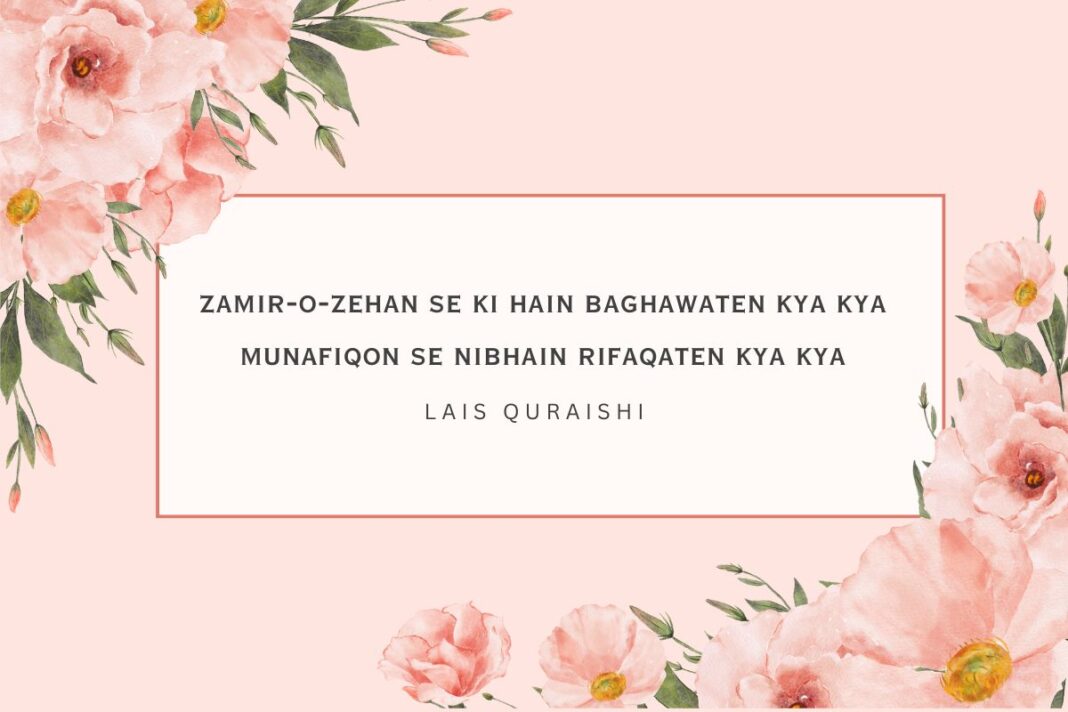

He was born Abulais Quraishi on 6 May 1922 in the small village of Bhojapur, in Ghazipur district of Uttar Pradesh, with ancestral roots in Azamgarh. In that dusty countryside, where evenings came with the call to prayer and the smell of wet earth after rain, a shy boy slowly discovered the music of words. His pen name “Lais” was unusual in the Urdu world, where many poets repeated familiar takhallus, and this different name quietly hinted that he would walk his own path.
ye masala hai aur koi masala nahin
Lais Quraishi
apna harif main hun koi dusra nahin
He did not arrive with fanfare, great ustads, or literary salons waiting for him. Instead, he grew like a lone tree beside a narrow village road, unnoticed yet stubbornly alive. In those early years, book culture was limited, and life was practical. However, somewhere in that simple routine, the young Abulais started storing phrases, images, and feelings like a careful farmer storing grain for the poems that would come later.
Partition, Karachi, And A Life Inside A Bank
History’s sharpest wound, the Partition of 1947, cut through his life too, pushing him from eastern Uttar Pradesh towards the new country of Pakistan. After Partition, Lais moved to West Pakistan and found work in the National Bank, an office world of ledgers, signatures, and long working hours that did not look like a poet’s life at all.
tum ne bhule se kabhi ye nahin socha hoga
Lais Quraishi
hum jo bichhDenge to kya haal hamara hoga
Yet inside that quiet bank cabin, among files and figures, another secret ledger was open in his mind, full of images of lost lanes, vanished neighbours, and the ache of migration. He continued his studies while working, and by the time he retired, he had risen to the post of Senior Vice President, proving that a sensitive heart could still move through the hard machinery of bureaucracy.
KHub andaz-e-pazirai hai
Lais Quraishi
izzat-e-nafs pe ban aai hai
He began writing poetry around 1946, on the very edge of freedom and fracture, and, remarkably, he had no permanent literary guide, shaping his craft without a formal ustad in a tradition that usually insists on such lineage. That absence became a freedom, allowing him to develop his own measured, reflective tone without the pressure of any established school stamping his voice.
The Ghazal Lover And His Shimmering Books
Lais loved the ghazal form, with its brief, sharp couplets that hold a whole universe in two lines, though he also wrote nazms when a thought needed more room to breathe. His collections carry titles full of movement and light: Lams-e-Gurezan, Aks-e-Larzan, Sho’la-e-Raqsaan, and Taaban Taaban. These names suggest a slipping touch, a trembling reflection, a dancing flame, and a shining brightness. Just the titles reveal his inner climate, where feeling is never still. It trembles, glows, and flickers like a lamp in an evening wind.
dil muzmahil hai teri nawazish ke bawajud
Lais Quraishi
ye sarzamin udas hai barish ke bawajud
In his other works, Toque Hayat, Daastan-e-Hayat, and Bar Sabeel-e-Ghaalib, he engages with life and literary tradition directly, even walking in Ghalib’s path with humility and curiosity rather than mere imitation. A famous couplet associated with him says, “Yahi bahut hai ke zinda hain qaid-e-zist mein hum.”
ahl-e-jahan ke sath wafa ya jafa karun
Lais Quraishi
meri samajh mein kuchh nahin aata hai kya karun
It translates roughly as: It is enough that we are alive in the prison of existence. The line catches that feeling of tired endurance which so many twentieth-century lives quietly carried. His poetry does not shout. It stays low and steady, like the voice of someone talking late at night after the world has grown silent, when people finally dare to say what they really feel.
Today’s Relevance: A Moderate Voice In Harsh Times
In today’s noisy age of sharp slogans and quick anger, Lais Quraishi’s temperament feels almost rebellious in its calmness. His work often echoes a balanced, middle-path sensibility, closer to the e’tidal-pasand attitude that refuses extremes and believes in slow, thoughtful change.
‘umr-bhar KHwab-e-mohabbat se na bedar hue
Lais Quraishi
isi kirdar se hum sahab-e-kirdar hue
The term means moderate, gradualist, anti-violent. For young readers in India and Pakistan, his journey from a small village in Ghazipur to a senior bank post in Karachi, without abandoning poetry, offers a quiet lesson: you can hold a salaried job and still protect the soft, luminous corner of your mind where art lives.
muskura sakta nahin aansu baha sakta nahin
Lais Quraishi
zindagi ab main tere ehsan uTha sakta nahin
His migration story also mirrors countless families who crossed borders and built new lives while carrying old memories, making his lines about survival and inner captivity feel painfully current in any discussion on displacement. In a time when Urdu is often pushed to the margins, digital platforms that host his verses keep him present for new generations, turning his once-private reflections into shared screens of feeling.
itni mushkil mein bhi ahbab na Dalen mujh ko
Lais Quraishi
ki sambhalna bhi na chahun to sambhaalen mujh ko
Reading Lais today is like sitting with an elder who has seen countries change names, currencies, and flags, yet still believes that the most honest record of history is sometimes written not in official documents but in a few trembling, truthful couplets.
A Flame That Still Flickers
Lais Quraishi never became a household name like Faiz or Ghalib, but that may have been part of his design. He preferred the margins, where observation is more precise, and noise does not drown out nuance. His poetry remains a testament to the millions who lived through Partition not as heroes or villains but as ordinary people trying to make sense of sudden, violent change.
ye aarzu hain hum koi aarzu karte
Lais Quraishi
asir KHud ko na hum dam-e-rang-o-bu karte
He proved that you do not need a grand stage or a famous patron to leave behind something worthwhile. All you need is honesty, patience, and the courage to keep writing even when the world around you is falling apart. His voice, soft but unbroken, continues to reach those who listen carefully.
Also Read:Kaif Ahmed Siddiqui: Sitapur’s Poet Who Chases Words
You can connect with DNN24 on Facebook, Twitter, and Instagram and subscribe to our YouTube channel.