

A young boy in Azamgarh, eastern Uttar Pradesh, watched poverty, feudal arrogance, and new hopes after Independence, quietly collecting words like burning coals in his pocket. That boy grew into M Kothiyavi Rahi, born in 1935, who became a respected progressive Urdu poet, storyteller and journalist.
dard ko dard se nisbat hogi
M Kothiyavi Rahi
kyon sochen ki mohabbat hogi
His family had roots in Iran, then in Delhi, and finally in a village called Kothiya near Azamgarh, where the village name slowly became his identity. “Kothiyavi” marked his geography, while “Rahi”, the traveller, became his pen name. He grew up when India was breaking its chains, but remained tied to hunger, class divisions and injustice.
hijr ka chand dard ki naddi
M Kothiyavi Rahi
yahi surat hai apni duniya ki
His poetry rose exactly from this tension, from this half freedom. When readers today meet Rahi, they do not meet a distant literary figure. They meet a restless man of his age, trying to walk with his people through darkness, with only language as a small lamp in his hand.
Progressive Fire Behind Gentle Images
Rahi is counted among the important progressive Urdu poets, but his progressivism was never only a slogan or loud speech. He took the line of the Progressive Writers’ Movement, standing with workers, peasants, and ordinary citizens. Yet, he turned those ideas into images that feel like dreams, deserts, and rivers moving inside the heart.
gumun nahin to kya main kahin ja ke paD rahun
M Kothiyavi Rahi
bimar aadmi ki tarah raat kaT dun
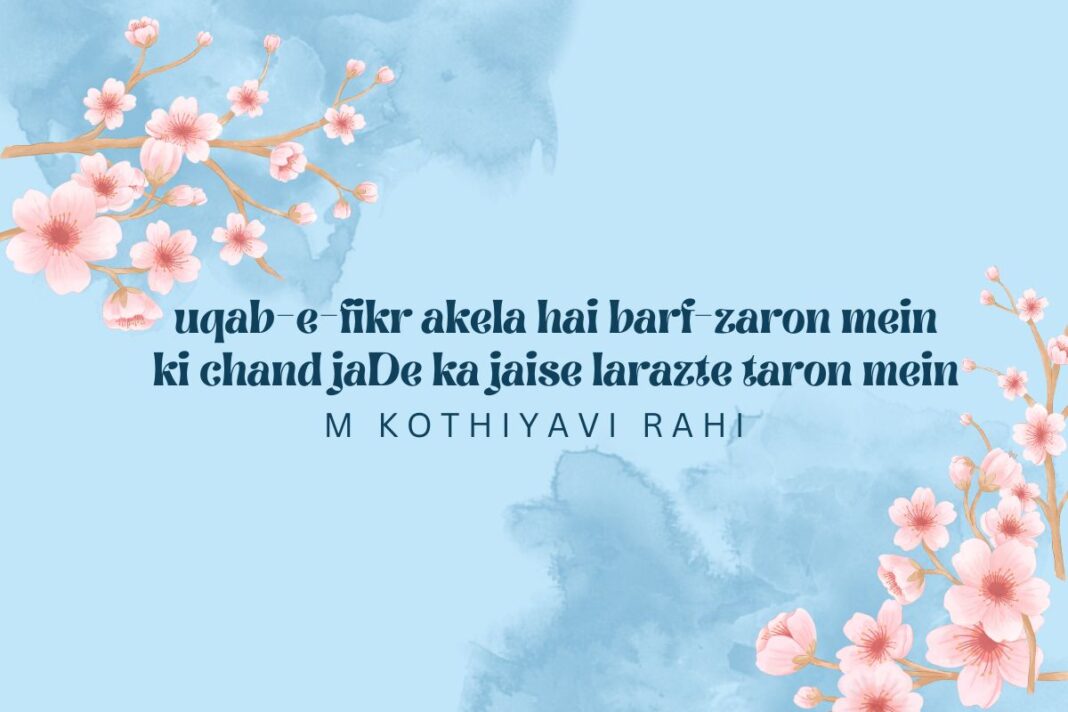
In his ghazals and nazms, you see “the eagle of thought alone in snowfields”, “the moon of separation”, “the river of pain”, “smoke rising from burning stars”. All these pictures carry the weight of social anxiety and personal loneliness together. He did not stay limited to poetry. He wrote novels, short stories, plays and sketches, and also brought out a literary quarterly called “Adabi Asnaaf”, trying to create a space where many forms of writing could breathe side by side.
jalega chand sitare dhuan uDaenge
M Kothiyavi Rahi
hamare KHwab teri aankh mein jab aaenge
Under the moral and intellectual shelter of Firaq Gorakhpuri, he ran a weekly named “Ishtiraaq”, using journalism and literature as twin tools to spread progressive thought into small towns and student rooms. When we read him now, we feel a rare balance. He is angry without becoming harsh, tender without becoming weak, and political without losing the private ache of the individual.
Books Like Milestones On A Long Road
If you place Rahi’s books in a line, they look like milestones of one long inner journey. His collections of poetry include “Kasak”, “Ye Geet Tumhare Hain”, “Manzil Manzil”, “Khoob Baha”, “Zaitoon Ke Ped”, “Shafaq Ke Phool”, “Shahar Bekhwab” and “Jale Ped Ki Chhaon”. Each title already hints at hurt, travel, sleeplessness and a stubborn hope that refuses to die.
ek anjaan rah par donon
M Kothiyavi Rahi
mil gae aaj be-KHatar donon
As a storyteller, he wrote works such as “Jhoothe Sanam”, “Andhera Shahar”, “Ashk Sang”, and “Zaad-e Safar”, in which cities become characters, tears turn to stones, and love itself is tested against lies and social pressure. Through these books, you can watch him move from youthful romantic sorrow to a wider, sharper understanding of exploitation, migration, lost dreams and changing moral values in post-independence India.
daraaz-qamat daraaz-gesu ajib sa ek nigar tha wo
M Kothiyavi Rahi
gulon ki bag us ke hath mein thi hawaon par jab sawar tha wo
He did not sit inside a safe academic circle. He treated magazines, editorials, and even small reviews as serious work because for him every page was a chance to push his reader one step closer to awareness. Significantly, he managed all this while remaining rooted in the Hindi-Urdu belt, away from the big glamour capitals, proving that strong literary voices can grow in modest soil and still shake the national mind.
Darkness, Distance, And The Courage To Feel
In Rahi’s verses, night appears again and again, not as simple romance, but as a testing ground for courage. One of his well-known lines calls the reader “Ai dasht-e shab-guzar, teri aas ka hiran”, addressing the night’s desert and the fragile deer of hope that runs through it, trembling yet alive. Love in his work is never only private. It touches politics, class, and geography. The beloved’s light often falls across the borders of language and religion, becoming a path for all the wounded to walk on.
rasta kisi wahshi ka abhi dekh raha hai
M Kothiyavi Rahi
ye peD jo is rah mein sadiyon se khaDa hai
His imagination plays with movement, wandering roads, unknown paths, circling thoughts, as if to say that a human being must keep walking mentally even when physically stuck in one small town or one tight job. There is also a deep sense of creative loneliness. The “eagle of thought alone in snowfields” is clearly the artist himself, trying to stay awake and alert while the world around him settles into comfortable sleep.
ab to ye soch ke bhi dil mera ghabraata hai
M Kothiyavi Rahi
subh ka bhula hua sham ko ghar aata hai
Yet his poetry never collapses into despair. Even when he writes of burning moons and smoking stars, you feel that he is urging you to look straight at pain, not to decorate it but to recognise it, and then slowly move beyond it with quiet bravery.
Why Rahi Matters In Our Noisy Present
Rahi passed away in Gorakhpur on 21 September 2005, but the questions inside his writing have grown sharper in our current time of noise, divided opinions and fragile attention spans. He wrote about sleepless cities before social media turned every night into a lit-up bazaar. His “shahar bekhwab” now looks like a prophecy of our anxious, glowing, restless metros.
fusun kar gai raat pagal hawa
M Kothiyavi Rahi
uDa le gai surKH aanchal hawa
His commitment to progressive ideas, the dignity of labour, equality, and questioning power feels urgently relevant in an India still fighting over identity, language, and memory. For young writers, his life offers a simple but powerful lesson. You can come from a small village, write in a language often neglected by global markets, resist commercial formulas, and still leave behind a strong, clear voice that refuses to be erased. For readers, entering Rahi’s world is like standing before a quiet mirror that neither flatters nor disfigures us. It shows how we have treated our poor, our lovers, our own dreams, and then asks softly: what kind of traveller, what kind of “rahi”, do you really want to be now?
Also Read:Lais Quraishi Quietly Rewrote Pain Into Poetry
You can connect with DNN24 on Facebook, Twitter, and Instagram and subscribe to our YouTube channel.