
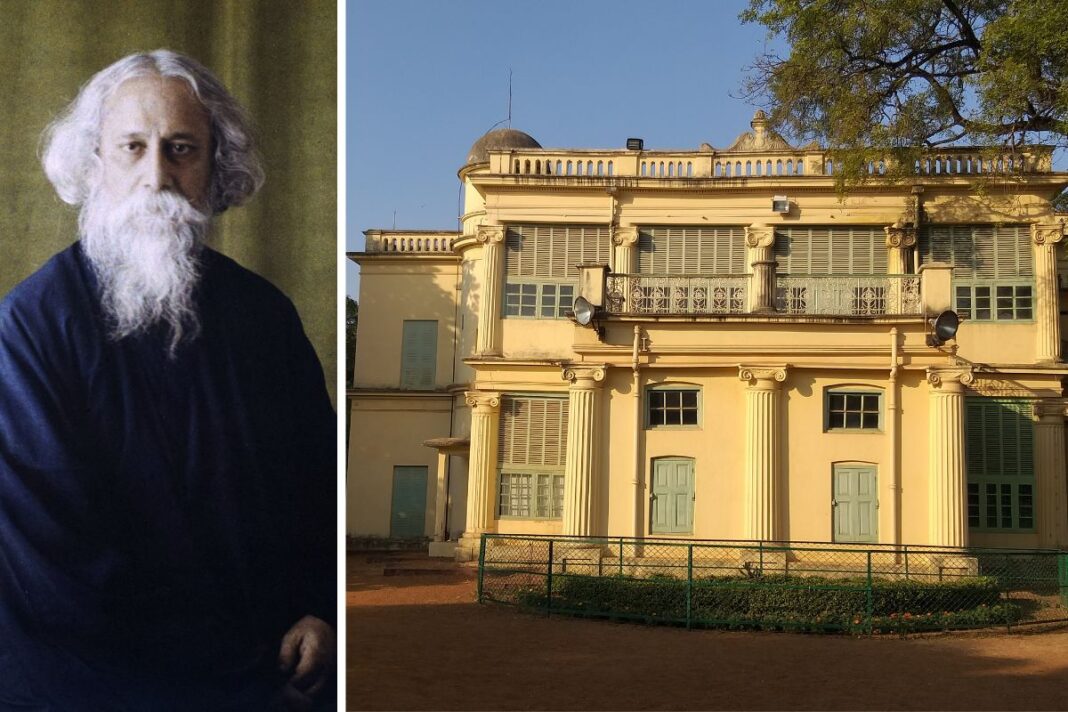

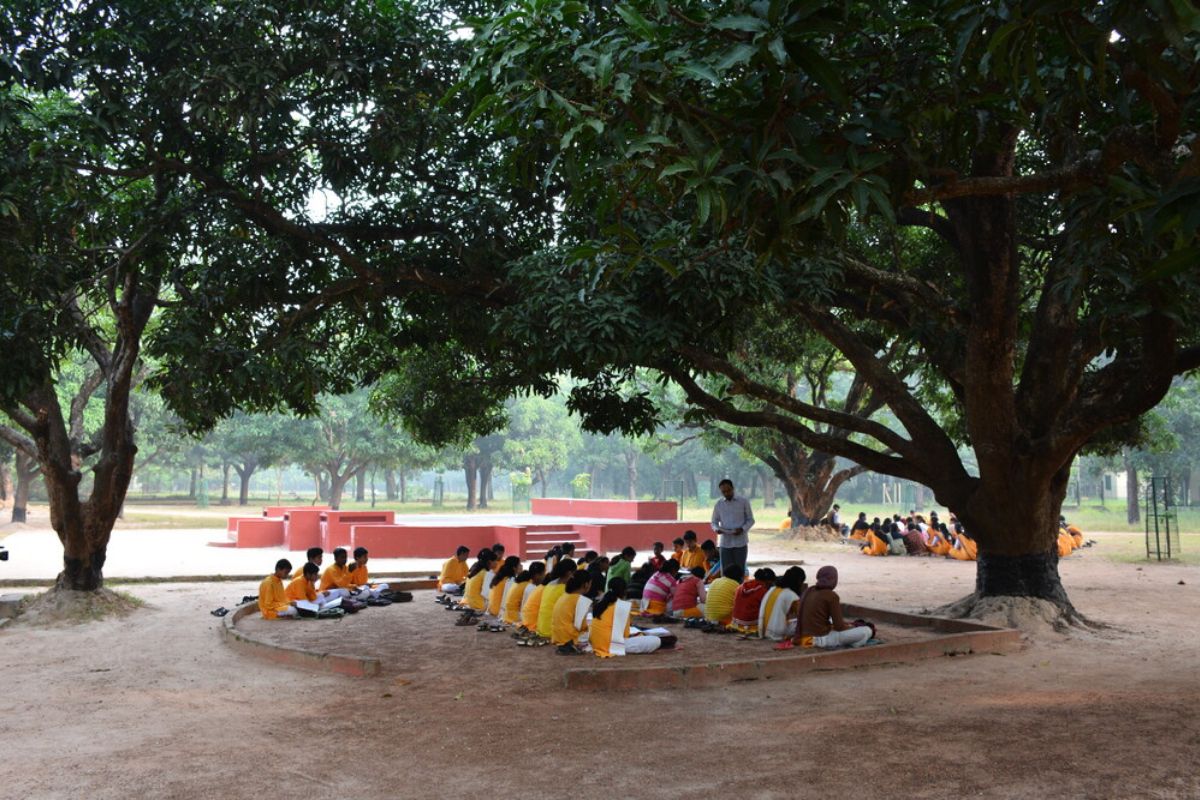
There is a university in rural Bengal where, for more than a century, students have sat beneath trees to study poetry, paint murals on mud walls, and learn music by listening to the wind. Rabindranath Tagore built it not as an act of nostalgia but as a quiet act of defiance. In September 2023, UNESCO inscribed Santiniketan on its World Heritage List, making it India’s 41st such site and the fifth in West Bengal. The recognition was long overdue.
A School Born from Protest
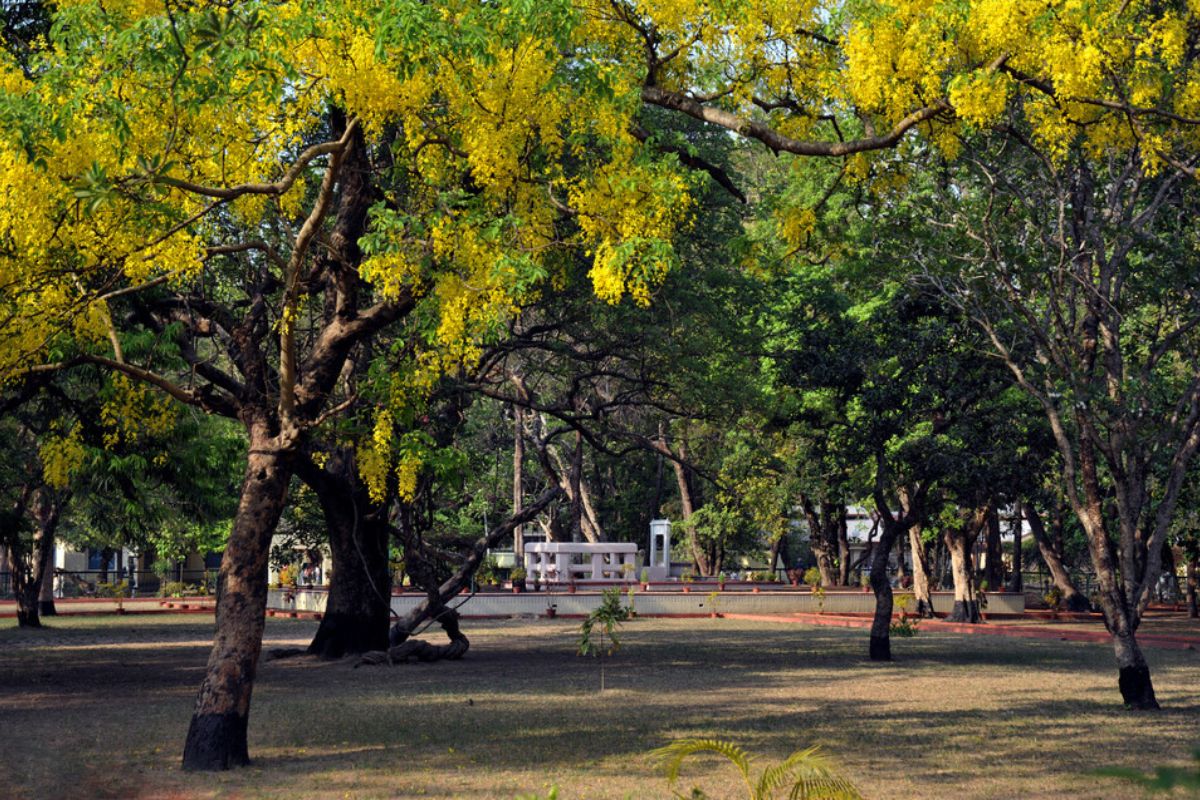
Tagore established Santiniketan in 1901 in Birbhum district, a stretch of laterite soil and open sky far from the colonial administrative centres of Calcutta. He had watched colonial education hollow out the Indian mind, training clerks and functionaries while the country’s own traditions of learning went unacknowledged. His answer was not a manifesto but a school.
He called it an ashram in the old sense: a place of living and learning together. Classes were held outdoors. The curriculum drew from Sanskrit, Bengali literature, philosophy, music, and art, but Tagore was not a revivalist. He looked outward as readily as inward, bringing Persian, Japanese, Chinese, Balinese, and Burmese influences into a place that was unmistakably Indian in its rhythms and spirit.
This was the paradox Tagore maintained all his life. He wanted Santiniketan to be rooted and cosmopolitan at the same time, a place where ancient Vedic custom and modern artistic experiment could share the same afternoon.
What UNESCO Recognised
The inscription was granted under two criteria. The first acknowledged Santiniketan as an exceptional experimental community where education, communal life, art, and work were not separated but treated as a single continuous activity. The second recognised its direct association with Tagore’s thought and work, as well as its role as a catalyst for the artistic and intellectual awakening of colonial India.
That awakening touched politics as well as art. Mahatma Gandhi, Jawaharlal Nehru, and Indira Gandhi all spent time at Santiniketan. The campus did not produce politicians; it produced people who understood that culture and freedom were the same conversation.
The World Heritage property encompasses an ensemble of historic buildings, gardens, pavilions, artworks, landscapes, and the unbroken educational traditions that bind them. What UNESCO was recognising was not a ruin but a living institution.
The Buildings Themselves
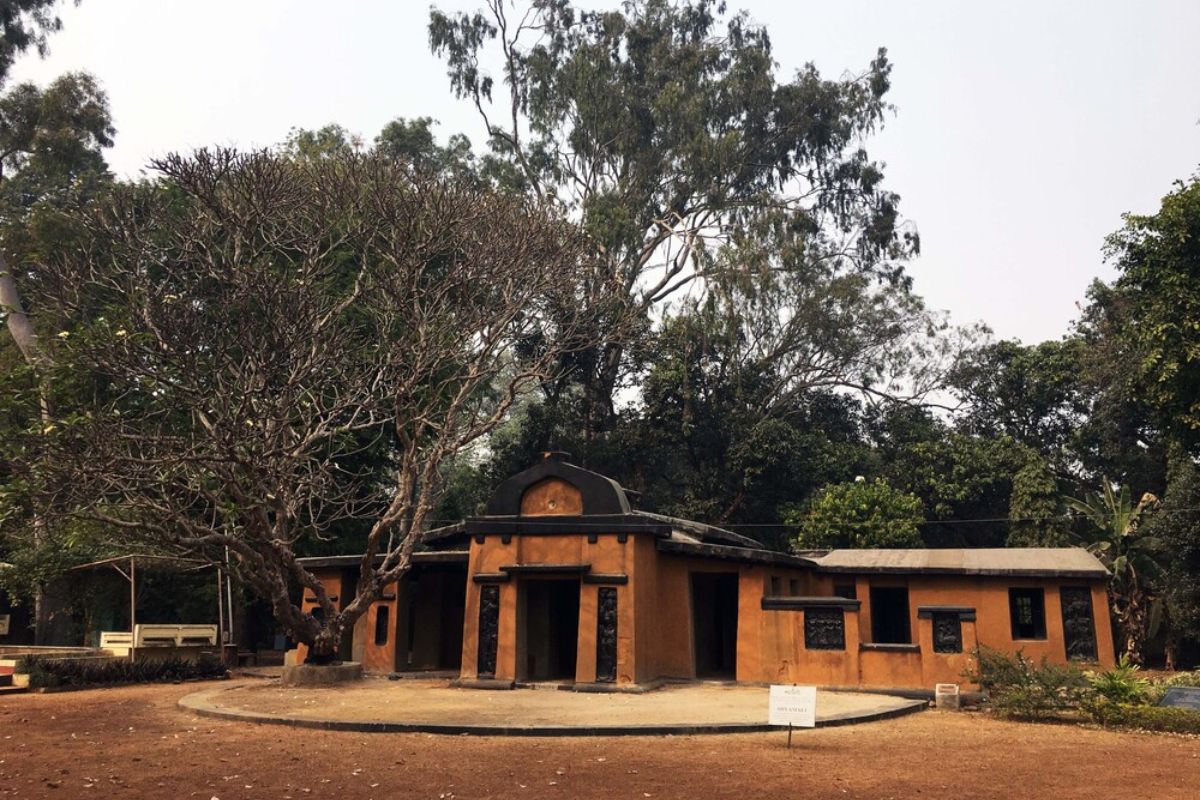
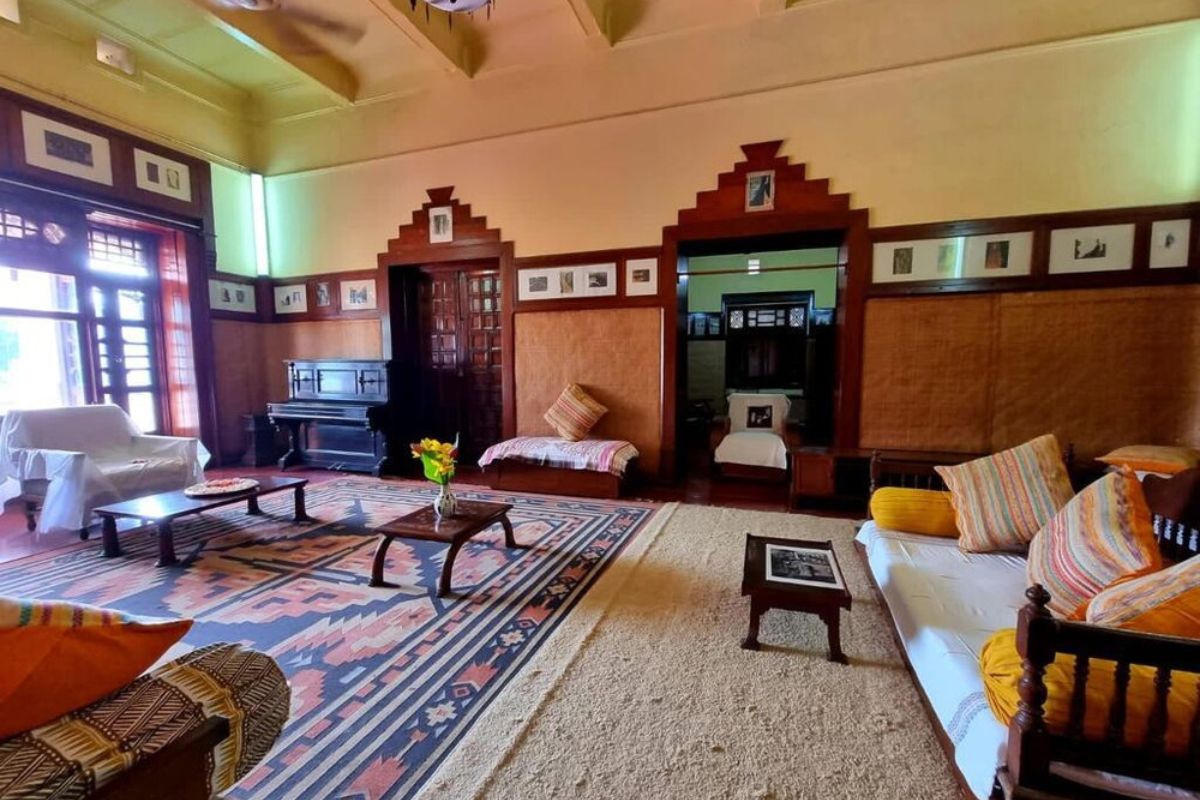
The architecture at Santiniketan is unlike anything else in India. Tagore and the artists and builders he gathered around him worked with brick, mud, coal tar, sandstone, glass, cast iron, thatch, timber, bamboo, laterite, and concrete, often within the same structure. Living trees were incorporated as structural and decorative elements. The result is not a single style but an accumulated sensibility, an ongoing argument in built form about what modernity might mean for a people who did not wish to abandon their past to reach it.
Among the key sites within the heritage boundary: Kala Bhavana, the fine arts institute, whose black facade carries elaborate white relief murals of stylised figures; Rabindra Bhavana Museum, which holds Tagore’s manuscripts, paintings, and personal effects; Chhatimtala, the meditation grove connected to the campus’s founding; the Udayan complex, where Tagore and his family lived; and Uttarayan, a cluster of buildings central to the educational life of the place.
Kala Bhavana: Where Indian Modern Art Was Made
Founded in 1919 and brought under Visva-Bharati University in 1921, Kala Bhavana is the institution within the institution. It opened the same year as the Bauhaus school in Weimar, and scholars have since placed the two in productive comparison, both treating the act of making as a form of knowledge, both insisting that art could not be separated from the community it served.
The comparison should not be pushed too far. Kala Bhavana was working in a different political and cultural condition. Tagore refused colonial government funding, drawing instead on his own resources, including the proceeds from his Nobel Prize and his book sales. He was building something that colonial modernity had not provided: a space where Indian artists could work from their own traditions rather than imitate European ones.
Three figures defined Kala Bhavana in its formative decades. Nandalal Bose, its first principal, developed a pedagogy that rejected the conventions of Western academic training in favour of methods drawn from the old gurukul tradition. He trained a generation of artists and contributed significantly to the visual language of the Indian nationalist movement. Benode Behari Mukherjee, who studied under Bose and later joined the faculty, developed his own distinctive practice that extended Tagore’s ideas into new territory. Ramkinkar Baij, also a former student turned teacher, worked in cement, pebbles, and concrete to create monumental sculptures that still stand across the campus, permanent presences in the landscape he had moved through as a young man.
The curriculum drew students into batik, alpona, pottery, weaving, and traditional crafts alongside the study of art history and studio practice. Art fairs brought students into contact with the surrounding community. The school argued that art was not the exclusive possession of urban professionals.
Among those who studied at Kala Bhavana: K.G. Subramanyan, recipient of the Padma Vibhushan; Jogen Chowdhury; Somnath Hore; and Satyajit Ray, who came as a student of art before he became one of the great directors of the twentieth century.
A Heritage That Has Not Stopped
What distinguishes Santiniketan from most World Heritage Sites is that it remains in active use. Visva-Bharati University, established as an institution of national importance by an act of Parliament in 1951, continues to operate on the campus. Open-air classes still take place. Traditional festivals, including Poush Mela and Basanta Utsav, mark the year. The decorations, the chanting, the blowing of conch shells at certain hours: these are not performances staged for visitors. They are what the place does.
UNESCO’s inscription described the heritage value as residing in both tangible and intangible attributes, in the buildings and artworks alongside the educational philosophies and cultural celebrations that animate them. The two cannot be separated, as Tagore argued a century ago.
The Question of Conservation
Recognition carries obligations. The property and its buffer zone fall under the Visva-Bharati Act of 1951, and conservation is overseen by the Visva-Bharati Heritage Committee. Among the management priorities identified at the time of inscription: developing individual conservation plans for specific heritage attributes, creating a comprehensive inventory of traditional practices, and ensuring no new construction within the property boundaries.
These are not easy commitments to honour in an institution that must also function as a modern university, balancing the demands of research, accommodation, and academic administration against the integrity of a built environment that was never designed to accommodate the pressures of the present. The tension is real and will not be resolved by goodwill alone.
What Tagore Actually Built
It is worth stepping back from the architecture and the accolades to ask what Santiniketan was actually for. Tagore believed that education divorced from nature, art, and communal life produced a particular kind of damage: people who were competent but not whole. He wanted something different, not a return to the past but an education that took the full range of human experience seriously.
Whether Santiniketan achieved that goal consistently is a question its own graduates have debated. What is not in dispute is that it produced artists, writers, educators, and thinkers of the first order, and that the physical environment Tagore and his collaborators built remains, more than a hundred years later, one of the most considered attempts in modern history to make a place for learning that is also a place for living well.
The UNESCO inscription does not settle that question. It opens it to the world.
Also Read:Padma Shri Bhiklya Ladkya Dhinda- The Man Who Kept a 400-Year-Old Sound Alive
You can connect with DNN24 on Facebook, Twitter, and Instagram and subscribe to our YouTube channel.