

When Obaidur Rahman passed away in Delhi in 2014, he left behind something unusual in Indian intellectual life. Here was a man with a PhD in Zoology, a career at a national research institution, and three published poetry collections that won literary awards. Most people pick either science or art.
manzilen aur bhi hain wahm-o-guman se aage
Obaidur Rahman
hum ko karna hai safar qaid-e-makan se aage
Rahman quietly insisted on both, and in doing so, showed thousands of Indians from small towns that you do not have to choose between your education and your mother tongue, between professional ambition and emotional expression, between the microscope and the metaphor.
Obaidur Rahman: Growing Up in Muzaffarpur
Born in 1961 in Muzaffarpur, Bihar, Rahman grew up in India, still finding its feet two decades after independence. His childhood unfolded among flooded rice fields, monsoon nights alive with insect sounds, and the everyday rhythms of a North Indian town where people discussed politics under neem trees and children watched dragonflies hover over ponds. There was nothing in his background to suggest privilege or connections. What his family had was respect for learning and the belief that education could transform lives.
hai aaj andhera har jaanib aur nur ki baaten karte hain
Obaidur Rahman
nazdik ki baaton se KHaif hum dur ki baaten karte hain
Rahman finished his M.Sc. in Zoology in 1982, then completed his PhD in 1989. These were years when government research positions still represented sacred opportunities for first-generation graduates from modest backgrounds. A doctorate from a small town felt like climbing a mountain.
tamir-o-taraqqi wale hain kahiye bhi to un ko kya kahiye
Obaidur Rahman
jo shish-mahal mein baiThe hue mazdur ki baaten karte hain
It meant long hours in libraries, careful observation in laboratories, and the discipline to see projects through when nobody was watching. Rahman had that discipline. More importantly, he had curiosity that moved in two directions at once, toward the measurable patterns of nature and toward the emotional rhythms of human life captured in poetry.
Obaidur Rahman:The Science Career
After earning his doctorate, Rahman joined the Indian Council of Agricultural Research as a science editor. The position was unusual for someone with his training. Instead of conducting experiments or supervising field trials, he spent his days working with language. Scientists would submit research papers dense with technical vocabulary, data tables, and specialised knowledge of crops, pests, soil chemistry, and farming technologies.
kahani kuchh bhi nahin thi bayan ziyaada tha
Obaidur Rahman
zara si aag lagi thi dhuan ziyaada tha
Rahman’s job was to turn these papers into documents that extension workers, government officers and even educated farmers could actually read and use.It was translation work of a particular kind. The science itself could not be simplified, but the language around it could be made more transparent, more direct, more connected to the real concerns of people working in agriculture. Rahman discovered he was good at this.
pur-kaif kahin ke bhi nazare na rahenge
Obaidur Rahman
duniya mein agar ishq ke mare na rahenge
His scientific training enabled him to understand what the researchers were actually saying. His feeling for language meant he could find the right words to carry that meaning across to different audiences. In a country where agricultural research often stays trapped in academic journals, making no difference to the people it is supposed to help, Rahman’s editing work was genuinely valuable.
duniya-e-mohabbat mein charaghan na milega
Obaidur Rahman
palkon pe agar ashk hamare na rahenge
Later, he took on another role as Regional Director at the Patna Regional Centre of Maulana Azad National Urdu University. Here, his mission expanded beyond agricultural science. He worked to connect Urdu-medium students with higher education opportunities, distance-learning programmes, and the wider academic world. Many of these students came from backgrounds similar to his own.
tum chhoD ke mat jao mujhe shahr-e-bala mein
Obaidur Rahman
warna mere jine ke sahaare na rahenge
They were bright and motivated, but they worried that their language and their small-town origins would limit them. Rahman’s own career path offered them proof that these things need not be barriers. A boy from Muzaffarpur had become a national-level knowledge worker without abandoning his linguistic roots or cultural identity. If he could do it, they could too.
Obaidur Rahman’s Poetry Collections
While building his scientific career, Rahman was writing poetry. In 2001, he published his first collection, “Aawaaz Ke Saaye,” which means “Shadows of Sound.” The title itself works like a small poem, suggesting that every spoken word leaves behind an emotional echo, a shadow made not of light but of meaning. The book won awards from the Urdu Academies of Delhi and Uttar Pradesh, and from Sahitya Sansad in Patna. These were serious literary recognitions from judges who spent their lives reading poetry and knew craftsmanship when they saw it.
masale mere sabhi hal kar de
Obaidur Rahman
warna yarab mujhe pagal kar de
Rahman’s poems were not experimental or deliberately challenging. They spoke about everyday feelings, social concerns and the small observations that most people notice but rarely put into words. There was a traditional form in his work, the kind that comes from reading the old masters and understanding meter, rhyme and structure. But there was also a voice that felt contemporary and genuine, addressing the concerns of people living in modern India while drawing on a rich history.
nikharna aql-o-KHirad ka agar zaruri hai
Obaidur Rahman
junun ki rahbari mein safar zaruri hai
In 2007 came “Soch Aabshaar,” or “Waterfall of Thought.” The title suited someone trained in scientific observation. Just as a researcher studies a problem from multiple angles, Rahman’s poems often took a single image or feeling and explored it until deeper meanings emerged. The collection strengthened his reputation. People began noticing this unusual figure who could discuss agricultural research in the afternoon and recite moving couplets in the evening.
ek muddat se jo sine mein basa hai kya hai
Obaidur Rahman
karb-e-ehsas hai ya karb-e-ana hai kya hai
Then in 2010, Rahman published “Ek Nao Kaaghazi” in Devanagari script. This was a deliberate choice with quite political implications. Urdu and Hindi share much of their spoken vocabulary, but they use different scripts and carry different cultural associations. By publishing in Devanagari, Rahman was arguing that poetry should not be trapped behind script barriers. If readers could understand the words when spoken aloud, they should be able to read them regardless of the alphabet. The move expanded his audience and made a statement about linguistic openness in a region often divided along script and communal lines.
Obaidur Rahman: Making Science Accessible in Urdu
Rahman’s most distinctive contribution came through his science writing in Urdu. In 2003, he published “Kuchh Science Se,” followed in 2007 by “Science Sab Ke Liye.” Both books tackled a problem rarely discussed in urban, English-educated circles. How do you explain scientific concepts to people whose entire education happened in Urdu? How do you discuss atoms, health, environment and technology in a language primarily associated with poetry and religious discourse?
justuju ke safar mein rahte hain
Obaidur Rahman
hum ki paiham KHabar mein rahte hain
Rahman simply did it. He wrote about science in natural, flowing Urdu, avoiding jargon where possible, explaining technical terms when necessary, and structuring his chapters like stories rather than textbook lessons. The books proved that scientific thinking can live comfortably in any language, as long as the writer cares enough to make the translation work. “Kuchh Science Se” won recognition from the Bihar Urdu Academy. “Science Sab Ke Liye” was honoured by the Delhi Urdu Academy.
ghar ke andar bholi-bhaali suraten achchhi lagin
Obaidur Rahman
muskuraati gul khilati raunaqen achchhi lagin
The real achievement was reaching readers previously excluded from scientific knowledge. Students in Urdu-medium schools, parents helping children with homework, madrasa teachers curious about nature, elderly readers with time and interest but no English. For all these people, Rahman’s books opened windows onto a larger world of ideas and information.
What He Left Behind
Rahman died in 2014 after more than a year of illness. He was 53. His work remains relevant, perhaps more so now than during his lifetime. Current debates about language, education and access in India keep circling back to questions Rahman addressed through his life choices. Can you succeed in national institutions while working primarily in an Indian language? Can the same mind produce both rigorous science and moving art? Can someone from a modest background in a small town contribute meaningfully to national intellectual life?
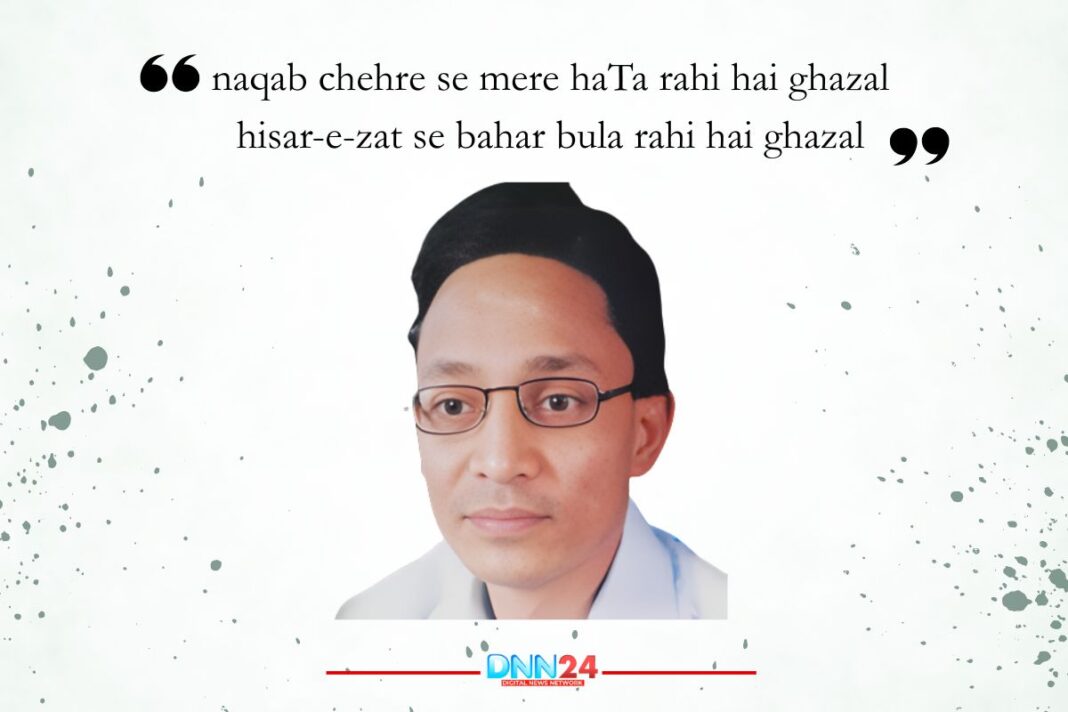
naqab chehre se mere haTa rahi hai ghazal
Obaidur Rahman
hisar-e-zat se bahar bula rahi hai ghazal
Rahman’s career answers yes to all these questions. He earned a doctorate, worked in prestigious institutions, published in multiple fields, and did it all without pretending to be someone he was not. For young people from non-metropolitan backgrounds, especially those educated in regional languages, his example says you do not have to abandon your identity to participate in national life. You can be both local and cosmopolitan, both rooted and mobile, both traditional and modern.
KHushbu tere lahje ki mere fan mein basi hai
Obaidur Rahman
ash’ar hain mere teri aawaz ke sae
His Urdu science books remain available, though not widely known. His poetry collections have found new readers through digital platforms. In an era when regional languages are finally being taken seriously in education policy and when translation is recognised as crucial intellectual work, Rahman’s life points toward possibilities that mainstream narratives often miss. He did not become famous or win national honours.
tasawwur mein mere aise koi chehra nikalta hai
Obaidur Rahman
ki sukhi shaKH par jaise hara patta nikalta hai
What he did was live a coherent, purposeful life that refused false choices. He proved that knowledge can travel in many languages, that beauty can coexist with rigour, and that a person from Muzaffarpur can contribute to national life without becoming someone else. That quiet message matters deeply in a country still learning how to honour both its diversity and its ambitions.
Also Read: Aazam Khursheed : The Poet Who Made Faces Speak & Still Matters
You can connect with DNN24 on Facebook, Twitter, and Instagram and subscribe to our YouTube channel.