
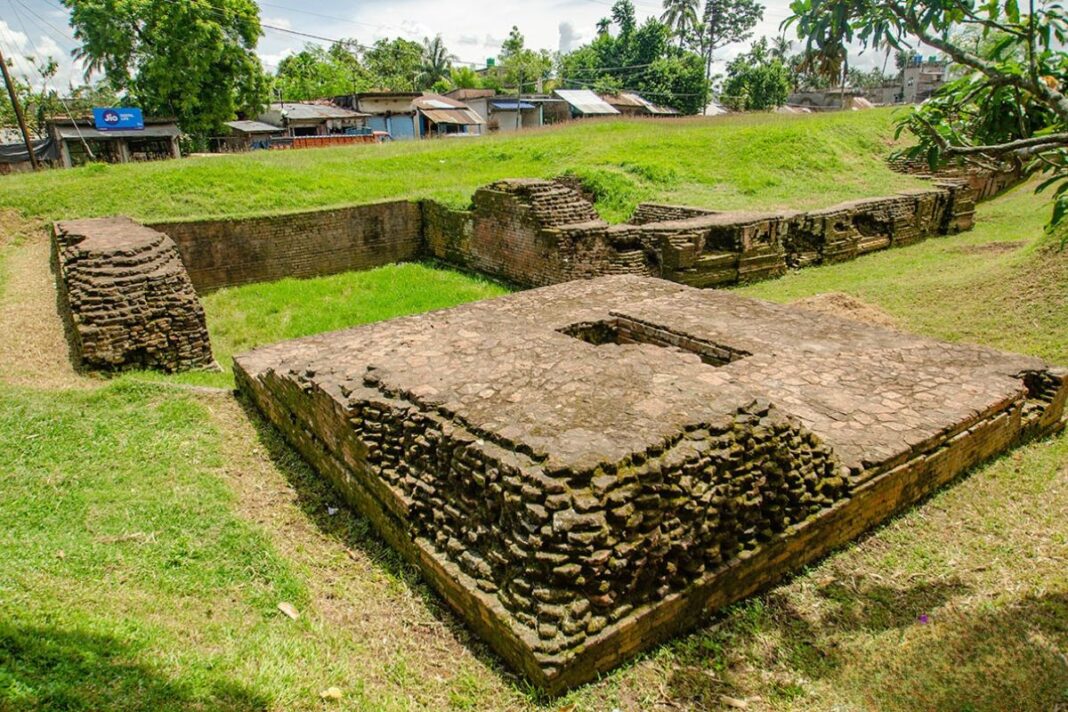

The Ganges Delta holds a secret that makes the Indus Valley blush with envy. While textbooks drone about Harappa and Mohenjo-daro, a terracotta empire flourished right under our noses in West Bengal, its traders shaking hands with Romans while Greek sailors mapped its ports. Chandraketugarh, sprawling across North 24 Parganas for nearly two millennia, remains the archaeological scandal nobody talks about. This is the story of how Bengal built a commercial titan that modern India conveniently buried under paddy fields and forgetfulness.

When Rivers Carved Empires
Around 600 BCE, the Bidyadhari River carved a path to the Bay of Bengal, and someone smart realised this was prime real estate. The early settlers of Chandraketugarh understood geography better than any modern city planner. They raised fortifications with ramparts and moats that could make contemporary engineers weep with admiration. These were not primitive villagers scratching at dirt. Archaeological layers reveal Northern Black Polished Ware pottery, the kind of glossy ceramics that screamed sophistication across ancient India.

The Mauryan period, around 300 BCE, brought iron discipline to this delta settlement. Brahmi inscriptions on pottery fragments tell us merchants kept meticulous records. Kharoshthi script connections point to trade networks stretching toward Kushan territories in the northwest. Greek historian Megasthenes wrote about the Gangaridai, describing their formidable elephant armies that supposedly deterred Alexander the Great. Modern researchers now suspect Chandraketugarh was this very fortress city, possibly the stronghold of King Chandraketu himself.
The Shunga period, from 185 BCE, added new dimensions. Terracotta figurines from this era show couples in intimate poses, women wearing elaborate hip ornaments, and men sporting turbans with the confidence of prosperous traders. These were not abstract religious symbols but snapshots of actual people living actual lives along the riverbank. Excavations have uncovered punch-marked silver coins, semi-precious stone beads, and ivory combs that speak of vanity and wealth.

The Gupta golden age, between 300 and 500 CE, pushed the settlement to its zenith, with temple foundations and gold coins appearing in stratified layers. By the Pala-Sena period, ending around 1250 CE, silt and changing river courses began their slow burial. Yet every artefact whispers the same truth: this was no backwater village but a beating commercial heart.
The Terracotta Testament
Museums across the world hoard 678 documented terracotta plaques from Chandraketugarh, and each one deserves its own biography. The craftsmanship rivals anything produced in contemporary Mathura or Kaushambi. Take the 1st century BCE Yakshi figures: voluptuous, adorned with multiple necklaces and bangles, utterly unashamed of their sensuality. These were not created for temple walls but for ordinary homes, suggesting a culture comfortable with celebrating human desire.

Family scenes appear frequently. One plaque shows a turbaned father in a meticulously detailed dhoti, holding a child while animals frolic nearby. Another depicts ships with masts bearing Sinhapura seals, connecting this Bengal port to Sri Lankan King Vijayasinha’s dynasty. The artisans clearly interacted with Roman traders, as several terracotta heads wear laurel wreaths in the classical Mediterranean style. This was not imitation but confident adaptation, proving the craftsmen understood global aesthetics.
The Kushan period, around 50 CE, produced the finest pieces. Toys for children appear: miniature carts, rattles, and figurines. Ivory bangles and bone tools survived despite organic materials typically decaying in delta conditions. Religious evolution emerges through these objects. Yakshi figures eventually influenced tantric traditions, suggesting local folk beliefs gradually merged with mainstream Hindu practices.

Gupta-era coins bearing images of Chandragupta and Kumardevi indicate royal patronage, or at least official recognition. Musicians, dancers, and lovers are depicted on the plaques from this period. The precision is remarkable considering these were mass-produced items, not royal commissions. Touch one of these terracottas today, and the clay still feels warm, as though the fire that baked it centuries ago never quite cooled. These are not museum pieces but frozen conversations between artist and buyer, intimate records of a culture that valued beauty in everyday objects.
Elephants, Coins, and Foreign Shores
Chandraketugarh was not built for contemplation but for commerce. The archaeological evidence screams international port city. Roman rouletted ware appears in multiple excavation layers. Silver coins stamped with dolphin motifs reference maritime trade. Beads manufactured from semi-precious stones match styles found in Mediterranean markets. The Gangaridai confederation, mentioned by Greek sources, controlled territory from Anga to Kalinga, with war elephants serving as both military deterrent and commercial asset.

The Shunga and Kushan periods, between 185 BCE and 300 CE, mark the peak of commercial activity. Brahmi inscriptions on pottery shards record transaction details. Merchants stored goods in warehouses protected by those ancient fortifications. The Gupta period brought gold coins into circulation, evidence of a monetised economy integrated with larger Indian trade networks. Wari-Bateshwar in modern Bangladesh served as a sister city, suggesting coordinated urban planning across the delta.
Ptolemy’s geography mentions Gange, which scholars now identify as Chandraketugarh. The urban sprawl covered approximately 3 square kilometres, encompassing villages such as Berachampa and Deulia, which specialised in craft production. Inscriptions reference distances in yojanas, connecting Bengal ports to southern Indian trade routes. This was not accidental prosperity but systematic economic development.

Post-Gupta decline came gradually. The Pala period, after 500 CE, shows reduced activity, though temple complexes continued to be built at sites like Khana Mihrer Dhibi. Changing river courses and repeated flooding eventually made the port inaccessible. But for over a millennium, this delta fortress functioned as Bengal’s window to the world. Silver, ivory, spices, and ideas flowed through its markets. Standing at the excavation sites today, the wind carries sounds that might be memory or might be imagination: coins clinking, merchants arguing prices, elephant handlers calling their charges to the docks.
Where Myth Meets Mud
Local legends wrap Chandraketugarh in supernatural drama. Medieval sources describe battles between the Hindu King Chandraketu and the Muslim saint Pir Gorachand. The mosque of Syed Abbas Ali sits near the central mound, a testament to Islamic influences that arrived centuries after the city’s commercial decline. These stories reflect the layered history of Bengal, where religious traditions blended rather than replaced each other.

Khana, the astrologer, adds another dimension to the mythology. Local tradition identifies her as the daughter-in-law of Varahamihira, the famous mathematician and astronomer at the Gupta court. Stories claim her father-in-law silenced her because her predictions proved more accurate than his. The Khana-Mihir mound preserves her name, connecting celestial science to earthbound clay. Whether historically accurate or not, the legend reveals how communities remember their intellectual heritage.
Archaeological rediscovery began slowly. The Archaeological Survey of India noted the site in 1907, but AH Longhurst dismissed it as uninteresting. Rakhal Das Banerji, fresh from excavations at Harappa, revived interest in the 1920s. Ashutosh Museum conducted systematic excavations between 1957 and 1968, revealing six distinct cultural periods. Recent IIT Kharagpur research supports the identification with ancient Gangaridai, suggesting this was indeed the fortress that intimidated Alexander’s army.

Illegal excavation and smuggling have severely damaged the site. Private collections hold artefacts that should be in public museums. The Dilip Moitey museum houses locally recovered objects, but proper conservation requires government resources. The mounds today look peaceful, covered in paddy fields and scattered settlements. Yet beneath the green surface, centuries of human ambition wait in stratified silence. Walk these fields at dawn, and the mist seems to carry voices, as though Khana herself might emerge to predict futures nobody wants to hear.
Chandraketugarh Museum Holds Bengal’s 2,500-Year Secret
Just 35 kilometres from Kolkata, a modest museum guards one of Bengal’s oldest mysteries. Chandraketugarh Museum may appear small and unassuming, yet within its walls lives the pulse of an ancient port city that thrived 2,000 to 2,500 years ago, connecting distant civilisations long before the Guptas ruled India.
Walk through the museum doors, and dozens of terracotta figures meet your gaze. Delicate female forms, children’s toys, ornate plaques and everyday pottery fill the display cases. These objects belonged to the people of Gangaridai, that legendary kingdom Greek historians wrote about with wonder. Large storage jars, punch-marked coins, seals bearing ship motifs and inscriptions in ancient Brahmi script reveal this was no quiet village but a bustling trading centre with links across the subcontinent and beyond.

Archaeological evidence shows that Chandraketugarh flourished from the 3rd century BCE through successive dynasties, including the Shunga, Kushana, Gupta, and Pala periods. The settlement once had defensive walls, a protective moat and proper gateways. Skilled artisans produced terracotta sculptures while merchants conducted trade using standardised currency, building a cosmopolitan culture that slowly shaped Bengal’s religious and artistic traditions.
Keeper of Lost Stories
Over the decades, many exceptional pieces from this site travelled to larger Indian and foreign museums or vanished into private collections. The local Chandraketugarh Sangrahalaya, lovingly maintained by dedicated individuals such as Dilip Mait, preserves what remains. This museum serves as the faithful guardian, keeping statues, ritual objects, and trade goods where they belong, anchored to their original homes.

Today, as plans develop for expanded facilities and continued excavation, Chandraketugarh Museum offers something rare: a chance to witness Bengal’s ancient maritime identity, built by traders, potters and sailors whose creative spirit still whispers from clay and stone.
The Excavation That Never Finished
As of 2025, Chandraketugarh remains criminally under-researched. The Archaeological Survey of India designated it a nationally protected monument (site number N-WB-1), but protection on paper means little without active conservation. Excavations in 2014 opened trenches that remain incompletely documented. TMC politician Kakoli Ghosh Dastidar raised the issue in Parliament, prompting Chief Minister Mamata Banerjee to announce a site museum in 2017. Progress remains sluggish.

The logistics are straightforward. Chandraketugarh lies just 35 kilometres from Kolkata. Buses from the Ultadanga bus depot reach Berachampa village regularly. Haroa Road railway station provides another access point. The Ashutosh Museum at Calcutta University houses significant collections that could serve as the nucleus of a site museum. Private donors have expressed a willingness to contribute artefacts if proper facilities were available.
West Bengal Tourism has identified the site for the development of a heritage circuit. UNESCO recognition remains possible if systematic excavation resumes and documentation meets international standards. Recent IIT studies confirming Gangaridai connections provide the scholarly foundation for such recognition. The site offers immense potential for educational tourism, blending archaeological significance with an accessible location.

The urgency is real. Climate change is increasing the severity of flooding in the delta region. Each monsoon damages unexcavated deposits. Encroachment by modern construction threatens peripheral areas. Smuggling continues despite legal protections. This is not just Bengal’s loss but India’s loss. While Indus Valley sites receive lavish attention and funding, an equally significant urban civilisation slowly dissolves into monsoon mud.
The Chandraketugarh story deserves better than academic footnotes and dusty museum labels. This was where Bengal announced itself to the ancient world, where craftsmen created beauty for daily use, where merchants gambled fortunes on monsoon winds. The terracottas still smile from museum cases, waiting for someone to finally hear what they have been saying all along.
Also Read: Eklakhi Mausoleum: Pandua’s One Lakh Rupee Royal Secret
You can connect with DNN24 on Facebook, Twitter, and Instagram and subscribe to our YouTube channel.