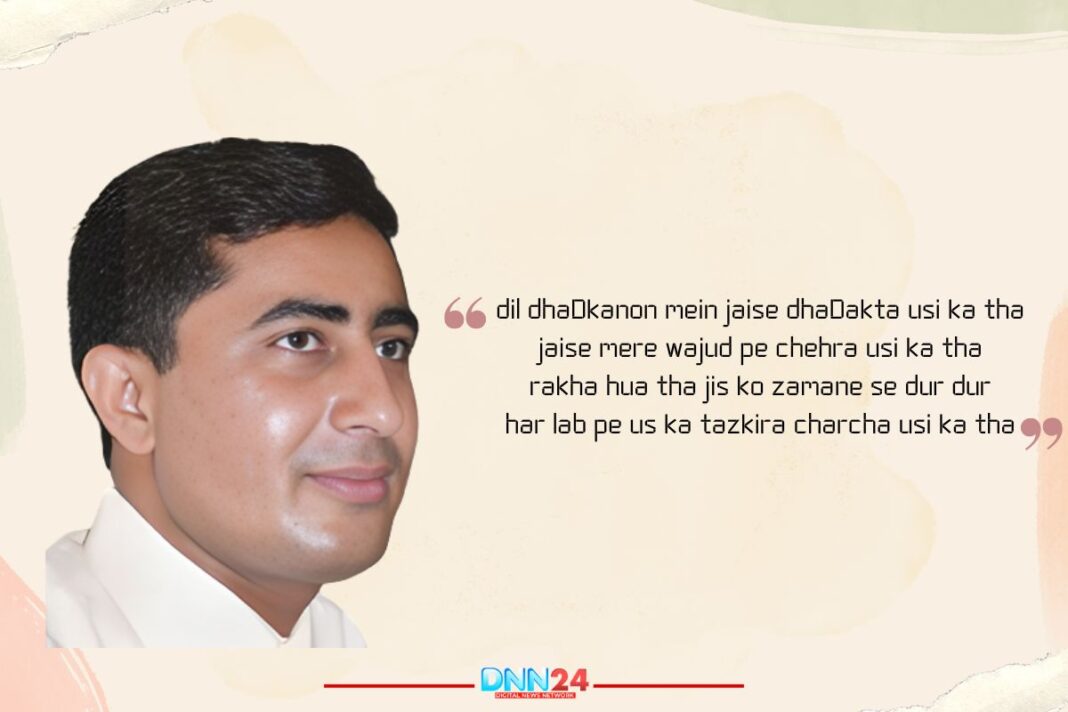

In a world where languages slip away quietly, Nabeel Ahmad Nabeel writes poetry that lands on smartphone screens at midnight and speaks to readers who have never met him. Born in 1982 in Lahore, he belongs to a generation that opened its eyes after General Zia’s years, when television, cassettes and globalisation were entering Pakistani homes, but evening azan and tea stall culture still thrived.
aisi uljhan ho kabhi aisi bhi ruswai ho
Nabeel Ahmad Nabeel
dil ke har zaKHm mein dariyaon ki gahrai ho
His name appears on Urdu poetry websites, in academic journals and at mushairas, proving that Urdu remains a living river where young writers still swim with courage. This is not about a famous poet everyone recognises. This is about someone who chose the difficult path between feeling and thinking, between mohalla tradition and digital platforms, showing that Urdu has not yet become a museum language.
Growing Up in Lahore’s Word-Soaked Streets
Lahore gave Nabeel Ahmad Nabeel his first education before any classroom did. The city during the 1980s and 1990s held onto its Urdu heartbeat even as satellite dishes appeared on rooftops. Walk through Urdu Bazaar, and you would find street libraries selling second-hand poetry collections, old men on charpais debating whether Ghalib understood love better than Mir, and walls covered with mushaira announcements at Alhamra Arts Council.
jalan ke KHauf se bahar nikal sako to chalo
Nabeel Ahmad Nabeel
bichhi hai dhup hi raston mein chal sako to chalo
This atmosphere became a natural classroom where young Nabeel learned that poetry lived in arguments, got printed on cheap paper, and was recited over evening chai. Growing up here meant absorbing wounds, too. Lahore, after Partition, carried migration stories in every household, whispered by grandparents who remembered violence and displacement. The city showed him the gap between Defence Housing Authority residents and those in narrow inner lanes, the frustration of power cuts during exams, and the political tension on television news.
teri talash teri tamanna to main bhi hun
Nabeel Ahmad Nabeel
jaisa tera KHayal hai waisa to main bhi hun
These images entered his childhood mind and later found their way into his poetry as metaphors for separation, broken promises, and stubborn survival. For Nabeel Ahmad Nabeel, growing up meant experiencing both personal memory and the collective memory of a city trying to preserve its culture while everything changed faster than anyone wanted.
Walking the Double Path of Poet and Scholar
Most Urdu poets stay content writing verses and attending mushairas where audiences snap fingers in appreciation. Nabeel Ahmad Nabeel took a different route. He decided not just to feel poetry but to understand how it works, study its history, and analyse why specific images move readers across generations. His detailed research on Rajinder Manchanda Bani, another Urdu poet, clearly shows this dual nature.
jo naqsh miT chuka hai banana to hai nahin
Nabeel Ahmad Nabeel
ujDa dayar hum ne basana to hai nahin
In that scholarly article, he examines how Bani brought intellectual depth to ghazals, how his work carried emotional weight alongside philosophical questions, and how his voice remained distinct while working within classical forms. This kind of writing usually comes from established professors, not younger poets still building reputations. But Nabeel Ahmad Nabeel belongs to a generation refusing to see theory and feeling as enemies.
teri talash teri tamanna to main bhi hun
Nabeel Ahmad Nabeel
jaisa tera KHayal hai waisa to main bhi hun
He reads academic papers, writes critical essays, publishes in journals, and then also creates ghazals that people share during lonely nights. This double role makes him valuable in ways pure poets or pure scholars cannot be. Students encounter his name while researching Urdu literature and then discover that he writes lines that speak directly to their confusion about love and identity. His work bridges the seminar room and the poetry platform, analysis and emotion, knowing why something works, and simply letting it work on your heart.
Poetry Living in Digital Pockets
The internet changed how poetry travels, and Nabeel Ahmad Nabeel understood this shift early. His work appears on websites dedicated to Urdu collections, gets quoted in blog posts, and travels through social media as screenshot couplets. Young people in Karachi, Delhi, Dubai and London encounter his verses not in printed books but as forwarded messages from friends going through difficult times. A student in Lucknow copies his lines into a diary after a friendship breaks.
jo naqsh miT chuka hai banana to hai nahin
Nabeel Ahmad Nabeel
ujDa dayar hum ne basana to hai nahin
Someone in Toronto stumbles upon his nazm while searching for Urdu content online and suddenly remembers the language their grandfather spoke. This digital presence means his poetry lives in pockets, literally. Smartphones, which usually distract people, become carriers of his words, turning into small moving libraries where classical meters meet modern anxiety. The reach extends beyond what any physical mushaira could achieve.
chaaron jaanib pagal-KHane lagte hain
Nabeel Ahmad Nabeel
mausam aise hosh uDane lagte hain
Where earlier poets depended on radio broadcasts or printed magazines with limited circulation, the verses of Nabeel Ahmad Nabeel slip into WhatsApp statuses, Instagram stories and YouTube recitation videos. This happens organically, without marketing campaigns. Readers find his work, feel something shift inside them, and pass it along. Urdu poetry continues its old tradition of oral sharing, but now through fibre-optic cables rather than evening gatherings.
Themes Running Through His Work
Reading Nabeel Ahmad Nabeel’s poetry, specific themes recur. Separation sits heavily in many poems, not just the romantic kind, but the distance between who you are and who you want to be, between your generation and the previous one, between the promises Pakistan made and the reality people live. Love appears, too, but complicated love, carrying doubt within sweetness, questioning whether connection is possible when everyone feels isolated despite being surrounded by people.
sar jhuka kar shah ke darbar mein
Nabeel Ahmad Nabeel
chhed hum ne sau kiye dastar mein
Identity becomes another thread, especially relevant for someone born in 1982 who watched Pakistan shift from Zia’s martial law to Musharraf’s government, and then to the democratic complications that followed. His poetry does not spell out political opinions directly, but you feel the weight of living where electricity fails during summer heat, where young people wonder whether to stay or migrate, where economic stress enters homes and changes families.
tum ne kiya hai tum ne ishaara bahut ghalat
Nabeel Ahmad Nabeel
dariya bahut durust kinara bahut ghalat
What makes his style effective is the use of simple, everyday Urdu that anyone can understand on first reading, yet beneath that simplicity lie questions about time, memory, honesty and the gap between hope and disappointment. He follows the old tradition where a single image carries multiple meanings. An empty street might be about a lover who left but also about a neighbourhood that changed, about a childhood that cannot return, about safety that disappeared. This layered approach means different readers find different things in the same couplet depending on what they bring to it.
Respecting the Literary Chain
The serious engagement Nabeel Ahmad Nabeel shows with earlier Urdu poets reveals that he understands that writing does not happen in isolation. His research on Rajinder Manchanda Bani demonstrates respect for the long chain that stretches from Mir Taqi Mir and Ghalib through Iqbal and Faiz to modernists and the experimental voices of recent decades. By studying Bani’s intellectual diversity, by analysing how that poet balanced thought and feeling, Nabeel Ahmad Nabeel positions himself within an ongoing conversation.
hare hain zaKHm kuchh is tarah bhi mere sar ke
Nabeel Ahmad Nabeel
tamam ‘umr uThae hain naz patthar ke
He accepts that any new poet responds to, argues with and builds upon what hundreds of writers did before. His critical essays help younger readers see Urdu not as a dead language preserved in textbooks but as a living argument in which ideas about love, faith, politics, and society are constantly discussed and reworked. Through scholarly work, he performs a service beyond his own poetry. He keeps the memory of lesser-known but essential poets alive, prevents their work from disappearing, and shows students that Urdu literature is more diverse than the few big names everyone knows.
Why Nabeel Ahmad Nabeel Matters Today
In today’s South Asia, Urdu finds itself in a strange position. India and Pakistan use it as a symbol in identity battles, yet the language remains an emotional home shared across borders that politics cannot fully divide. Writers like Nabeel Ahmad Nabeel quietly strengthen that shared home, without grand statements about unity or heritage. His poetry, rooted in Lahore’s specific landscape, is easily understood by readers in Delhi, Lucknow and Hyderabad, proving that pain, love, loyalty and loneliness travel freely even when people cannot.
hum ko ye Dar hai ki imkan kisi aur ka hai
Nabeel Ahmad Nabeel
yani wo shaKHs nigahban kisi aur ka hai
The feelings he writes about do not ask for passports or religious certificates. His academic work on poets like Bani, who came from a non-Muslim background yet contributed profoundly to Urdu, quietly underlines that the language belongs to all who love it. This becomes important in current conversations about inclusion, pluralism and who has the right to claim which cultural tradition. For young writers trying to find their voice, his journey offers encouragement without being preachy.
sau uljhanon ke beach guzara gaya mujhe
Nabeel Ahmad Nabeel
jab bhi teri talab mein sanwara gaya mujhe
You can live in the digital chaos of the 21st century, study your literary ancestors seriously, engage with theory and history, and still carve an honest space for original work. Nabeel Ahmad Nabeel proves through his own practice that tradition and modernity, feeling and thinking, accessibility and depth need not be enemies. The language he inherited from Mir and Ghalib adapts to smartphone screens without losing its power to move hearts.
Also Read: Aazam Khursheed : The Poet Who Made Faces Speak & Still Matters
You can connect with DNN24 on Facebook, Twitter, and Instagram and subscribe to our YouTube channel.