

Delhi is not just a city, but a living story that has been pulsating for centuries. It is a city that has witnessed the pain of destruction many times and has learned to rebuild itself anew each time. The echoes of history resonate in its streets, its air, and its soil. Amidst the crowds, traffic, and noise, some buildings still stand silently in Delhi today, narrating the stories of their time. Every stone holds a tale of the past. One such historical place is Khair-ul-Manazil.
Khair-ul-Manazil: A Glimpse into the Mughal Era
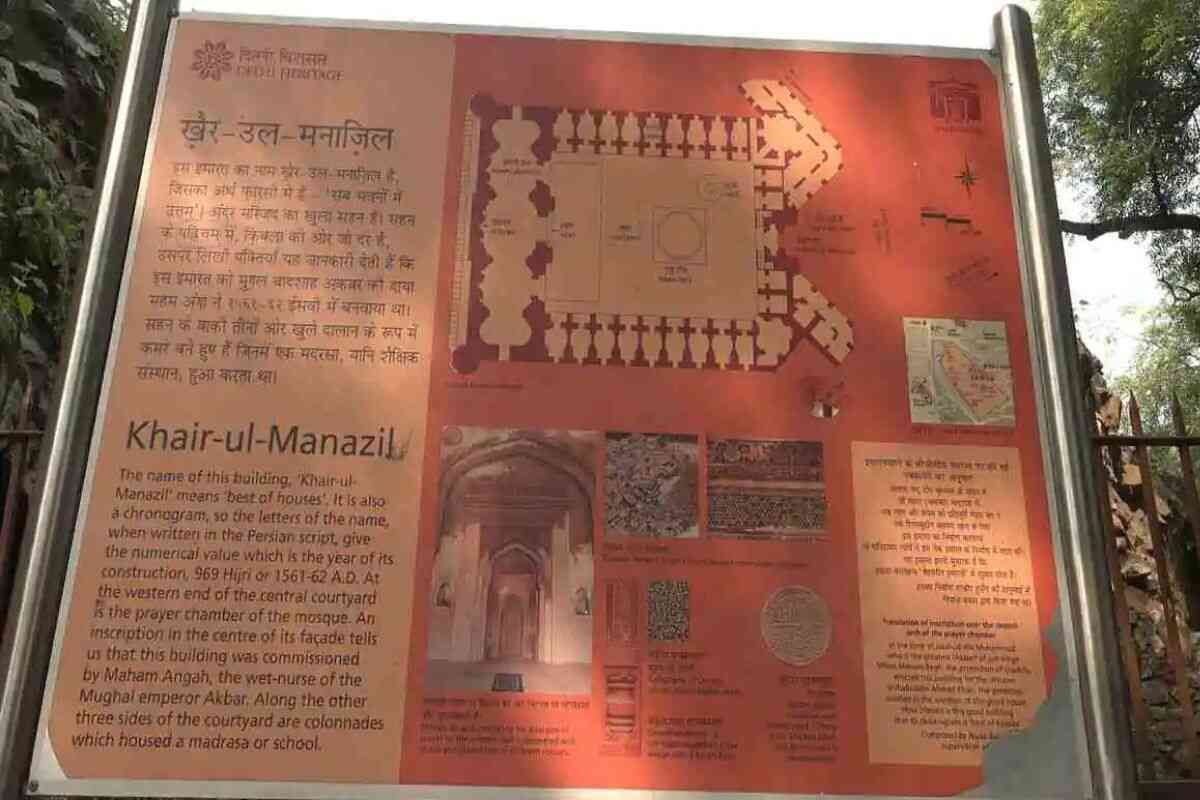
Khair-ul-Manazil still stands opposite Purana Qila (Old Fort) in Delhi. Upon arriving there, one feels as if time has stopped, and you are transported to the Mughal period. Khair-ul-Manazil is not just a building, but a story of Delhi’s rich heritage and history that unfolded centuries ago.
Khair-ul-Manazil was built in 1561 by Maham Anga. Maham Anga was the wet nurse of Mughal Emperor Akbar and a very powerful woman in his court. Imagine, at that time, a woman possessed such power and intellect that she could create history through her work and vision. Therefore, Khair-ul-Manazil is not just a place of worship, but also a symbol of her vision, art, and power.
An unparalleled example of Indo-Islamic architecture
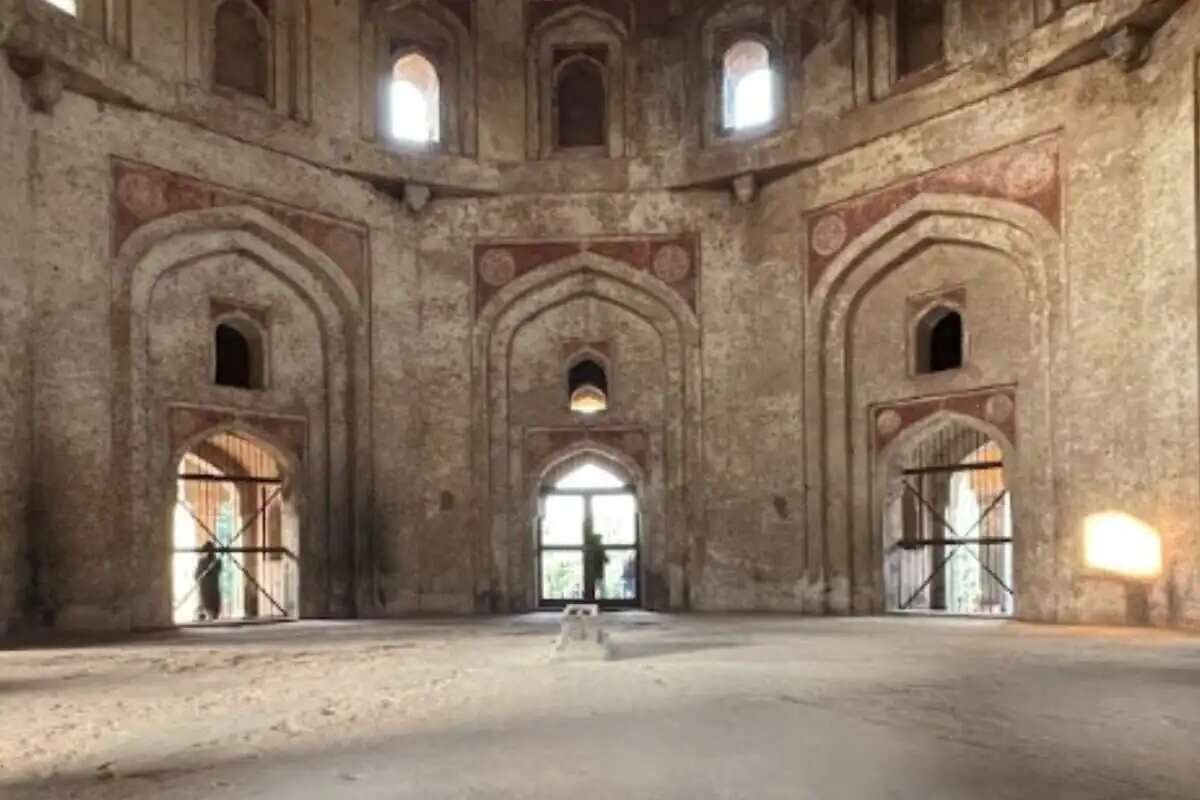
The Khair-ul-Manazil mosque is built of red sandstone and features a large courtyard, high arched doorways, and a prayer hall. The carvings on the walls and the colorful tiles still showcase the exquisite artistry and beauty of the Indo-Islamic architecture of that era. Everything inside and outside the mosque was built with great care and love.
Although some parts of Khair-ul-Manazil have deteriorated over time, even in its current state, it evokes a sense of history. The Khair-ul-Manazil mosque reminds us of the deep cultural and religious heritage of our city, Delhi, and how women also played a significant role in shaping history. If you visit this mosque, you won’t just be seeing a building, but you will also feel the stories of that era, the people of that time, and their lives.
From Worship to Politics: The Other Side of the Story
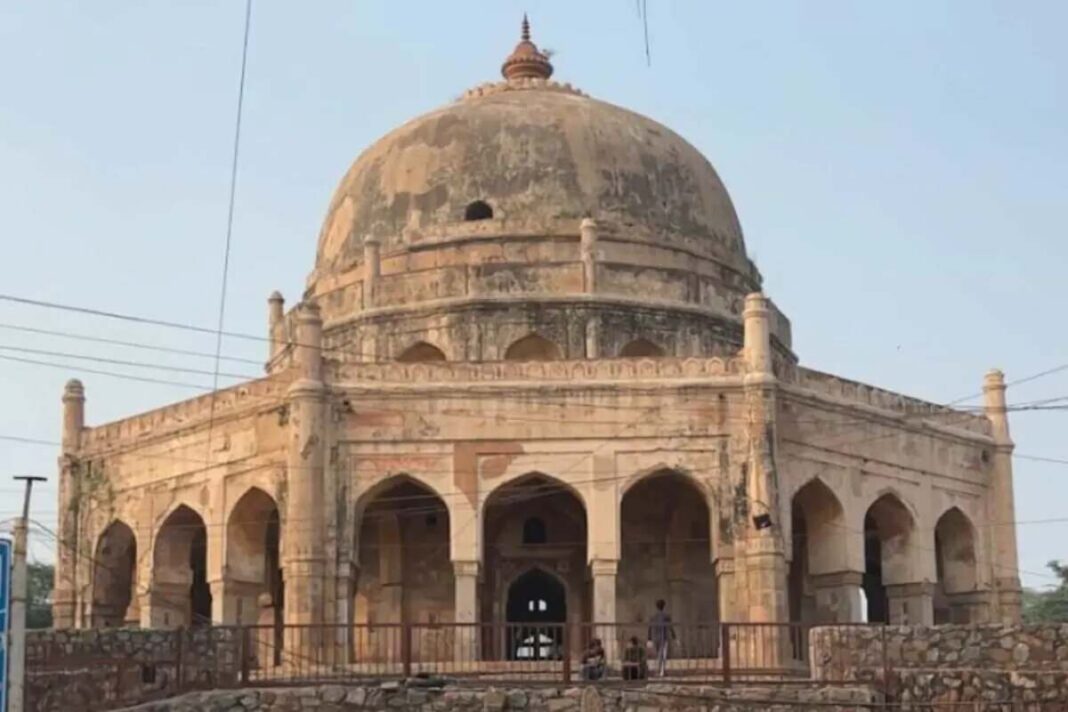
You have just read about the mosque and madrasa built by Maham Anga, but now you will read about the tragic part of Maham Anga’s story that ended the lives of both her son, Adham Khan, and herself. While the first story was about worship and learning, this story is about punishment and politics. Adham Khan’s tomb is located in Mehrauli, Delhi, quite close to the Qutub Minar. It is not just a historical building, but also a witness to one of the most tragic stories of the Mughal court. Buried here is the tale where the struggle for power and strained relationships led to the demise of both a son and his mother.
Anga and Koka: Relationships in the Mughal Court
During the Mughal Empire, foster mothers were called Anga, and their sons were called Koka. The book by the famous writer Shazi Zaman mentions that Adham Khan was the son of Maham Anga, Emperor Akbar’s foster mother. Akbar was raised by Maham Anga in his childhood, making Adham Khan his foster brother.
Munim Khan held the position of Vakil (minister) in the Emperor’s court. When Munim Khan’s position was given to Shamsuddin Muhammad Atka Khan, both Munim Khan and Maham Anga were displeased by this development. Following this incident, Munim Khan began instigating Maham Anga’s son, Adham Khan. Adham Khan, in turn, became jealous of Shamsuddin Atka Khan’s growing influence in Akbar’s court.
Blood in the Court: The Murder of the Wazir
Adham Khan and his men stormed into the Diwankhana of the Agra Fort, where the Sultanate’s lawyer, Shamsuddin Mohammad Atka Khan, was serving. On Adham Khan’s orders, his soldiers thrust a sword through Shamsuddin Mohammad Atka Khan’s chest. As Atka Khan, wounded, ran toward the Diwankhana door, another of Adham Khan’s men stabbed him to death with a sword. Shamsuddin Atka Khan was Akbar’s most trusted minister, but he was killed in his own court. When news of this reached Emperor Akbar, he was furious.
Akbar’s Confrontation: Relationships and Justice Face to Face
Emperor Akbar emerged from the Diwankhana upon hearing the commotion. He asked his servant, Rafiq, whose body it was. Rafiq replied, “My King, this is your Atka.” Emperor Salamat asked, “Who killed him?” Rafiq replied, “Adham Khan.” When Emperor Akbar asked Adham Khan, “Why did you kill our Atka?” Adham Khan replied, “He was a traitor.” Emperor Salamat looked at Adham Khan’s face.
Then he remembered Adham Khan’s mother, Maham Anga. Akbar could never forget the day when Emperor Humayun’s brother, Mirza Kamran, had exposed little Akbar to cannonballs, and Maham Anga had stood in front as a shield. Now, before Emperor Salamat’s eyes lay the corpse of Shamsuddin Mohammed Atka Khan, the husband of his breast-feeding sister, Anga. And right in front of him stood the murderer, whose mother, Maham Anga, had raised him.
Old Mistakes and Akbar’s Memories
At this moment, Emperor Akbar remembered Adham Khan’s past mistakes. After conquering Malwa, he kept the winning supplies for himself and sent only a few elephants. Angered by this, Akbar himself arrived in Malwa. Maham Anga was also present with him. Adham Khan then presented all the supplies and accounts to Akbar.
As the royal caravan was returning to Agra, Emperor Salamat discovered that Adham Khan had once again resorted to cunning. He had hidden two beautiful girls from the harem, whom Maham Anga later killed. When this secret was revealed, the army was immediately stopped and the people were silenced so that Adham Khan’s name would never be revealed. Emperor Akbar was haunted by all these incidents.
Decision of Punishment: Akbar’s Justice
While Akbar and Adham Khan were face to face, a fight broke out between them. Emperor Akbar ordered the soldiers to tie Adham Khan’s hands and feet. Adham Khan was thrown from the roof by Emperor Salamat’s orders. When he didn’t die the first time, he was thrown headfirst. This time, his neck broke, and he was thrown headlong. After this, the Emperor approached Maham Anga and said, “Uncle!”
Adham Khan killed our Atka. We have avenged him.” “He did the right thing,” Maham Anga said. This was the moment when Akbar chose justice over relationships. Maham Anga was devastated by the news of her son’s death. After hosting Adham Khan’s 40th-day feast, she too passed away a few days later. Akbar built this tomb for both of them.
Lord Curzon and the Restoration Attempt
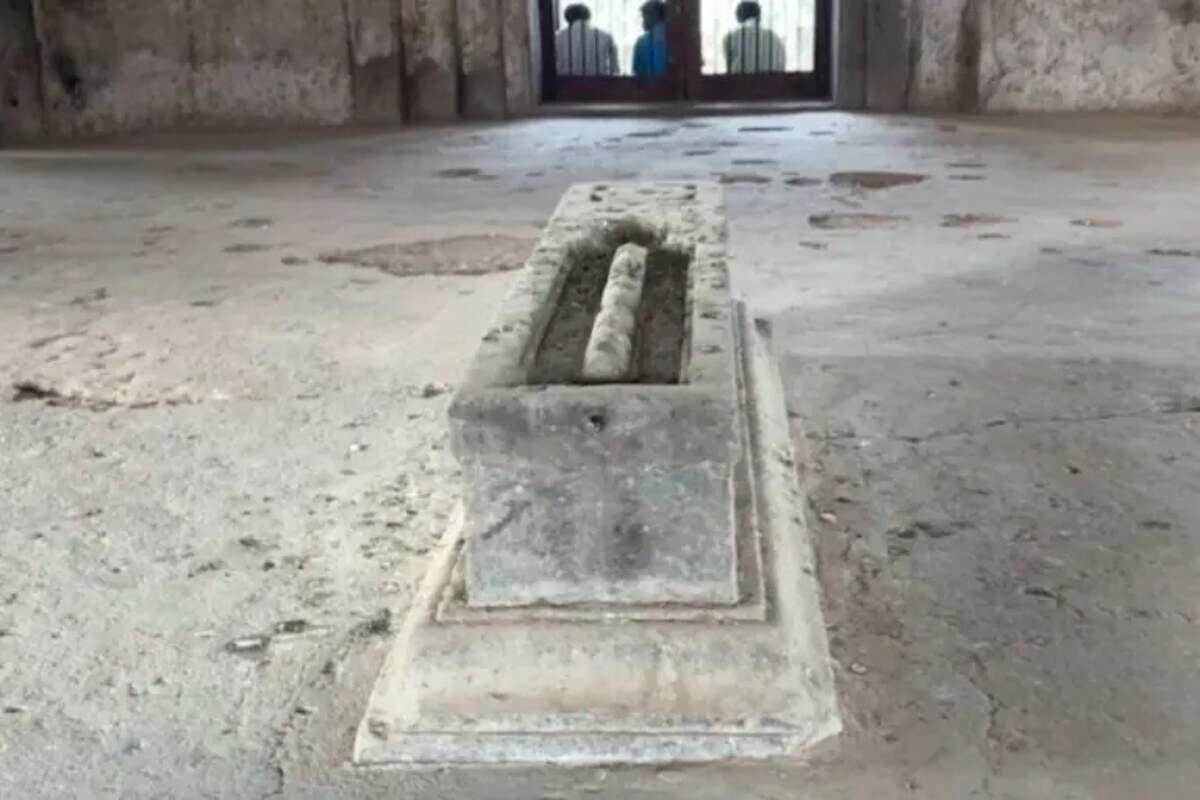
According to media reports, in 1830, a British officer converted the tomb into his residence and removed the graves. It also served as a rest house, police station, and post office. It was Lord Curzon, Viceroy and Governor-General of India, who restored the tomb. His efforts led to the return of Adham Khan’s remains to the site, but Maham Anga’s remains were never recovered. Today, only Adham Khan’s tomb remains. This tomb, which is crumbling with time, needs to be preserved. Where the makers of history are buried.
Also Read: Hyderabad’s Paigah Tombs: Hidden Architectural Treasure
You can connect with DNN24 on Facebook, Twitter, and Instagram and subscribe to our YouTube channel.