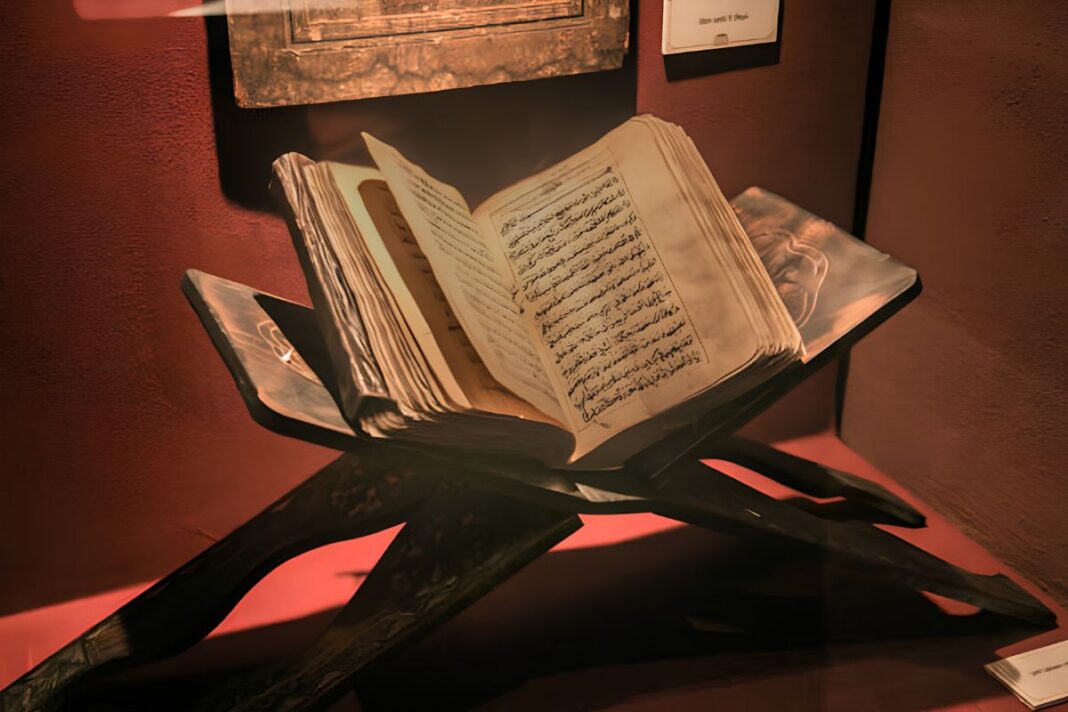

A 114-year-old copy of the Holy Quran, passed through four faiths, now rests with a Hindu scholar in Punjab.
There is a copy of the Holy Quran sitting in Punjab today that has passed through the hands of a Sikh saint, two Hindu brothers, a Sikh poet, a Muslim laboratory attendant, and a Hindu historian. No single community owns its story. No single religion can claim credit for its survival. That, perhaps, is precisely the point.
Sikh Scholar’s Quran Translation Bridged Faiths Across Punjab
The year was 1911. British India was whole, undivided, and tense with the quiet pressure of colonial rule. In Amritsar, at a modest printing establishment called Gurmat Press, a project of uncommon ambition was taking shape.
Sant Vaid Gurdit Singh Alomhari, a scholar affiliated with the Nirmal sect of Sikhism, had resolved to translate the Quran into Gurmukhi script so that Punjabi readers of every faith could access its teachings without an intermediary. The Nirmal tradition had long treated scripture across religions as repositories of knowledge rather than markers of division. For Gurdit Singh, translating the Quran was not a theological experiment. It was an act of straightforward scholarly respect.
He was joined by Bhagat Budhmal, Vaid Gurdita Mal, and Mela Singh. Together they prepared a text that would eventually be typeset and printed by Kataria and Sons, a firm run by two Hindu brothers based in Bombay. One thousand copies were produced. The ink dried on pages that carried both the weight of Islamic scripture and the labour of people who had never professed Islam.
From Kotkapura to Lande Village: A Copy Finds Its Reader
Among those thousand copies, one reached Sardar Jhanda Singh Arif, a Sikh poet of some reputation in Kotkapura. Arif was drawn to the Quran not as a curiosity but as a companion. He read it regularly, returned to its verses, and found in it a spiritual resonance that shaped the remainder of his life.
When Arif died, his son chose not to place the copy in a museum or auction it to the highest bidder. He gave it instead to Noor Mohammad, a senior laboratory attendant from Lande village in Punjab, a Muslim who had known the family and was considered a man of genuine learning and care.
Noor Mohammad received the Quran as a trust, not a possession. He kept it without ceremony but with complete attentiveness. It was not displayed for visitors. It was not locked away. It remained present in his home, handled with the kind of quiet reverence that requires no announcement.
The Historian Arrives
Somewhere around 2023, Professor Subhash Parihar, a Punjab-based historian of considerable standing, was in the middle of compiling what may be the most comprehensive encyclopedia of Sufism yet attempted in India. His research had led him through archives, private collections, and obscure village holdings. Word reached him of a Gurmukhi Quran from 1911, still in private hands.
He went to see Noor Mohammad.
What followed was not a negotiation. Noor Mohammad looked at the historian, understood the seriousness of his work, and handed over the copy without hesitation or condition. His words, as Parihar later recalled them, were simple and clear: this book belongs to no one person, he said. It is an inheritance of affection. Take it. Use it well. It is my good fortune that it goes to a scholar.
Professor Parihar, a Hindu, now holds the Quran. He intends to incorporate it as a primary document in his encyclopedia.
What the Record Shows
The provenance of this single copy of the Quran reads as follows:
Translator: A Sikh religious scholar
Printers: Two Hindu brothers from Bombay
First recorded owner: A Sikh poet from Kotkapura
Recipient: A Muslim laboratory worker from Lande village
Current custodian: A Hindu historian from Punjab
This is not a constructed narrative. It is simply what happened, documented across more than a century of transfers, each one undertaken in good faith and without calculation.
Professor Parihar’s Assessment
When Professor Parihar speaks about this Quran, he does not reach for grand conclusions. He notes, with the measured tone of a working historian, that this object offers perhaps the clearest available evidence of how religious communities in early twentieth-century Punjab actually behaved toward one another when no one was watching, and no political point was being made.
At a time when the British administration found considerable advantage in emphasising communal difference, ordinary people in Amritsar, Kotkapura, and Bombay were sharing scripture across faith lines as a matter of course. They were not making a statement. They were doing what scholars and artisans do: working together on something they considered worth doing.
That, Parihar suggests, is what genuine religious practice looks like when it is not performing for an audience.
114 Years Later
The Quran has survived partition, displacement, and decades of national argument about who belongs where and to whom. It has passed through households that prayed in different languages and bowed toward different directions. None of those households considered the exchange remarkable enough to publicise. It was simply what neighbours did.
Today, when hostility between communities is frequently amplified and carefully distributed through every available channel, this document sits quietly in a scholar’s keeping, asking nothing and saying everything.
A Sikh translated it. Hindus printed it. A Muslim preserved it. A Hindu historian now carries it forward. The book itself has always been the same.
Also Read:Padma Shri Awardee Devaki Amma: The Woman Who Grew Forests
You can connect with DNN24 on Facebook, Twitter, and Instagram and subscribe to our YouTube channel.