

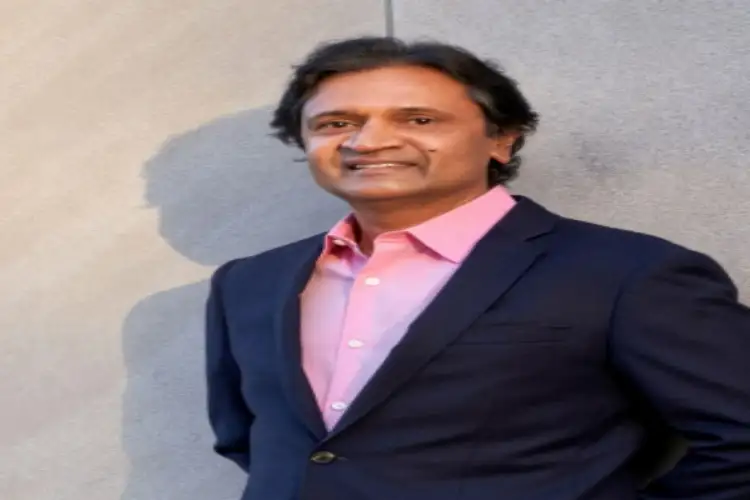

Professor K. Nair
Professor K. Nair, of Indian descent, and T.C. Chang of Columbia University have received Japan’s prestigious Okawa Prize for their foundational work in computer vision and computational imaging.
Professor of computer science at Columbia Engineering. Nair was honored for pioneering image techniques now widely employed in digital photography and computer vision.
I am grateful to the Okawa Foundation for this honor, said Nair, who directs Columbia’s Computational Imaging and Vision Laboratory.
Over the past three decades, I have had close relationships with Japanese researchers and companies, Nair said in a statement.
This has enabled my lab to translate our results into imaging techniques currently used in consumer devices and factory automation systems.
Nair, who hails from Thiruvananthapuram, heads the Columbia Vision Laboratory (CAVE), which develops advanced computer vision systems.
Applications inspire his work in digital imaging, computer vision, computer graphics, robotics, and human-computer interfaces.
Nayyar’s work has changed how visual information is captured and used by machines and humans.
In the mid-1990s, he pioneered computational imaging, combining unconventional optics with advanced image processing algorithms.
Columbia University said that Nair’s idea to create composite pixels for high-dynamic-range (HDR) imaging had enabled smartphone cameras to leap in terms of the images they capture.
It is estimated that over one billion smartphone users worldwide are using its technology daily.
Nair received a BS degree in Electrical Engineering from the Birla Institute of Technology, Jharkhand.
He holds an MS degree in Electrical and Computer Engineering from North Carolina State University. He holds a Ph.D. in Electrical and Computer Engineering from the Robotics Institute at Carnegie Mellon University.
Nair has received numerous honors for his research and teaching, including the David Marr Prize (1990 and 1995), the David and Lucile Packard Fellowship (1992), the National Young Investigator Award (1993), the Carnegie Mellon Alumni Achievement Award (2009) Huh. ), Helmholtz Prize (2019) Prize (2019).
For his contributions to computer vision and computational imaging, he was elected to the National Academy of Engineering in 2008, the American Academy of Arts and Sciences in 2011, and the National Academy of Inventors in 2014.
Nair will receive the award at a ceremony held in Tokyo, Japan, in March 2023.
Since 1996, the prize has been awarded annually to one Japanese and one international researcher for outstanding contributions to research, technological development, and business in the information and telecommunications fields.
Before Nair, two other Indian-origin scientists – Dr. Raj Reddy (2004) and Dr. J.K. Agarwal – Were awarded.
You can connect with DNN24 on Facebook, Twitter, and Subscribe to our YouTube channel.