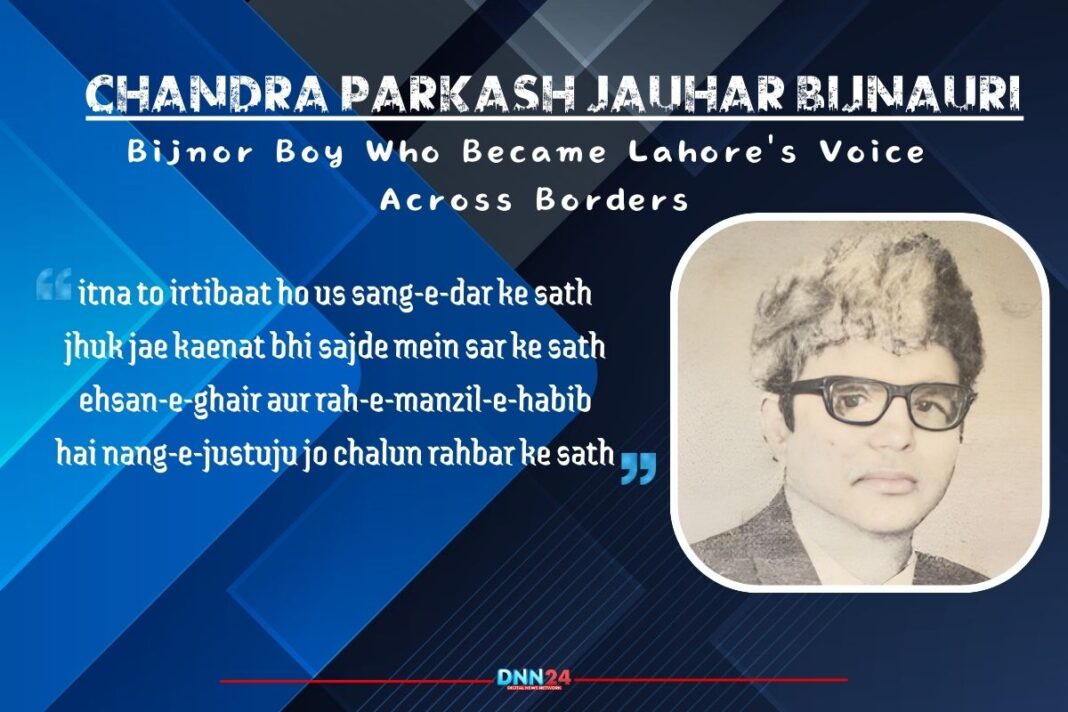

Chandra Parkash Jauhar Bijnauri was born in Bijnor, Uttar Pradesh, in 1923, the village lanes whispered with the flow of the Ganga and simple dreams. His father was no poet, yet their home became a gathering place for travelling shayars who filled evenings with ghazals and nazms. Young Chandra would hide behind doors, absorbing rhythms and metaphors he barely understood but deeply felt. Those stolen moments became his secret education, planting seeds that would bloom across borders.
hijab ban ke wo meri nazar mein rahta hai
Chandra Parkash Jauhar Bijnauri
mujhi se parda hai mere hi ghar mein rahta hai
By 1947, when Partition tore the subcontinent apart, Chandra made a choice that defined everything after. Despite his Hindu identity meaning danger in the new Pakistan, he chose Urdu poetry over safety. He packed his verses and crossed into Lahore, transforming from refugee into legend as Chandra Parkash Jauhar Bijnauri. Today, decades after he died in 1995, his ghazals still bridge the divide between India and Pakistan.
pahle to us ki zat ghazal mein sameT lun
Chandra Parkash Jauhar Bijnauri
phir sari kaenat ghazal mein sameT lun
His story matters now because in our age of rising walls, he remains proof that art outlives anger. When Instagram poets chase viral moments, his depth reminds us what truly lasts. This Bijnor boy, who became Lahore’s treasure, teaches us that roots can nourish two soils simultaneously, and that displacement can birth beauty rather than only bitterness.
wo kya jawab de arz-e-sawal se pahle
Chandra Parkash Jauhar Bijnauri
na samjhe baat jo izhaar-e-haal se pahle
Bijnor’s Soil and a Father’s Gift
Bijnor offered no grand promises, just honest earth and working hands. Chandra’s family was ordinary, neither wealthy nor connected to literary circles. Yet his father possessed one extraordinary gift that changed everything. He loved listening to poetry with such passion that travelling poets would stop at their modest home, turning ordinary evenings into magical gatherings. The boy soaked in every word like parched earth drinks rain.
aisa nahin ki ek mera ghar udas hai
Chandra Parkash Jauhar Bijnauri
tere baghair jo bhi hai manzar udas hai
No one handed him books or encouraged him to write, but those mushaira nights became his university. By adolescence, he was scribbling verses on whatever paper he could find, shy about showing anyone yet burning with creative fever. Local gatherings gave him his first taste of performing, where his voice trembled but his words held unexpected power. Then came Izhar Rampuri, the established poet who recognised the teenager’s raw talent and took him under his guidance.
suni suni si hai har bazm-e-suKHan tere baad
Chandra Parkash Jauhar Bijnauri
KHatm hai silsila-e-azmat-e-fan tere baad
This mentorship was not formal schooling but something older and more sacred. Afternoon sessions under trees where the young poet brought his attempts and the elder tore them apart with love. Izhar taught that ghazals are not just pretty words but an architecture of emotion, where each couplet must stand alone yet contribute to a larger meaning. Through patient correction, meters and radif became second nature.
ba-waqar lahje mein pur-asar kaha jae
Chandra Parkash Jauhar Bijnauri
dil ka haal kuchh bhi ho muKHtasar kaha jae
Izhar’s greatest gift was confidence, telling his student that Bijnor’s origins did not disqualify him from the highest circles of Urdu poetry. This encouragement proved vital when Chandra later entered Lahore’s competitive literary scene. When Partition’s violence erupted, Chandra faced his hardest choice. He chose art over safety, carrying verses into an uncertain future. Bijnor remained in his memory as a phantom limb, inspiring a nostalgia that coloured every ghazal he wrote in his adopted home.
kaun jaane ki taKHayyul mein hain paikar kitne
Chandra Parkash Jauhar Bijnauri
but tarashega abhi aur ye aazar kitne
Lahore Stages and Mushaira Magic
Lahore, after Partition, was a city of wounds and wonders. Refugees poured in carrying trauma and hope in equal measure. Chandra arrived among thousands, but his gift quickly set him apart. The mushaira culture in Lahore was fierce, with audiences demanding and poets competing for recognition. His first performances were tests by fire, where one weak line could lose a crowd forever. He passed magnificently.
gham ki aaghosh mein jo palte hain
Chandra Parkash Jauhar Bijnauri
wahi duniya ka ruKH badalte hain
His ghazals about displacement spoke to everyone’s experience without drowning in self-pity. He found words for collective grief that individual conversations could never match. Lines describing delicate sorrow, giving life a taste, became instant classics, quoted across the city. His style remained rooted in tradition even as modern poets experimented with free verse. This was not conservatism but mastery, like a classical musician who needs no gimmicks because the fundamentals are perfect.
wo dilkashi wo raushni-e-baam-o-dar gai
Chandra Parkash Jauhar Bijnauri
tum kya gae ki raunaq-e-sham-o-sahar gai
Step into a 1970s Lahore mushaira where Chandra commands the stage. Hundreds pack the hall, from labourers to lawyers, all waiting for his turn. When the host announces his name, the room shifts from chatter to charged silence. He begins slowly, letting the first couplet land before building momentum. His voice is conversational, making each listener feel personally addressed.
jab bhi un se kalam hota hai
Chandra Parkash Jauhar Bijnauri
har suKHan na-tamam hota hai
The genius lies in pauses, in knowing when to let a line breathe. When he recites verses about lost homes, the Partition refugees nod in recognition. When he explores love’s contradictions, young couples exchange knowing glances. Unlike poets who performed for elite circles, Chandra appealed across classes. Rickshaw drivers memorised his shers alongside professors.
zindagi KHwab bhi hai fitna-e-bedar bhi hai
Chandra Parkash Jauhar Bijnauri
naghma-e-amn bhi hai nara-e-paikar bhi hai
This democratic reach came from choosing universal themes within the classical framework. He never dumbed down content, but he also never obscured it with unnecessary complexity. Fellow poets respected him as much as audiences adored him, recognising someone who elevated the entire form. Through decades of performing, he became synonymous with Lahore’s poetic identity.
chehre se numayan hai ek ek ada gham ki
Chandra Parkash Jauhar Bijnauri
insan jise kahte hain taswir hai matam ki
Auraq-e-Gul: A Lifetime in Petals
When Auraq-e-Gul appeared in 1986, it was not just another poetry collection but a lifetime’s distillation. Every ghazal was earned through living rather than imagining. Chandra selected pieces that represented his journey from Bijnor boy to Lahore legend, arranging them to create an emotional architecture. The title itself worked metaphorically, referring to the leaves of flowers and suggesting both fragility and beauty.
aadamiyyat ki kami aaj jis insan mein hai
Chandra Parkash Jauhar Bijnauri
wo na hindu mein hai shamil na musalman mein hai
Each ghazal functioned independently while contributing to a larger portrait. Critics immediately recognised its significance, praising how traditional forms carried fresh emotional weight. Readers found themselves returning to specific verses during their own trials, discovering new meanings with each reading. His treatment of gham, that uniquely Urdu concept of bittersweet sorrow, reached new depths. He showed how sadness sharpens life’s flavours rather than deadening them, how loss teaches appreciation.
shuur-e-gham ko jaga iztirab paida kar
Chandra Parkash Jauhar Bijnauri
nafas nafas mein naya inqalab paida kar
Love in his verses was never simple romance but a complex force encompassing devotion, destruction, and transcendence. The collection demonstrated technical mastery without feeling academic. Every riff clicked perfectly, every meter flowed naturally, yet readers focused on emotion rather than craft; this invisibility of technique marked true artistry.
shua-e-nur se zarron ko de ke tabani
Chandra Parkash Jauhar Bijnauri
ek aaftab se lakh aaftab paida kar
Auraq-e-Gul became an essential text for anyone serious about Urdu poetry, was studied in universities, and was quoted in subsequent mushairas. Its influence extended beyond literary circles into popular culture, with lines appearing in films and songs. Decades later, the collection remains in print, finding new generations of readers through digital archives that have made it globally accessible.
nashat-e-gham se mayassar hai zindagi ko farogh
Chandra Parkash Jauhar Bijnauri
numud-e-gham se gham-e-be-hisab paida kar
The Echo That Refuses to Fade
Chandra Parkash Jauhar Bijnauri passed away in 1995, but his voice never stopped echoing. Lahore mourned publicly, while Bijnor claimed him as a native son; this dual ownership reflected his unique position of belonging fully to both nations despite their hostility. His legacy operates on multiple levels that grow more relevant with time. Artistically, he preserved classical ghazal traditions while infusing them with contemporary emotion, proving traditional forms were living containers for modern feelings.
chaman mein chehra-e-gul par kahan nikhaar ka rang
Chandra Parkash Jauhar Bijnauri
na jaane kaisa hai ab ke baras bahaar ka rang
Young poets studying his work learn how discipline and freedom coexist, how structure enables rather than limits expression. Culturally, he remains a symbol of pre-Partition unity, when Hindu poets wrote flawlessly in Urdu and Muslim audiences cherished them. His cross-border identity challenges nationalist narratives on both sides. In the digital age, his relevance has grown unexpectedly.
wo iztirab ka aalam wo intishaar ka rang
Chandra Parkash Jauhar Bijnauri
KHusha wo dil jise ras aae intizar ka rang
YouTube videos of his mushaira performances attract millions of views. Rekhta Foundation has digitised its works, making them searchable and shareable. Instagram poets quote his verses, introducing him to generations born decades after his death. The themes he explored remain eternally relevant: displacement, belonging, love’s complications, and mortality’s shadow. Today’s refugee crises echo his experience of Partition.
chaman ko jis ne KHud apne lahu se sincha hai
Chandra Parkash Jauhar Bijnauri
usi se puchhiye ranai-e-bahaar ka rang
Modern relationship struggles mirror tensions he captured in romantic verses. Literary festivals in both India and Pakistan regularly feature sessions on his work, drawing crowds hungry for depth in shallow times. His story inspires because it proves that art can transcend politics and that individual voices matter even in collective tragedies. From Bijnor’s dust to Lahore’s stages, Chandra Parkash Jauhar Bijnauri built bridges with words, and those bridges stand stronger today than ever before.
Also Read: Aazam Khursheed : The Poet Who Made Faces Speak & Still Matters
You can connect with DNN24 on Facebook, Twitter, and Instagram and subscribe to our YouTube channel.