
Maulana Badruddin Ajmal, a Member of Parliament and the Chief of the All India United Democratic Front (AIUDF), recently made headlines for his candid remarks about the educational challenges Muslims face in Assam. In a conversation with Awaz-The Voice, he clarified that his statement addressing issues within the Muslim community was aimed at spurring positive change in education rather than a blanket condemnation.
Educational Disparities: A Call for Introspection
Maulana Ajmal drew attention to the sobering reality that out of 100 Muslim youths, only less than 20 percent receive a quality education. He questioned the limited number of doctors and engineers produced within the community, underscoring the urgency for self-reflection and improvement in education.
Population and Educational Challenges
In Assam, the Muslim population constitutes 34.22 percent of the total, as per the 2011 Census, making up a significant portion of the state’s demographics. In the broader context of India, the Muslim population is around 14.2 percent or approximately 17.22 crore people.
Maulana Ajmal’s Vision for Educational Upliftment
Maulana Ajmal’s speech at Dalgoma Anchalik College predominantly revolved around the belief that the youth within the Muslim community have gone astray and require upliftment through rational thinking and the power of education. He stressed that education is the singular path towards development.
A Unique Approach: Focusing on Women’s Education
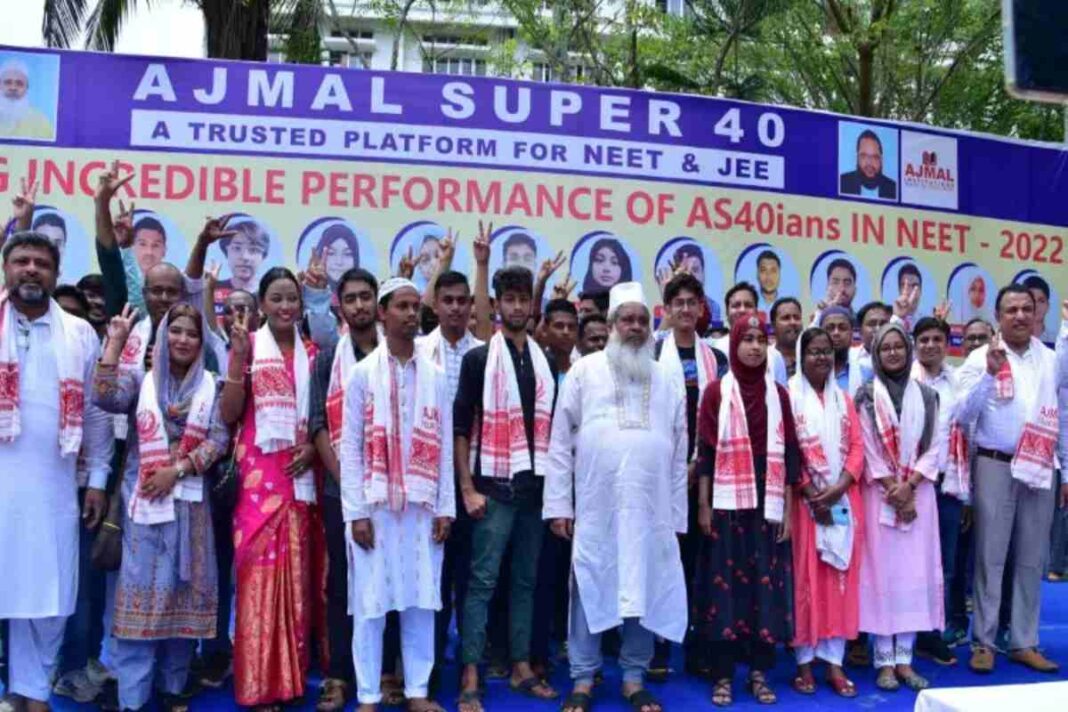
Maulana Ajmal distinguishes himself from many other Muslim politicians by not delving into contentious issues such as hijab or triple talaq. Instead, he has taken concrete steps to establish modern educational institutions dedicated to the education of Muslim women across Assam. These institutions aim to empower women and break stereotypes surrounding them.
An Educational Revolution: The Ajmal Foundation
Maulana Ajmal’s commitment to educational transformation led to the creation of the Ajmal Foundation, which set up its first institution, the Maryam Ajmal Women’s College of Science and Technology, in 2006.
Challenges in Promoting Education
While the Ajmal Foundation continues its efforts to provide educational opportunities, Maulana Ajmal acknowledged that relatively few Muslim students take advantage of these institutions. He reiterated that education is the singular pathway to development and the only means to uplift the community.
For a detailed story, please visit: Awaz the voice
Also Read: India’s Global Leadership: G-20 and Development
You can connect with DNN24 on Facebook, Twitter, and Instagram and subscribe to our YouTube channel.