
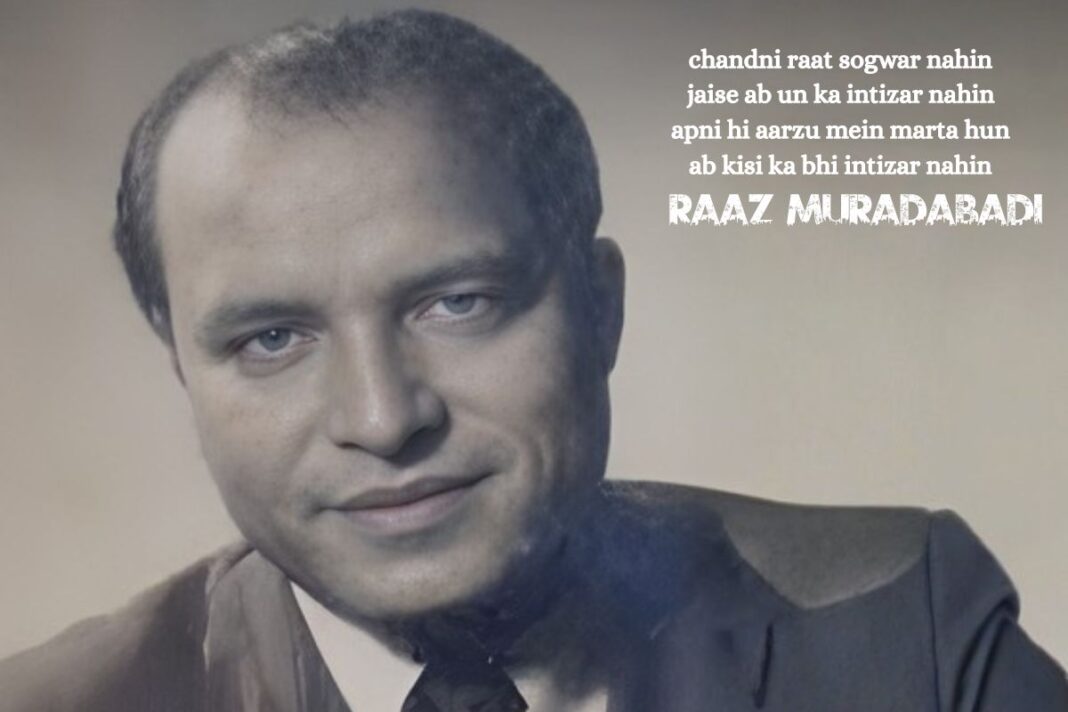

While modern poetry rushed towards experimentation and revolution, Raaz Muradabadi chose to walk the old path with quiet conviction, turning his back on trends to preserve something the world was too hurried to remember.
chaman mein aatish-e-gul bhi nahin dhuan bhi nahin
Raaz Muradabadi
bahaar to ye nahin hai magar KHizan bhi nahin
A House Built on Soldiers and Saints
Raaz Muradabadi came into the world in 1916, born as Sajid Ali Khan in Moradabad, Uttar Pradesh, where his family tree bore both military medals and prayer beads in equal measure. His father’s lineage spoke of battlefields and barracks, men who understood what it meant to stand guard and follow orders. His mother’s side, however, whispered verses late into the night, reciting couplets that had survived generations not through books but through careful repetition at family gatherings.
bhari bahaar mein daman-e-darida hain hum log
Raaz Muradabadi
hamein tha zoam bahaar-afrida hain hum log
This dual inheritance gave young Sajid a peculiar kind of balance: he knew discipline from watching soldiers, and he knew beauty from listening to poetry being passed like heirlooms from one voice to another. When he was seventeen, in 1933, he placed himself before Jigar Moradabadi, one of the most respected Urdu poets of that time, and asked to be taught.
ye to nahin ki un se mohabbat nahin mujhe
Raaz Muradabadi
pahli si walihana aqidat nahin mujhe
Jigar did not simply accept him as a student; he renamed him “Raaz,” meaning secret, as if recognizing that this young man would carry something precious and hidden through all his years. The name stuck, and Sajid Ali Khan disappeared into it. Soon after, Raaz moved to Aligarh, a city alive with debates, ideas and restless young minds trying to figure out what India would become.
gham ki tha harif-e-jaan ab harif-e-jaanan hai
Raaz Muradabadi
ab wo zulf-e-barham hai ab wo chashm-e-giryan hai
At Aligarh Muslim University, he did not study alone. Around him gathered Janisar Akhtar, Majaz, Jazbi, Akhtar-ul-Iman, Manzoor Shor, Shakeel Badayuni, Shahid Latif and others who would all, in their own ways, reshape modern Urdu literature. His teachers were not lenient. Rashid Ahmed Siddiqui, Maulana Ahsan Marharvi and Jalil Qidwai corrected his language, sharpened his judgment, and insisted that refinement was not optional.
ittifaqan mile the wo sar-e-rah
Raaz Muradabadi
phir na uTThi kisi taraf bhi nigah
Raaz absorbed this. He became Secretary of Anjuman Hadiqa-ul-Sher, where he helped organize literary events, and he edited Aligarh Magazine, overseeing a special issue on Fani Badayuni that showed his respect for earlier masters. Even then, before he had published much of his own, Raaz understood something important: tradition was not decoration but duty.
The Uniform, The Studio, and the Split
After earning his M.A. in 1940, Raaz tried something unexpected. He joined the army, trading the soft rhythms of ghazals for the hard routines of military life. Commands replaced couplets. Drills replaced discussions. For a brief period, he lived in that world of uniforms and obedience, where poetry had no place and silence meant something entirely different. However, the fit was wrong.
tere KHayal se fursat jo umr bhar na hui
Raaz Muradabadi
kab apne aap se guzre hamein KHabar na hui
His inner voice, already tuned to metaphor and emotion, could not settle into this new structure. He left the army and returned to Aligarh Muslim University, this time as a research scholar, hoping to pursue a PhD. However, before he could finish, another door opened. In 1944, he joined All India Radio, stepping into a world where his voice and his words could travel through airwaves into distant homes.
nahin ki teri tawajjoh kabhi idhar na hui
Raaz Muradabadi
mujhe sawal ki jurat hi umr bhar na hui
Radio was intimate in ways print was not. It asked for clarity, warmth and timing. Raaz learned to speak to listeners he would never meet, shaping broadcasts that carried Urdu into living rooms across the subcontinent.Then came 1947, and everything broke. Partition tore through families, cities and institutions, redrawing borders and destinies overnight. Raaz was transferred to Radio Pakistan, suddenly on the other side of a line that had not existed before.
ba-qaid-e-hosh mohabbat azab dida-o-dil
Raaz Muradabadi
jigar ka KHun to kya jurat-e-nazar na hui
Between 1952 and 1956, he was sent to BBC London on deputation, where he worked among many languages and saw how Urdu held its own music even in a foreign studio. When he returned, he eventually took a position as Public Relations Officer at POF Wah Cantt, a job requiring diplomacy, careful phrasing and the ability to navigate bureaucracy without losing dignity. He stayed there for about fifteen years before retiring in 1975. By then, he had lived many lives: student, editor, soldier briefly, broadcaster, institutional diplomat, and always, quietly, a poet working on verses that might never make headlines but would outlast them.
sahar ke nam pe bazm-e-nashat ki barham
Raaz Muradabadi
charagh hum ne bujhae magar sahar na hui
The Man Who Refused to Rush
Raaz Muradabadi belonged to the ghazal, and he never wavered. While others around him experimented with free verse, political slogans and radical forms, Raaz stayed loyal to classical Urdu structures, not out of stubbornness but out of love. He saw the ghazal not as an old habit but as a living home, a place where emotion could still find its proper shape. His training under Jigar had taught him that Urdu could be soft without being weak, musical without being shallow, emotional without losing control.
tajalliyon ne diye sainkaDon fareb magar
Raaz Muradabadi
asir-e-dam meri shoKHi-e-nazar na hui
His collection Harf-e-Raaz, published by Karachi University in November 1978, became proof of this discipline. The book was considered serious enough to be included in academic syllabi, with scholars like Waqar Azim, Majnooh Gorakhpuri and Abu Laes Kashfi writing its preface. This was not light entertainment; this was poetry that demanded attention and rewarded patience. His couplets moved through familiar themes: love, separation, time, loneliness.
ufuq ke par ujale hain subh-e-sadiq ke
Raaz Muradabadi
hum intizar mein baiThe rahe sahar na hui
However, beneath these universal emotions lay a distinctly mid-century ache, the experience of migration, dislocation and fragile identity in a new country built on an old language. In temperament, Raaz was old-fashioned. He was polite in debate, respectful in disagreement, and more interested in depth than display. One of his famous couplets reads: “Yeh aur baat zamana hamein samajh na saka / Nigaah-e-ishq mein lekin khuli kitaab the hum.”
watan ki KHak se aati hai bu-e-KHun paiham
Raaz Muradabadi
ki pak rahzanon se ye rahguzar na hui
The world could not understand us, but in the gaze of love, we were an open book. This was how he saw himself and his generation: often misread by the times they lived in, yet completely transparent to those who truly looked. When he died in 1982, many remembered him as the last renowned disciple of Jigar, the final living link in a chain of masters for whom poetry was worship as much as expression.
husn jo lab kusha hua ghunche chaTak chaTak gae
Raaz Muradabadi
hum to harim-e-naz mein aaj bahak bahak gae
Why His Silence Still Speaks
To read Raaz Muradabadi now is to step out of speed. His ghazals do not offer quick comfort or instant answers. They ask the reader to sit with a word, to listen to its rhythm, and to accept that emotions do not resolve themselves neatly; they unfold slowly. Contemporary discussions on Urdu poetry often celebrate revolutionary voices, progressive manifestos and experimental forms, but Raaz’s value lies elsewhere.
garmi-e-chashm-e-mast se shishe darak darak gae
Raaz Muradabadi
jam chhalak chhalak gae rind bahak bahak gae
He believed that tradition itself could be quietly radical, that holding on to something beautiful in a world obsessed with newness was its own form of resistance. In an age where love is announced, performed, and sometimes exhausted in a few lines of social media caption, his verse reminds us that love is less about performance and more about inner transformation. For young writers and students in India and Pakistan today, his life also carries a practical lesson.
husn ki bargah mein kah na sake hadis-e-gham
Raaz Muradabadi
aankh uThi na lab hile hum hi jhijak jhijak gae
He navigated multiple institutions: university, army, radio, and bureaucracy. None of them shrank his inner space as a poet. At a time when many feel torn between earning a living and pursuing passion, Raaz shows that it is possible to carry poetry like a quiet ember, protecting it through every transfer and every border.
us se bichhaD ke umr bhar phirte rahe hain dar-ba-dar
Raaz Muradabadi
manzilen sar huin magar rah bhaTak bhaTak gae
His inclusion in university syllabi and curated anthologies keeps his name alive, but more importantly, his work offers something rare: a counter-culture to anxiety and haste. Each couplet is a small act of resistance against forgetfulness, a reminder that language can still hold refinement, that emotion can still wear humility, and that a poet from Moradabad, who walked through Aligarh, Delhi, Lahore and London, can still speak directly to a young reader staring at a glowing screen, searching for words that do not shout, but stay.
Also Read: Pandit Daya Shankar Naseem Lakhnawi: Urdu’s Kashmiri Genius
You can connect with DNN24 on Facebook, Twitter, and Instagram and subscribe to our YouTube channel.