
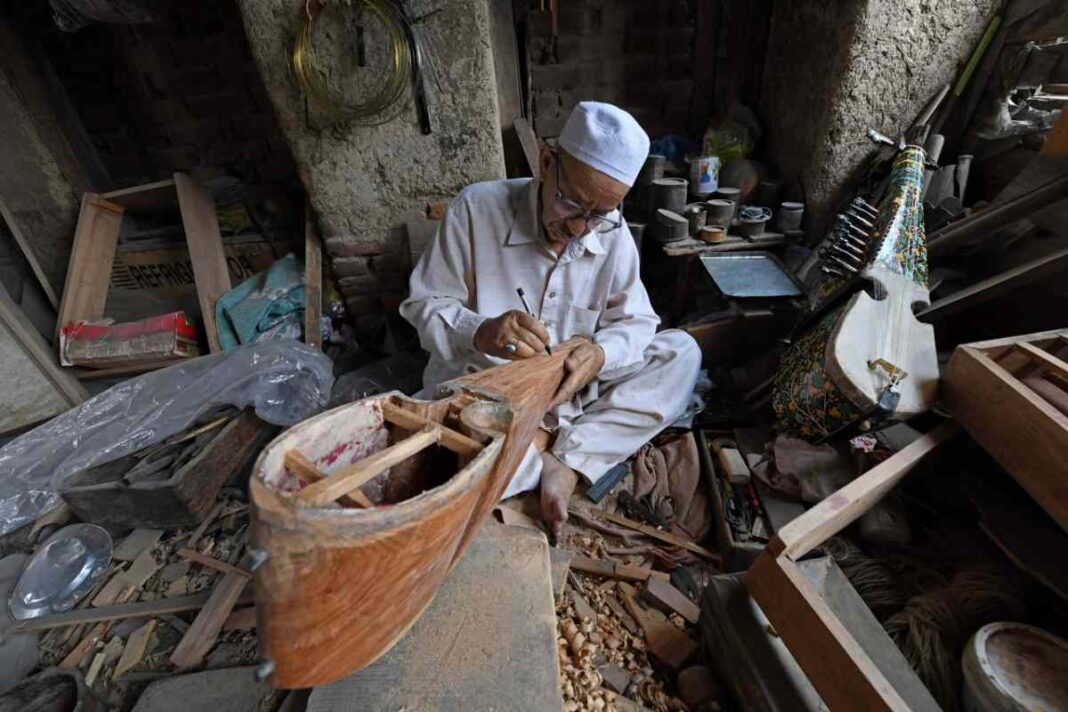

In a crumbling room by the Jhelum River in Srinagar, 74-year-old Ghulam Mohamed Zaz works on a santoor. For three centuries, his family has crafted Kashmir’s finest santoors and rababs, traditional stringed instruments. Zaz, the eighth generation of this family, is now the last of his line.
As a boy, Zaz learned by watching his father and grandfather work. At 15, he made his first santoor. The santoor, with its 100 strings, came to Kashmir with Persian invaders in the 15th century. Different versions exist worldwide, varying in string count.
The Golden Age of Kashmiri Music
The santoor and rabab are key to Kashmiri folk and Sufi music. In the past, as Sufiana music filled royal courts and wealthy homes, the Zaz family was highly respected. They were treated as artists and paid well for their work.
Zaz recalls those better days with pride. His shop, now decaying, was once bright and busy. The walls, blackened from years of heating walnut wood, tell a story of changing times.
A Dying Art in Modern Kashmir
Today, Zaz feels forgotten in his quiet shop. Customers are rare, and true santoor lovers are even harder to find. He spends his days surrounded by unfinished instruments, wondering if his work is still valued.
Zaz has three daughters, but none showed interest in learning the craft. He worries that after him, this centuries-old tradition might disappear. Sometimes, months pass without a single sale.
The old craftsman feels left behind in Kashmir’s fast-changing world. He’s frustrated that while others profit from writing about him and taking photos, he struggles to make ends meet. As Zaz continues his work, the future of Kashmir’s traditional instrument-making hangs in the balance, with no clear successor to carry on this rich cultural legacy.
For detailed story, please visit: Awaz the voice
Also Read: The Sacred Pause: Lord Jagannath’s Rath Yatra and the Mazar of Salabega
You can connect with DNN24 on Facebook, Twitter, and Instagram and subscribe to our YouTube channel.