
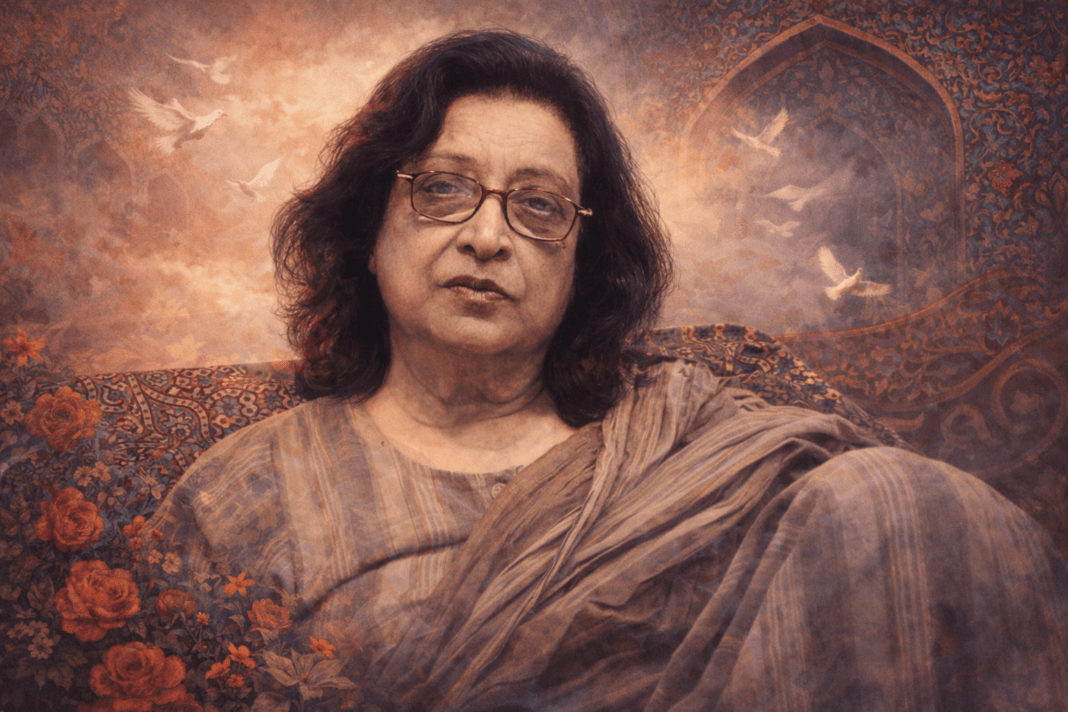

In the firmament of Urdu literature, there are some stars that not only shine but also guide the way. Fahmida Riaz was one of them. She was not just a poet or a writer, but a philosophy, a protest, and an outspoken voice that spoke with great passion about women, society, power, and human freedom.
Fahmida Riaz was born on July 28, 1945, in Meerut, Uttar Pradesh, into a literary family. This was the time when the borders between India and Pakistan were about to be drawn. After the partition, her family moved to Pakistan and settled in Sindh. Fahmida was only four years old when her father passed away. After that, she was raised by her mother, a mother who, even in difficult circumstances, did not compromise on her daughter’s education and freedom.
The Journey from Radio to Literature
After completing her studies, Fahmida started working as a newscaster at Radio Pakistan. It was from here that her voice reached the people. But she soon realized that simply reading the news was not in line with her temperament. There was a restlessness within her, there were questions, and there was a need to give voice to those questions.
She started writing at a very young age. At the tender age of 15, her first ghazal was published in the famous literary magazine ‘Funoon’. This was a great achievement for any young poet.
‘Awaz’: When the Pen Stood Against Power
Fahmida and her husband Riaz started an Urdu magazine called ‘Awaz’. This magazine became not only a voice for literature but also for justice, equality, and democracy. It openly questioned the dictatorial policies of General Zia-ul-Haq.
As a result, ‘Awaz’ was banned. Fahmida and her husband were charged with serious offenses like sedition. More than 10 cases were filed against her under Section 124 of the Pakistani Penal Code. She was arrested. She endured imprisonment, fear, and pressure. Despite all this, Fahmida did not give up writing.
Seven Years in India for Fahmida
After being released on bail, Fahmida came to India with her two children. She came under the pretext of attending poetry recitals and then lived in exile in India for almost seven years. The renowned writer Amrita Pritam spoke to the then Prime Minister Indira Gandhi and arranged for Fahmida to stay in India.
During this time, Fahmida remained associated with Jamia Millia Islamia, Delhi, and continued to write. This was the period when her poetry and verses transcended borders and spoke of humanity.
Her famous poem “You Turned Out to Be Just Like Us”
is a profound commentary on Indo-Pak relations – where the shared pain hidden behind the enmity is clearly visible.
Tum bilkul hum jaise nikle,
ab tak kahaan chhupe the bhai
The Voice of a Woman, the Language of a Woman
In Fahmida Riaz’s poetry, the woman is not a silent character. She questions, she desires, she demands the right to desire, and she wants control over her body and her life.
Her poems say:
Daulat, taaqat aur shohrat sab kuch bhi nahin,
uske badan mein chhupi hai uski azaadi.
Jo mujh mein chhupa mera gala ghont raha hai,
ya wo koi Iblees hai ya mera Khuda hai.
This poetry is not just an expression of feelings, but a protest against patriarchy, religious hypocrisy, and the tyranny of power.
Books that Became Questions
Fahmida Riaz wrote more than 15 books. In the form of poetry, verses, novels, and essays. Her major works include:
Patthar ki zubaan
Godavari
Badan dariya
Dhoop
Khat-e-marmooz
Gulabi kabootar
Khule dareeche se
Adhoora aadmi
Qafile parindon ke
Khana-e-aab-o-gil
Her novel ‘Body River’ was quite controversial. She was accused of writing openly about societal restrictions and taboos, and of writing about “sexuality.” But Fahmida clearly stated that writing about a woman’s body is not obscenity, but reality.
Fahmida Riaz made a significant contribution to the field of translation. She translated Persian and Sindhi literature into Urdu.
She translated the Masnavi of Maulana Jalaluddin Rumi into Urdu.
Shah Abdul Latif Bhittai
Sheikh Ayaz
and the Albanian writer Ismail Kadare
Through these translations, she conveyed Sufi philosophy and human love to the new generation.
Honors and Responsibilities
In 1988, during Benazir Bhutto’s tenure, Fahmida Riaz was appointed Managing Director of the National Book Foundation. She also headed the Urdu Dictionary Board. In addition, she received several awards, including:
Sitara-e-Imtiaz
Sheikh Ayaz Award
Hellman-Hammett Award for Human Rights
Fahmida Riaz passed away in Lahore on November 21, 2018, after a long illness. She was 73 years old. But Fahmida Riaz is not dead—she lives on in her poems, in her questions, and in the voice of every woman who refuses to remain silent. Fahmida Riaz is a voice of our time that will continue to be heard intensely in the future. Because the truth never dies.
Also Read: Zubair Ali Tabish: A journey of love-filled poetry from a simple poet
You can connect with DNN24 on Facebook, Twitter, and Instagramand subscribe to our YouTubechannel