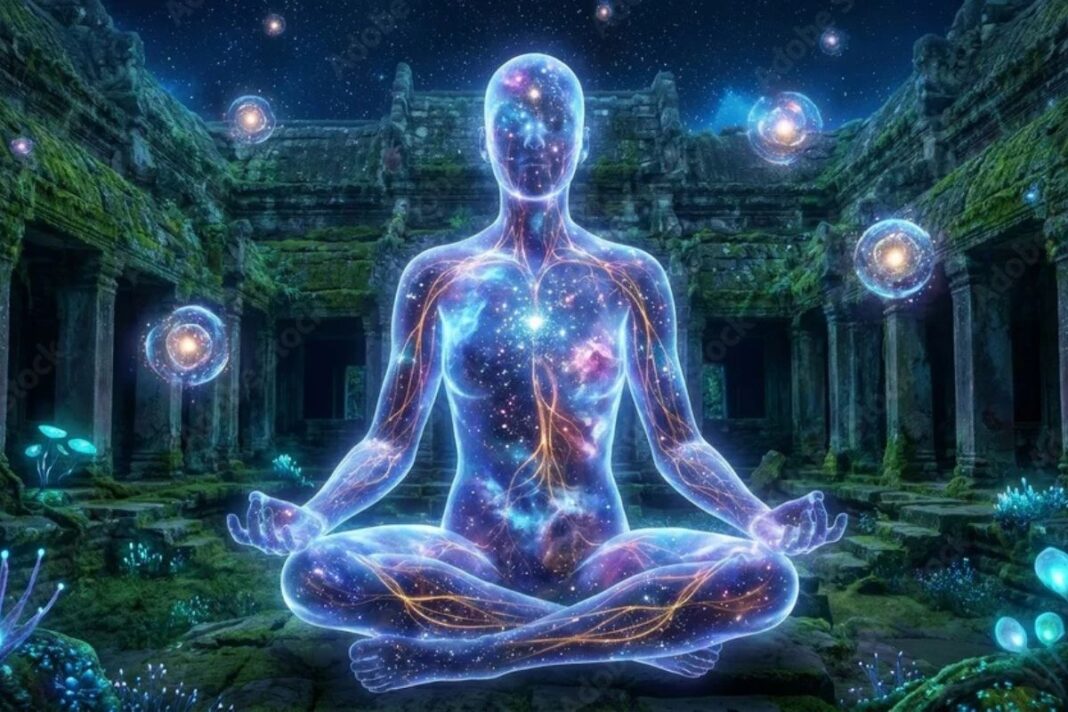

There is a reasonable chance that the yoga mat rolled out in your living room this morning once existed, in spirit, as a hymn to the sun god composed by a forest hermit in northern India around 3000 BCE. Few living traditions have made such a long and complicated journey.
The Vedic Roots
The word “yoga” appears first in the Rig Veda, among the oldest sacred compositions in any human language. At that stage, it had nothing to do with downward dogs or breathing sequences. It referred to the act of yoking, of joining the individual self to something larger, and it belonged to a world of priestly ritual, oral recitation, and disciplined contemplation passed between teacher and student across generations.
By roughly the middle of the first millennium BCE, the Upanishads had begun to draw out the philosophical implications of this practice. The concern shifted inward. Where Vedic religion was largely ceremonial and outward-facing, the Upanishadic tradition turned its attention to the nature of mind and consciousness, to what the self actually was behind all its noise. Yoga became a method of inquiry rather than merely a mode of prayer.
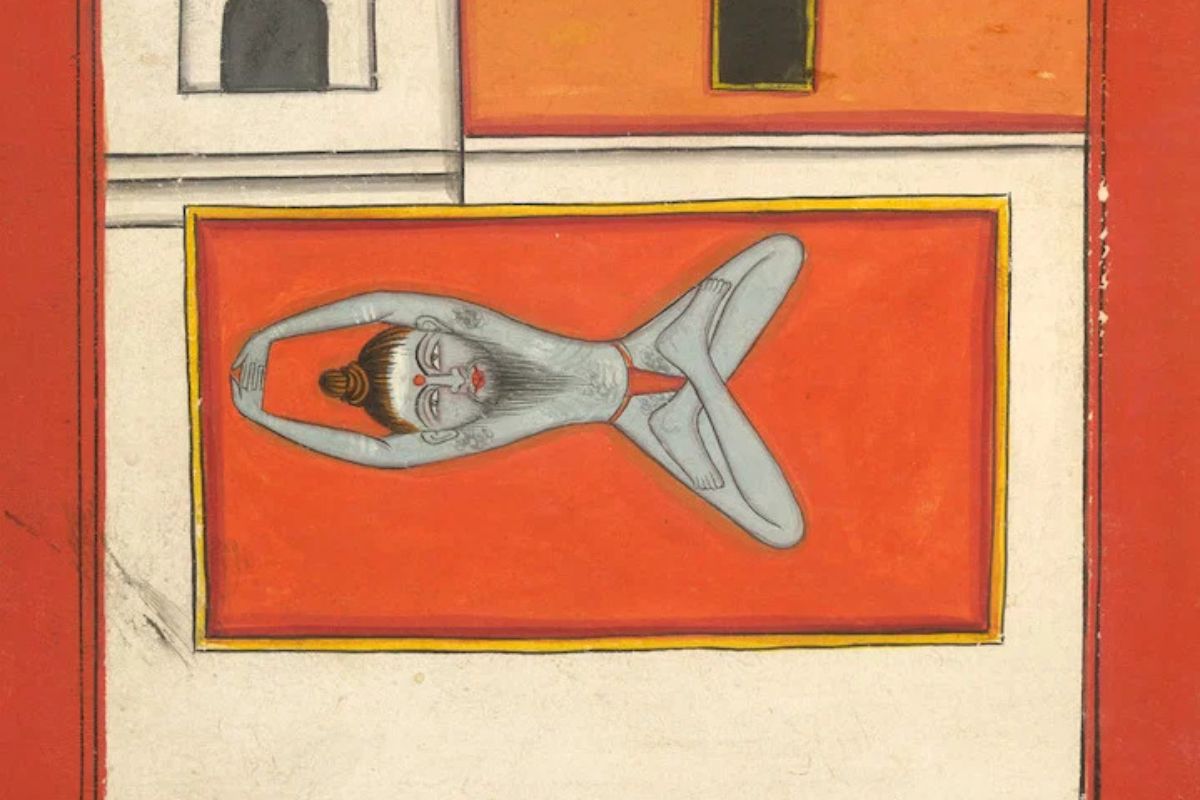
This was not a sudden break. Indian intellectual life has always moved in long arcs, with new ideas folding into old structures rather than displacing them. What the Upanishads achieved was a deepening, the addition of a speculative and philosophical dimension to practices that had always existed as a unified whole.
Patanjali and the Architecture of Practice
The most enduring single contribution to yoga’s intellectual history is a short text of roughly 196 aphorisms composed by a scholar named Patanjali, probably sometime between 400 BCE and 400 CE. The Yoga Sutras did something that had not been done before: they organized yoga into a system.
Patanjali’s framework, known as Ashtanga or the eight-limbed path, moved from external conduct through physical posture, breath regulation, and stages of mental withdrawal toward absorption and, finally, liberation. The first sutra of substance states the matter plainly: yoga is the stilling of the fluctuations of the mind. Everything else in the text is commentary on that premise.
What made this framework durable was its precision. Patanjali did not simply describe yoga in general terms. He identified the specific mental states that disturb practice, catalogued their causes, and proposed ways to overcome them. The result was less a devotional manual than a clinical one, and it has remained the primary philosophical reference for yoga therapists to this day. Practitioners working in modern healthcare settings still draw on the Sutras when designing protocols for stress, anxiety, and emotional dysregulation, because the text’s account of how the mind works under pressure has proven remarkably consistent with clinical observation.
The Medieval Elaboration
Between roughly 500 CE and 1500 CE, a more physically demanding tradition emerged under the broad heading of Hatha Yoga. Postures and breath control, which had existed in earlier traditions but as secondary concerns, moved to the centre of practice. The body became a vehicle in its own right, not merely something to be managed or suppressed while the mind sought liberation.
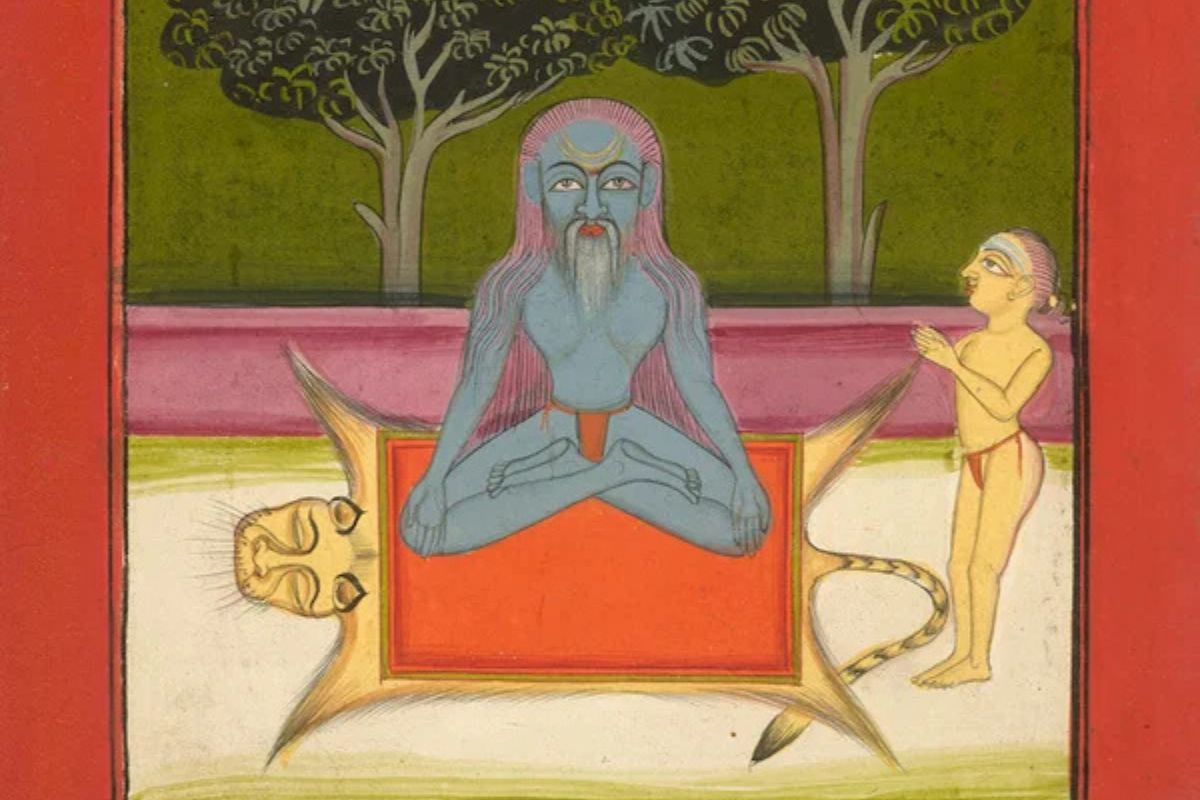
This shift reflected a wider development in Indian religious thought. Tantric traditions began to argue that the body, rather than an obstacle to spiritual progress, was its proper site. Hatha Yoga inherited this orientation, developing detailed anatomical frameworks and sequences of postures that would eventually, after considerable transformation, become the basis of what most people mean by yoga today.
The Nineteenth Century and the Western Encounter
The most consequential single event in yoga’s modern history was an address delivered in Chicago in September 1893 by a 30-year-old Bengali monk, Swami Vivekananda. Speaking to the Parliament of the World’s Religions, Vivekananda introduced yoga to a North American audience in terms it could receive: as a rational, universally applicable science of mind and consciousness, stripped of its specifically Hindu ritual context and presented as compatible with modern thought.
Vivekananda’s yoga was not primarily a physical practice. He emphasized meditation, mental discipline, and the philosophical tradition of Vedanta. His 1896 book Raja Yoga made the case to a wider English-language readership and became the founding document of yoga’s global career.
Behind Vivekananda stood a broader cultural movement. The Bengal Renaissance of the nineteenth century, centred on institutions such as the Brahmo Samaj, had already been working to reassert Hindu intellectual identity under British colonial rule. This project required, among other things, presenting Indian traditions as serious, systematic, and philosophically respectable to audiences shaped by Western criteria. Yoga was well-suited to this task.
The physical dimension came later, and from a different direction. The gymnastics tradition of nineteenth-century Europe, propagated through institutions like the YMCA and adopted into British colonial educational practice in India, provided both a template and an audience. By the early decades of the twentieth century, teachers such as Tirumalai Krishnamacharya were synthesizing ancient textual traditions with contemporary physical culture to produce something new: a vigorous, asana-centred practice organised around breath-movement coordination.
Krishnamacharya’s influence has been extraordinary. His students went on to develop Iyengar Yoga, Ashtanga Vinyasa, and the flow-based practices that now constitute the mainstream of global yoga. The tradition he established is physically demanding and technically precise, bearing a complicated but traceable relationship to the practices recorded in classical texts.
What Remains and What Has Changed
The transformation is obvious. A practitioner in a contemporary yoga studio is doing something genuinely different from what a forest hermit in the early Upanishadic period was doing. The physical emphasis, the class format, the commercial infrastructure, and the separation from specifically Hindu religious commitment: none of these are features of classical yoga.
What has persisted is harder to characterise, but it is real. The foundational premise, that sustained attention to breath, body, and mind produces measurable changes in both physiological and psychological function, runs without interruption from the Yoga Sutras through to current clinical research. The contemporary interest in yoga as a therapeutic tool for conditions ranging from chronic pain to post-traumatic stress is not, at its core, a departure from the tradition. It is a translation of the tradition into a language the present moment understands.
The Bhagavad Gita, which integrates yoga’s devotional, contemplative, and active strands into a single philosophical statement, has never lost its authority as a primary text. Patanjali’s eight limbs remain the standard conceptual framework for serious yoga teacher training programs worldwide. The texts are older than most civilizations still in existence, and they continue to reward careful reading.
International Yoga Day and the Living Tradition
Each year on June 21, International Yoga Day draws participation across more than 170 countries. The occasion was proposed by India and adopted by the United Nations in 2014, a formal recognition of what has been true for some decades: yoga is no longer primarily an Indian domestic practice but a genuinely global one.
The complications this creates are worth acknowledging honestly. A practice that originated in a specific philosophical and religious tradition, within a specific social structure, and under specific historical conditions does not travel without loss. Questions about commercialisation, cultural appropriation, and the thinning of a rich tradition into a fitness product are legitimate and have been raised by serious scholars and practitioners in India.
At the same time, the tradition has always adapted. Classical yoga absorbed Vedic ritual, Upanishadic philosophy, Jain and Buddhist influences, Tantric elaborations, and colonial-era physical culture. What emerges at each stage is both continuous with what came before and genuinely new. The contemporary global form, in this view, is simply the latest instance of an ancient process.
The person on the mat this morning, whatever they know or do not know about that history, is participating in something with a very long past. That past is not inaccessible. It is there in the texts, in the teaching lineages, and in the practice itself, waiting for anyone who chooses to look.
Also Read: How 20 Transgender Women Built a Temple That Educates and Feed Hundreds
You can connect with DNN24 on Facebook, Twitter, and Instagram and subscribe to our YouTube channel.