

Friday, January 16, 2026
7.1 C
Delhi

Framing India’s Constitution: Overcoming Criticisms and Ensuring Representation

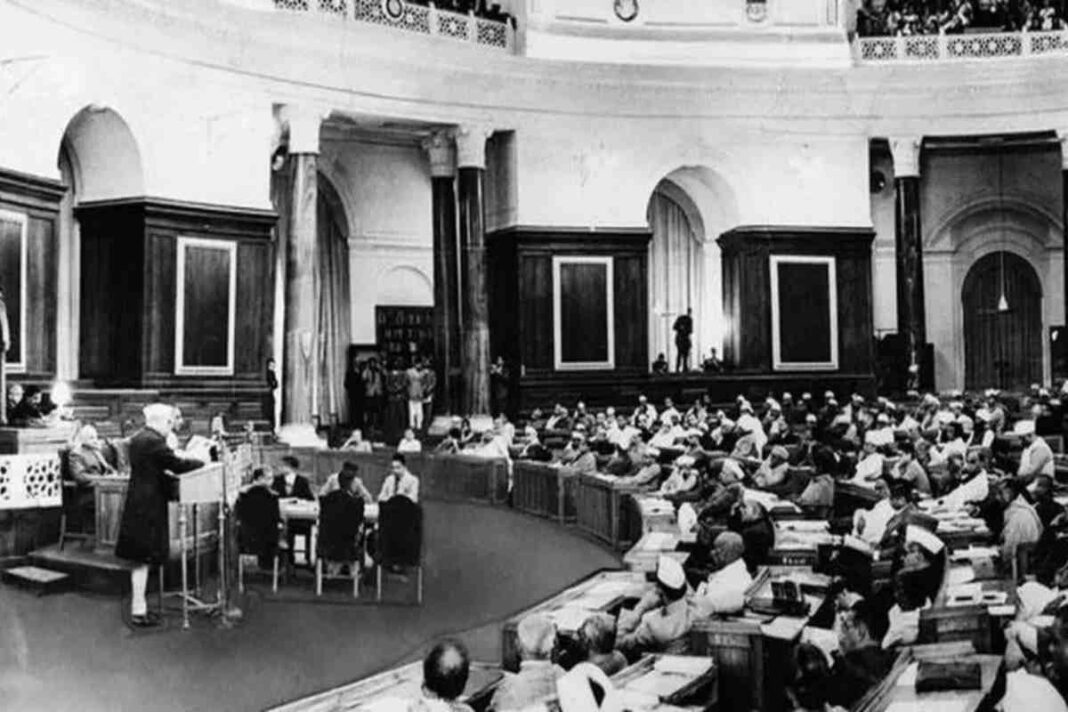
The demand for a free and sovereign India, with a constitution framed by its people, was a pivotal aspect of the Indian Freedom Struggle. However, as the process of preparing the body began in 1946, criticisms emerged, particularly from British leaders like Winston Churchill, challenging the legitimacy of the Constituent Assembly.

Questionable Legitimacy:

Critics argued that the Constituent Assembly was not entirely sovereign, as it was not democratically elected and lacked Universal Adult Suffrage. Churchill labeled it a “Hindu body” due to the Muslim League’s boycott. The British government’s declaration further fueled skepticism, emphasizing that a constitution without full representation would not be imposed on unwilling regions.

Composition of the Constituent Assembly:

In the 1946 elections, the Congress won 205 seats out of 296 in British India, with the Muslim League securing 73 seats. However, the League boycotted, leading to accusations that the assembly only represented upper-caste Hindus. Contrary to this, P. Misra highlighted that the group included diverse communities: Hindus, Scheduled Castes, Sikhs, Indian Christians, Backward Tribes, Anglo-Indians, Parsis, and even some Muslims.

Congress Dominance and Inclusivity:

While 69% of the assembly members belonged to Congress, critics from various backgrounds, including Congress adversaries like K.T Shah and B. R. Ambedkar, were welcomed. The assembly aimed for inclusivity, and even members who once campaigned for Pakistan were accommodated after the partition.

Intent of Representation:

Justice H. R. Khanna emphasized that the goal was to make the assembly genuinely representative. Despite limitations in the electoral process, efforts were made to ensure representation from various communities and regions. Committees and subcommittees, such as the Advisory Committee on Fundamental Rights, included members from diverse backgrounds.

Significant Contributors:

In the Constituent Assembly’s deliberations, Khanna pointed out the pivotal role of 20 individuals, including Nehru, Patel, Prasad, Azad, Ambedkar, and others. This diverse group, representing various professions and religions, was crucial in shaping India’s constitutional framework.

Conclusion:

The Constituent Assembly, despite criticisms, strived for inclusivity and representation. It overcame challenges to lay the foundation for India’s constitutional democracy, reflecting the commitment to a free and sovereign nation.

For a detailed story, please visit: Awaz the voice

Also Read: India’s Global Leadership: G-20 and Development

You can connect with DNN24 on FacebookTwitter, and Instagram and subscribe to our YouTube channel.

LEAVE A REPLY

Please enter your comment!
Please enter your name here

Hot this week

Pranshu Chatur Lal: The Home Where Music Breathes, Today’s Custodian of Pandit Chatur Lal’s Legacy

Pranshu Chatur Lal has performed in front of Prime Minister Narendra Modi and the President of Sri Lanka. He has also performed with renowned South Indian flutist Vijayagopal, Anup Jalota, Rajan-Sajan, and Hari Prasad Chaurasia.

Usman Parvaiz: The Story of a Specially-Abled Player Who Won Silver at the 18th Floorball Championship

Nine-year-old Usman Parvaiz from Pulwama, who cannot hear or speak, is rewriting the meaning of determination. Winning a silver medal at the National Floorball Championship, he proves that courage, focus, and passion can turn silence into strength.

Walls that speak: Preserving Uttarakhand’s Folk Art Through Murals

Colorful murals across Almora are turning public walls into living galleries, celebrating Uttarakhand’s rich folk art, traditions, and hill life. This creative initiative blends culture with tourism, offering locals and visitors a vibrant glimpse into the region’s heritage.

No land, Only Courage: Jammu & Kashmir’s Aasiya Turned Her Rooftop Into A Farming Field

Despite many challenges, social remarks, and an atmosphere of...

Countless Tablas, One Bond– The Journey Of Zakir Hussain & His Tabla Maker Haridas Ramchandra Vhatkar

From a Miraj workshop to the world’s grand stages, Haridas Ramchandra Vhatkar shaped rhythm with patience and devotion. A third-generation tabla maker, his hands crafted the sound trusted by legends- especially Ustad Zakir Hussain- proving that true legacy is built quietly.

Topics

Pranshu Chatur Lal: The Home Where Music Breathes, Today’s Custodian of Pandit Chatur Lal’s Legacy

Pranshu Chatur Lal has performed in front of Prime Minister Narendra Modi and the President of Sri Lanka. He has also performed with renowned South Indian flutist Vijayagopal, Anup Jalota, Rajan-Sajan, and Hari Prasad Chaurasia.

Usman Parvaiz: The Story of a Specially-Abled Player Who Won Silver at the 18th Floorball Championship

Nine-year-old Usman Parvaiz from Pulwama, who cannot hear or speak, is rewriting the meaning of determination. Winning a silver medal at the National Floorball Championship, he proves that courage, focus, and passion can turn silence into strength.

Walls that speak: Preserving Uttarakhand’s Folk Art Through Murals

Colorful murals across Almora are turning public walls into living galleries, celebrating Uttarakhand’s rich folk art, traditions, and hill life. This creative initiative blends culture with tourism, offering locals and visitors a vibrant glimpse into the region’s heritage.

No land, Only Courage: Jammu & Kashmir’s Aasiya Turned Her Rooftop Into A Farming Field

Despite many challenges, social remarks, and an atmosphere of...

Countless Tablas, One Bond– The Journey Of Zakir Hussain & His Tabla Maker Haridas Ramchandra Vhatkar

From a Miraj workshop to the world’s grand stages, Haridas Ramchandra Vhatkar shaped rhythm with patience and devotion. A third-generation tabla maker, his hands crafted the sound trusted by legends- especially Ustad Zakir Hussain- proving that true legacy is built quietly.

Kashmir’s Floral Spectacle: The 2026 Tulip Show To Bloom With 1.8 Million Vibrant Flowers

As winter arrives, Kashmir’s Tulip Garden comes alive with preparations for the grand 2026 Tulip Show. A record 1.8 million bulbs, including fresh imports from Holland, are being planted, promising a breathtaking display of vibrant colors and boosting spring tourism in the Valley.

How Pobitora Women Are Redefining Assam’s Handloom With Wildlife-Inspired Designs?

Near Assam’s Pobitora Wildlife Sanctuary, women from Auguri village are turning threads into stories of nature. Their eco-friendly handwoven gamosas and stoles, inspired by the one-horned rhino, are winning tourists’ hearts while weaving livelihoods and conservation together.

Udaygiri Caves: Where Ancient Kings Carved Gods Into Mountains

Stand before a hill that holds secrets from 1,600...

Related Articles