
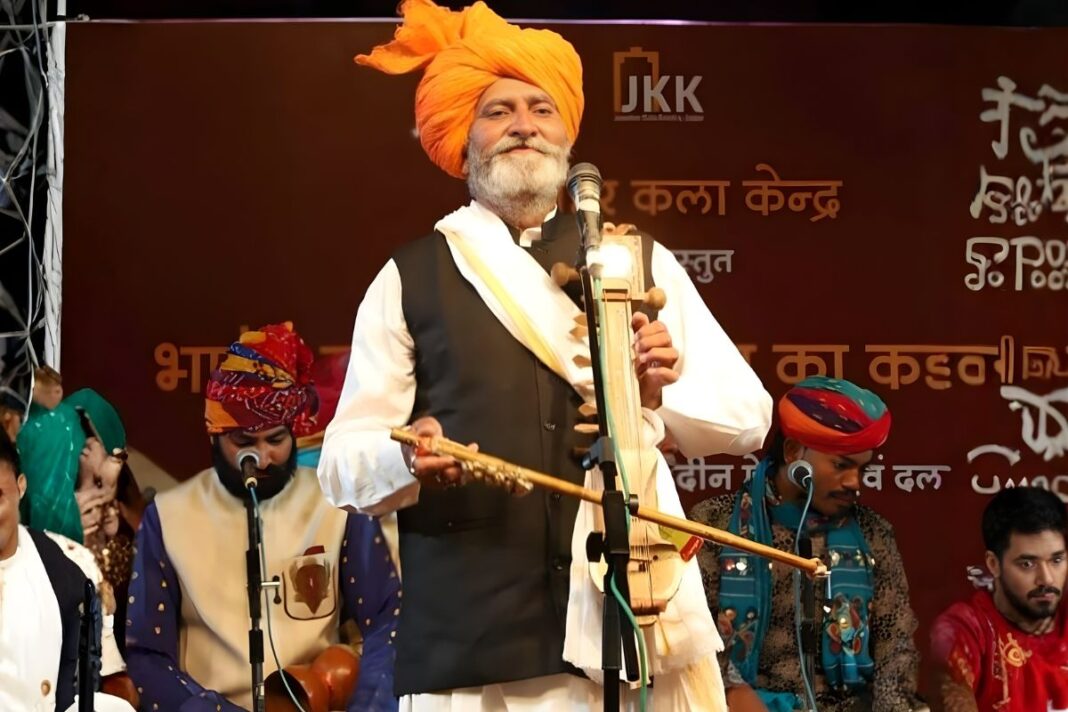

When Gafaruddin Mewati Jogi received a phone call on January 24, 2026, during a performance at Alwar’s Vande Mataram exhibition, he thought someone was playing a trick on him. The caller informed him that he had been selected for the Padma Shri, one of India’s highest civilian honours. At 63, the bhapang master from Rajasthan’s Mewat region had spent 38 years preserving a tradition most people had never heard of, performing Hindu epics as a devout Muslim. The recognition seemed too good to be true.
Gafaruddin later dedicated the award to his father, his community, and the Mewat region itself. He called it wages for decades of hard work. The honour brought attention to a man who embodies something rare in contemporary India: a living bridge between Hindu and Muslim traditions, carried through the rhythm of a hollow pumpkin shell and a single string.
The Making of a Tradition Bearer
Born on September 26, 1962, in Kaman, Rajasthan, Gafaruddin grew up in Kaithwada village in what was then Bharatpur district. The Mewat region, spanning parts of Rajasthan and Haryana, has long fostered a distinct cultural overlap. Here, Hindu and Muslim practices blend without friction, and the local dialect draws from both Haryanvi and Rajasthani roots.
Gafaruddin began his training at age three under his father, Budh Singh Jogi. The family belonged to the Jogi community, a group of Muslim performers descended from followers of the Hindu ascetic Gorakhnath. Their ancestor, Ismail Nath Jogi, had embraced Islam after reciting the kalma but continued to preserve Hindu folk narratives. This eighth-generation legacy meant that young Gafaruddin learned devotional songs about Krishna and Shiva while also observing Islamic prayers.
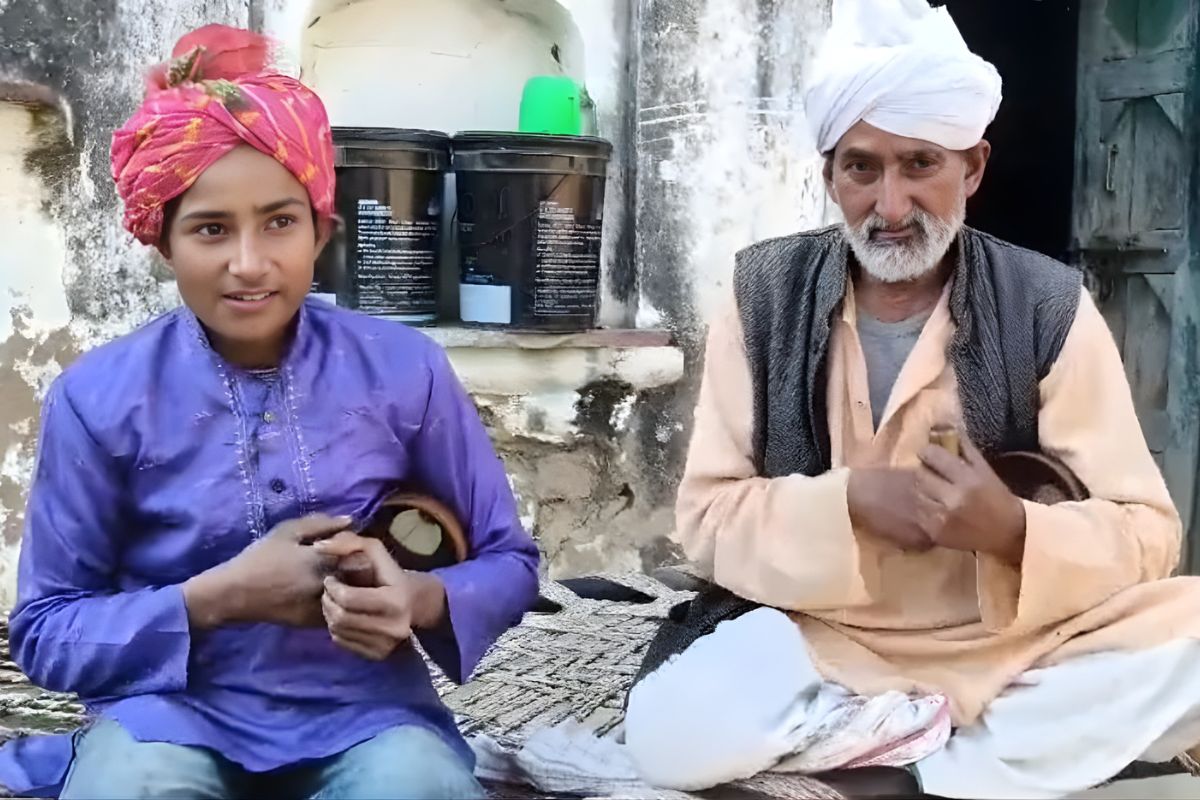
The training was rigorous and born of necessity. The family survived by begging for grains in villages, performing as they went. By age seven, Gafaruddin accompanied his father on performances. Budh Singh played the jogiya sarangi while uncles provided harmonium and dholak accompaniment. The boy learned the bhapang and, through it, absorbed more than 2,800 dohas and songs that his father had memorised.
In 1978, the family moved to Alwar, where Gafaruddin still lives. Poverty defined those early years, but the rhythm of the bhapang offered something beyond mere survival. It connected him to stories that stretched back centuries, tales that villagers once arranged their wedding dates around to hear performed.
The Talking Drum
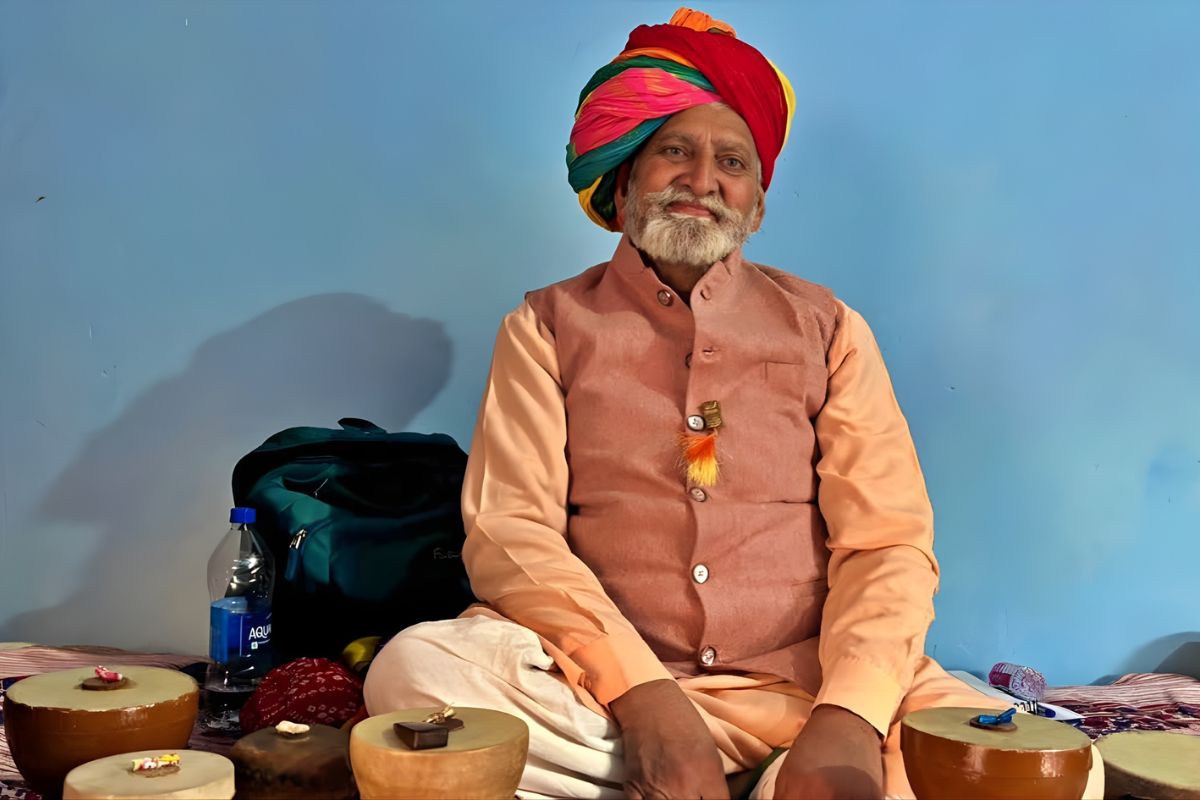
The bhapang earns its nickname as the talking drum through an unusual construction. A hollow dried pumpkin shell forms the base, topped with stretched goatskin. A single string runs through it. When Gafaruddin plucks that string, the sound mimics human speech patterns. He uses this quality to narrate epic stories, making the instrument seem to converse with listeners.
The bhapang anchors Mewati folk traditions. Through it, performers recount episodes from the Mahabharata, sing devotional bhajans, and preserve oral histories that might otherwise vanish. Gafaruddin has taken this regional instrument to more than 60 countries, including England, Australia, Canada, France, and Dubai. At a London celebration for Queen Elizabeth’s birthday, his Mewati melodies found an international audience that had never encountered such sounds.
The instrument requires skill to produce its distinctive voice. Gafaruddin has spent six decades mastering techniques that allow him to shift between narrative modes, devotional singing, and rhythmic percussion. Few others can replicate what he does. He estimates that only two or three practitioners of this tradition remain active.
Two Faiths in One Voice
Gafaruddin’s repertoire centres on Hindu epics and devotional songs. He performs Pandun ka Kada, a 2,500-doha retelling of the Mahabharata section dealing with the Pandavas’ exile in Viratnagar, located in present-day Alwar. He also presents Shivji ka Byavla, Lok Ramayana episodes about the conquest of Lanka, Shri Krishna Leela, and Brij folk songs.
In Pandun ka Kada, he enacts the adventures of the Pandava brothers, connecting Mewat’s landscape to the ancient epic. Poet Sadullah Khan may have first written down the oral tradition in the 16th century. Historically, families commissioned these performances for weddings and postnatal ceremonies, with sessions lasting through the night.
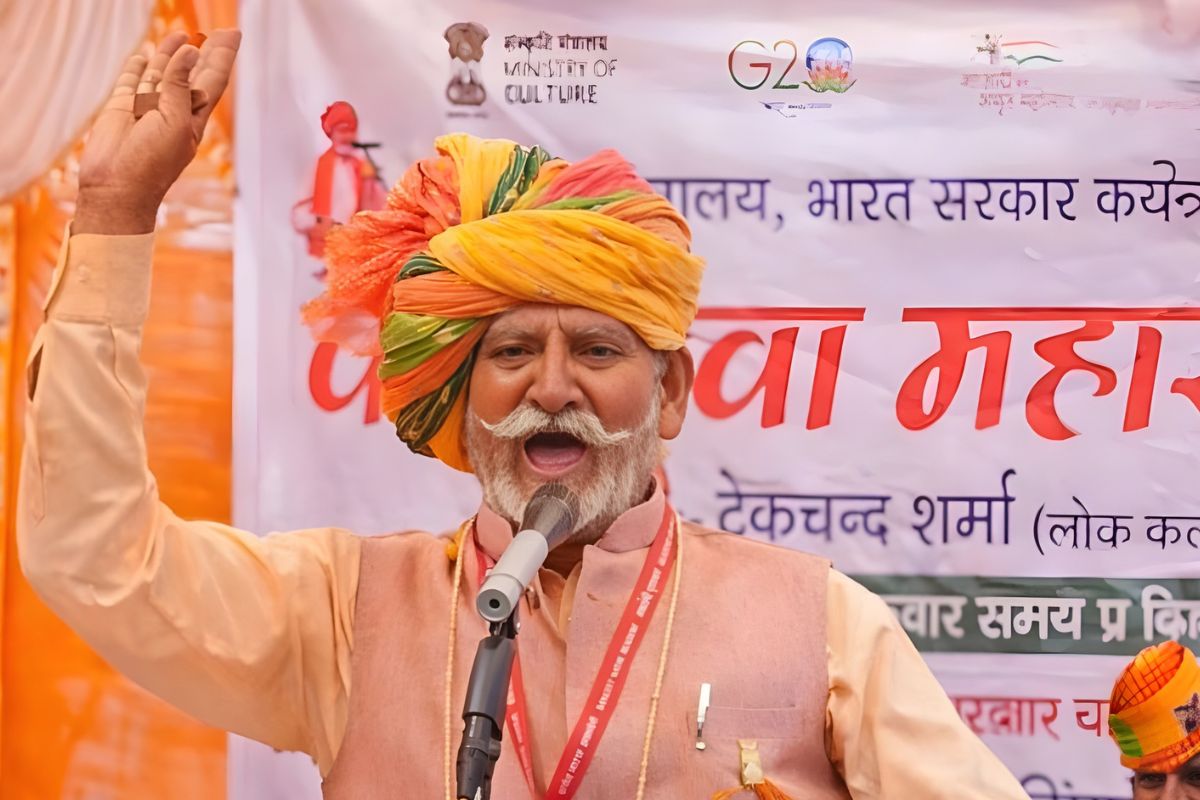
The tradition reflects Mewat’s particular religious character. Jogis recite the kalma yet glorify Krishna and Shiva with equal devotion. Gafaruddin prays at mosques and sings temple songs without seeing any conflict between the two practices. During the COVID-19 pandemic, Prime Minister Narendra Modi praised his Swachh Bharat songs, which blended folklore with public health messages.
This religious fluidity captivates audiences regardless of their own faith backgrounds. Listeners respond to the artistry and emotional depth rather than worrying about theological boundaries. Gafaruddin’s performances demonstrate that cultural traditions can carry multiple religious identities without contradiction.
Family Continuity
The Mewati Jogi tradition has been passed down through eight generations in Gafaruddin’s family. His father, Budh Singh Jogi, transmitted the complete doha repertoire and trained his son in both bhapang and jogiya sarangi. From age four, Gafaruddin accompanied his father door to door in Alwar, collecting flour while performing.
Gafaruddin’s brother continues to promote the bhapang alongside him. His son, Dr Shahrukh Khan Mewati Jogi, represents the eighth generation. Shahrukh holds a PhD focused on Mewat culture, combining scholarship with performance. He documents traditions while also mastering the bhapang, ensuring that academic understanding accompanies artistic practice.
Grandchildren now train under Gafaruddin, learning instruments and memorising epics. The family has adapted to modern contexts while preserving core traditions. Some of their performances appear on YouTube, where viewers discover Pandun ka Kada through digital platforms their ancestors could never have predicted.
The family belongs to the Tanwar lineage, which oral histories connect to Prithvi Raj Chauhan. They trace their origins to Bengal, where early Muslim Jogis developed the bhapang and began blending Shaivism with Islamic practice. Over centuries, they migrated to Mewat and established performing traditions that served social functions beyond mere entertainment. They blessed childless couples, narrated epics at life-cycle ceremonies, and maintained oral archives that entire communities relied upon.
Recognition After Decades
The January 2026 Padma Shri announcement validated work that had received little national attention. Gafaruddin had won Rajasthan government awards and Sangeet Natak Akademi recognition, but the Padma Shri carries a different weight. It positions him among India’s cultural guardians and draws attention to endangered traditions.
The award cited his contributions to reviving the bhapang and preserving folk traditions. It highlighted unsung artists like him and fellow recipient Taga Ram Bheel. For Gafaruddin, the honour represented acknowledgement that his community’s contributions matter at the national level.
The Struggle for Continuity
Pandun ka Kada once thrived among the Jogi and Meo communities in Mewat. Families scheduled wedding dates around the availability of performers like Budh Singh. Now the tradition faces extinction. Audiences prefer shorter entertainment formats, and urbanisation pulls young people away from village-based cultural practices.
Gafaruddin notes the steep decline. Performances that once lasted all night now struggle to find any audience at all. Modern entertainment options offer easier gratification than sitting through lengthy epic recitations. The dohas he memorised risk disappearing when he dies.
He appeals to the government for support to establish a free folk arts school. Such an institution would teach bhapang, Mewati singing, and epic recitation to young people. He wants land allocated for this purpose and funding to sustain instruction. His message to youth emphasises cultural rootedness: “Stay connected to your language, culture, and folk art; that is our true identity.”
The preservation challenge extends beyond one family or one instrument. Gafaruddin carries knowledge that represents centuries of cultural evolution. His performances demonstrate how religious boundaries can blur in artistic practice. His life contradicts narratives of inevitable Hindu-Muslim division by showing how one tradition can honour both faiths simultaneously.
Several of his songs have been adapted into Bollywood tracks, showing that Mewati traditions retain commercial and artistic value. These adaptations bring wider recognition but also raise questions about proper attribution and compensation for folk artists whose work enters popular culture.
A Living Archive
At 63, Gafaruddin remains the sole surviving master of over 2,800 dohas and songs. He performs tirelessly, trying to sustain a tradition that shaped Mewati identity for generations. Through one instrument and one voice, he maintains connections that urbanisation and modern entertainment threaten to sever.
His work matters beyond cultural preservation. He demonstrates that artistic excellence can transcend religious identity, that ancient traditions can address contemporary concerns, and that individual dedication can sustain collective memory. The Padma Shri recognises these contributions, but the real test comes in whether subsequent generations choose to carry the tradition forward.
Gafaruddin Mewati Jogi plays a hollow pumpkin shell strung with goatskin and tells stories that connect earth to epic, village to cosmos, Muslim prayer to Hindu devotion. In doing so, he keeps alive a vision of India where faiths meet in song rather than conflict. That vision, carried through the talking drum’s distinctive voice, represents his true legacy.
Also Read:Sikh Family Donates Land for Muslim Graveyard Access
You can connect with DNN24 on Facebook, Twitter, and Instagram and subscribe to our YouTube channel.