
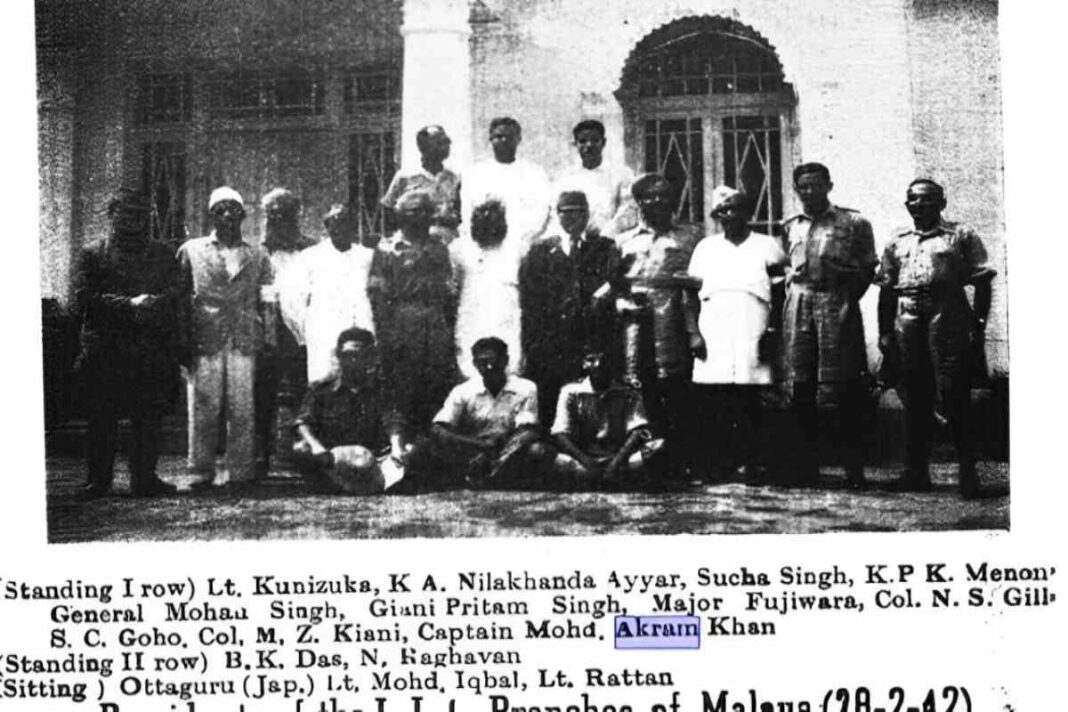

At Jitra, Captain Mohan Singh formed the Indian National Army as G.O.C. Patriotic cries filled the air. First recruits arrived in Alor Star in January 1942. After the British surrendered in Jitra, Malaysia, in December 1941, Giani Pritam Singh of the India Independence League convinced Indian officers in the British Army to join the freedom struggle. Captain Mohan Singh and Captain Mohd. Akram of the 14 Punjab, trusted by Indian soldiers, agreed. Major Fujiwara, a Japanese officer, promised to support the Indian Independence Movement.
Akram’s Role in Recruiting Soldiers
Akram played a big part in getting other Indian soldiers to join the INA. Whenever Japanese forces captured Indian soldiers, Mohan Singh and Mohammad Akram Khan would try to make them join INA. After World War II ended, the British Government put INA soldiers on trial. In court, Subedar Major Babu Ram said that after his regiment surrendered to Japan, “Two or three days later, Major Fujiwara, Captain Mohan Singh and Captain Mohd Akram visited the camp.”
Akram was second-in-command to Mohan Singh in the INA.
The Tokyo Conference and Akram’s Involvement
In March 1942, Indian leaders fighting in South-East Asia met in Tokyo for the Tokyo Conference. They discussed plans and working with the Japanese. Famous Indian revolutionaries Rash Behari Bose and Raja Mahendra Pratap also attended.
Mohammad Akram was one of three INA officers at the meeting. Mohan Singh and Akram flew to Tokyo in different planes. Kaiser Singh writes, “The first batch of four keen workers left for Japan via Saigon early on 11th March 1942. They were Swami Satyananda Puri, Sirdar Pritam Singh, Captain Mohammad Akram, and Mr. Nilkanth Ayre. Mr. Ottaguru from the Fujiwara Department and six other Japanese went with them. They reportedly left Saigon on 13th March 1942, and after that, no one heard from them.”
For detailed story, please visit: Awaz the voice
Also Read: The Sacred Pause: Lord Jagannath’s Rath Yatra and the Mazar of Salabega
You can connect with DNN24 on Facebook, Twitter, and Instagram and subscribe to our YouTube channel.