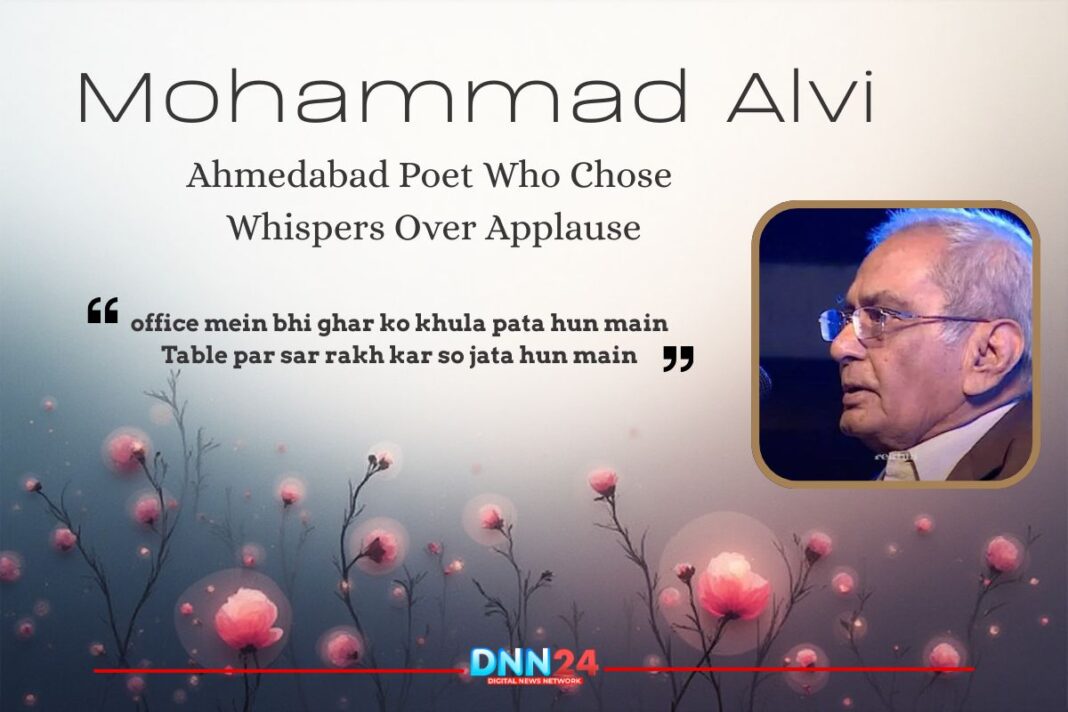

When most poets were chasing spotlights and filling auditoriums with thunderous verses, one man sat in a quiet corner of Ahmedabad and wrote lines so soft they could break your heart.
A Childhood Built on Books and Silence
Mohammad Alvi was born on 10 April 1927 in Ahmedabad, into a family that valued learning over wealth and words over noise. His parents were not wealthy, but their home had something better than money. It had books stacked on shelves, conversations about poetry at dinner, and a respect for language that shaped the boy before he even understood what was happening. Young Alvi was different from other children in the neighbourhood.
nind raaton ki uDa dete hain
Mohammad Alvi
hum sitaron ko dua dete hain
While boys his age played in the streets, he collected sentences. He would sit quietly during family gatherings, listening to adults talk, watching how they expressed joy or sadness, noticing when a simple phrase became something memorable. Ahmedabad during those years was a beautiful mix of cultures. Hindu and Muslim families lived as neighbours, Gujarati and Urdu flowed together in the markets, and the city itself felt like a living lesson in diversity.
achchhe din kab aaenge
Mohammad Alvi
kya yun hi mar jaenge
This environment entered his consciousness early and stayed there forever. He started writing down lines he heard, copying poems he discovered, trying to decode the mystery of how ordinary words could suddenly turn magical. Nobody forced him toward poetry. It grew inside him naturally, the way some children grow tall or develop a musical talent.
labon par yunhi si hansi bhej de
Mohammad Alvi
mujhe meri pahli KHushi bhej de
Finding His Voice in Changing Times
By the time Mohammad Alvi began serious writing, India had lived through Partition, and Urdu poetry was seeking new directions. The literary landscape was dominated by poets who wrote about politics, revolution, and social change. Their verses were designed to stir crowds and shake societies. Alvi looked at this trend and chose a completely different path. He turned inward instead of outward.
dhup ne guzarish ki
Mohammad Alvi
ek bund barish ki
He began crafting ghazals and nazms that appeared simple on the surface but carried layers of meaning underneath. His language was plain, accessible to anyone who could read Urdu, but his themes were deep and personal. He wrote about loneliness not as a political condition but as a human one. He explored the strange distance that grows between people who live together, the way time slips through our fingers, the difficulty of staying honest when the world rewards pretence.
aur bazar se kya le jaun
Mohammad Alvi
pahli barish ka maza le jaun
This approach made him part of the modernist movement in Urdu literature, but he never acted like a movement leader. He wrote what his heart demanded. His poetry became a bridge connecting old traditions with new sensibilities. He respected the ghazal form but filled it with contemporary anxieties. For Alvi, poetry was not performance or competition. It was survival, a daily practice of staying connected to truth.
din ek ke ba’d ek guzarte hue bhi dekh
Mohammad Alvi
ek din tu apne aap ko marte hue bhi dekh
The Price of Staying Invisible
Mohammad Alvi made a choice that shaped his entire career. He stayed in Ahmedabad. While other successful poets moved to Delhi, Mumbai, or Lucknow, where literary circles thrived and opportunities multiplied, he remained rooted in his city. This decision gave him stability and authenticity, but it also cost him visibility. He did not travel the mushaira circuit like other celebrated poets. He did not appear regularly in magazines or on radio programmes.
munh-zabani quran paDhte the
Mohammad Alvi
pahle bachche bhi kitne buDhe the
His work took years to reach readers beyond Gujarat. But he accepted this invisibility with remarkable grace and turned it into creative strength. His real struggles were internal. They were about maintaining faith in poetry when nobody seemed to notice, about finding meaning in daily life when routine threatened to dull everything, about continuing to write when there was no immediate reward.
sardi mein din sard mila
Mohammad Alvi
har mausam bedard mila
He worked ordinary jobs to pay bills, read voraciously to feed his mind, and filled notebooks with verses that might never be published. This disciplined obscurity shaped his voice. There is no vanity in his lines, no attempt to impress or dominate. His ups and downs were emotional and spiritual rather than professional. He wrestled with doubt, loneliness, and the universal questions that haunt sensitive people.
kyun na mahken gulab aankhon mein
Mohammad Alvi
hum ne rakkhe hain KHwab aankhon mein
When One Line Changed Everything
In 1994, Mohammad Alvi faced the darkest chapter of his life. His acclaimed poetry collection Chautha Aasmaan contained a couplet that offended certain religious authorities. They interpreted one of his lines as crossing boundaries of acceptable expression about faith. The controversy erupted quickly. A fatwa was reportedly issued by a religious leader associated with Jama Masjid, declaring him a kafir. That word is not just criticism.
kuchh to is dil ko saza di jae
Mohammad Alvi
us ki taswir haTa di jae
It is excommunication, a public severing from the community. For a poet who had spent decades exploring the delicate relationship between human souls and divine mystery, this judgment must have felt devastating. Alvi was not trying to provoke anyone. He was attempting to express complicated feelings about belief, doubt, and the spaces between certainty and confusion. Under intense pressure, he withdrew the controversial line from his book.
aag pani se Darta hua main hi tha
Mohammad Alvi
chand ki sair karta hua main hi tha
Some observers saw this as capitulation. Others understood it as wisdom. He probably saw it simply as a way to survive and keep writing. This episode revealed dimensions of his character that casual readers might never see. He was not interested in becoming a martyr for free expression. He was interested in continuing his work. So he bent under the storm, absorbed the pain privately, and moved forward without bitterness.
kabhi to aisa bhi ho rah bhul jaun main
Mohammad Alvi
nikal ke ghar se na phir apne ghar mein aaun main
Success That Did Not Change Him
In 1992, Mohammad Alvi received the Sahitya Akademi Award for his collection Khali Makaan. This recognition placed him among the most essential Urdu poets of his generation. Later came the Ghalib Award, another prestigious honour. These achievements should have been the highlights of his life, the moments when struggle transformed into triumph. But something interesting happened. Alvi remained essentially unchanged.
sharife ke daraKHton mein chhupa ghar dekh leta hun
Mohammad Alvi
main aankhen band kar ke ghar ke andar dekh leta hun
He did not move to a bigger city or start accepting speaking engagements everywhere. He stayed in Ahmedabad, continued his quiet routines, and kept writing in the same reflective style. The title Khali Makaan means ‘empty house,’ and it suggests that even success leaves certain rooms in us unfilled. His poetry from this period carries the same gentle melancholy, the same careful observation of life passing by.
main apna nam tere jism par likha dekhun
Mohammad Alvi
dikhai dega abhi battiyan bujha dekhun
He watched ordinary people in his neighbourhood going about their daily tasks and found profound meaning in their small gestures. A woman hanging clothes to dry. An older man feeding pigeons. A child running after a kite. These simple scenes became his subject matter, proving that poetry does not need extraordinary events. His humility was genuine, not calculated for effect. He truly cared more about the quality of a single line than about all the awards combined.
aankh mein dahshat na thi hath mein KHanjar na tha
Mohammad Alvi
samne dushman tha par dil mein koi Dar na tha
A Legacy Written in Soft Words
Mohammad Alvi passed away in the 2010s, leaving behind a body of work that continues to speak to new generations. Students studying modern Urdu poetry must encounter his name. Serious poetry lovers keep returning to his verses. What makes his legacy endure is not technical brilliance or innovative form. It is honesty. He wrote about feelings that most people experience but rarely name. The loneliness that exists even in crowded rooms.
ek laDka tha ek laDki thi
Mohammad Alvi
aage allah ki marzi thi
The disappointments that never make headlines. The small moments of beauty that make complex lives bearable. His questions were never rhetorical. Why do relationships fade? Why does happiness feel so temporary? Why do we struggle to express what matters most? These genuine inquiries give his work a timeless quality. Readers across decades recognise their own unspoken experiences in his lines.
is shahr mein kahin pe hamara makan bhi ho
Mohammad Alvi
bazar hai to hum pe kabhi mehrban bhi ho
He proved something important about literature. You do not need to be loud to be heard. You do not need connections to create connections. You do not need a spotlight to illuminate truth. Mohammad Alvi spent his life in modest rooms, walking familiar streets, watching the same sky change colours every evening.
din mein pariyan kyun aati hain
Mohammad Alvi
aisi ghaDiyan kyun aati hain
But from that small, consistent space, he produced work that travels far beyond geography or time. His story offers a powerful message to anyone who doubts themselves because they lack advantages. Write because you must, not because you seek applause. Stay gentle when the world demands aggression. Keep working even when nobody notices. The quietest voices sometimes carry the farthest, and the most miniature lamps often reveal the most profound truths.
Also Read: Tomb of Sher Shah Suri: An Emperor’s Dream Palace Floating On Water
You can connect with DNN24 on Facebook, Twitter, and Instagram and subscribe to our YouTube channel.