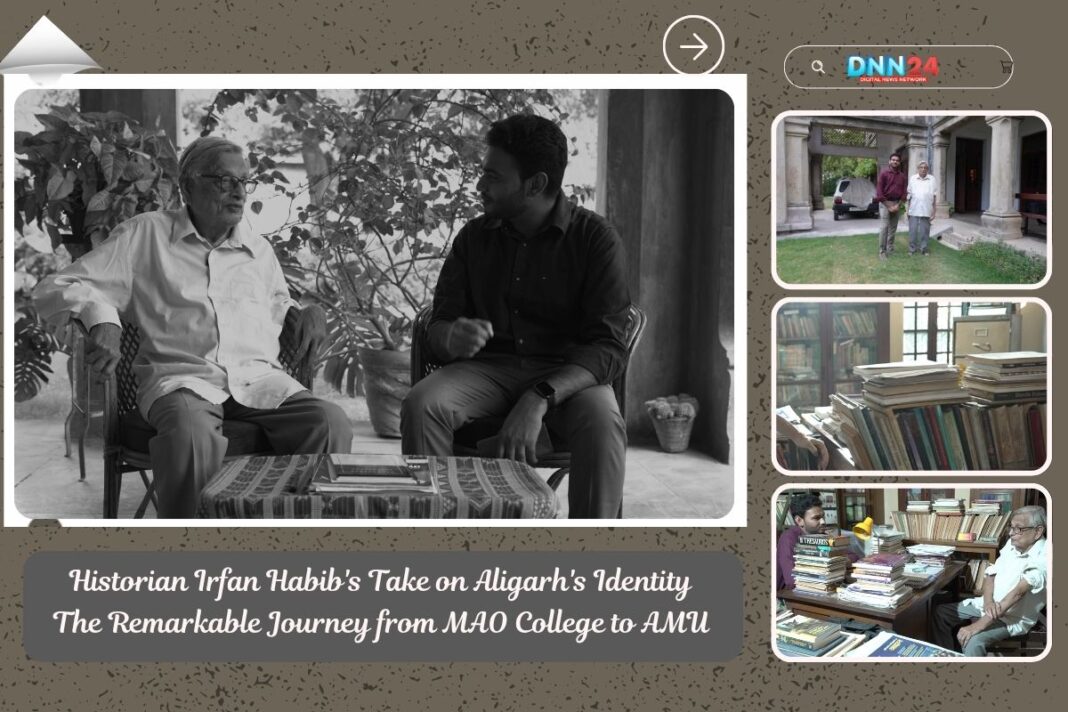

In the heart of Aligarh’s Badarbagh area stands a magnificent bungalow where time seems to have paused. This isn’t just any ordinary house—it’s where history itself takes breath. Entering this magnificent building, dusty books of past eras start to reveal their stories. This is more than just a home; it’s a place where the past lives and breathes.
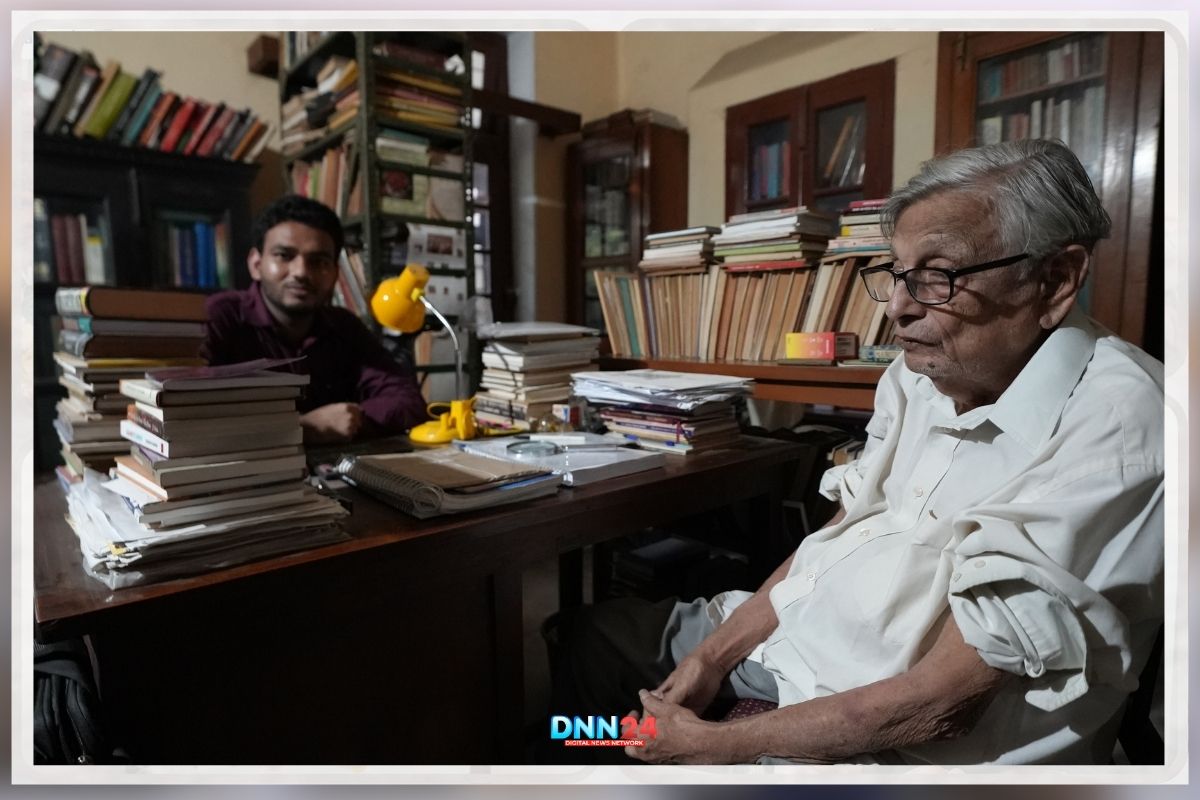
When we entered the building, we found Professor Irfan Habib sahab completely absorbed in the magic of books. The simplicity around him made him live in a different world altogether. In our interview with Irfan Habib Sahab, he told us one interesting fact; this house and his birth are of the same age. The two were born in the same year. This house was constructed in 1931, the year Professor Habib was born, by a British company. He also took us through his library, where thousands of books are arranged on the shelves like mute custodians of knowledge.
The Persian Connection That’s Fading Away
During our chat among the book-filled shelves, Irfan Habib Sahab mentioned the Persian language with a tinge of sadness in his voice. He complained that Persian is now read by very few people. This concern isn’t just academic—it’s deeply personal for someone whose research primarily focuses on Mughal history. Most of his work involves reading Persian texts written during the Mughal era in ‘Shikast’ script, and finding people who can read this style has become incredibly difficult.
“Persian is still studied because of Iran,” he explained, “but the Persian that was written during Mughal times in Shikast script – there are very few readers left. Even if there are a dozen, that’s considered a lot.” It is his business now to read these old books and to write articles upon the knowledge he has derived from them. The declining number of Persian readers poses a serious threat to understanding India’s 600-year history, as even Maratha history was written in Persian.
Irfan Habib: How Aligarh Got Its Name
The story behind Aligarh’s name is as fascinating as the city itself. Though it’s difficult to find documented proof in historical records, it’s widely believed since the 19th century that the name comes from Najaf Ali Khan. He was a politician in Delhi’s court with considerable influence and was friends with Mahadji Scindia. When Kol (the city’s original name) came under Scindia’s control, Najaf Ali Khan established his military base where the mosque and annual fair now stand – this area was called ‘Pakki Baradari.’
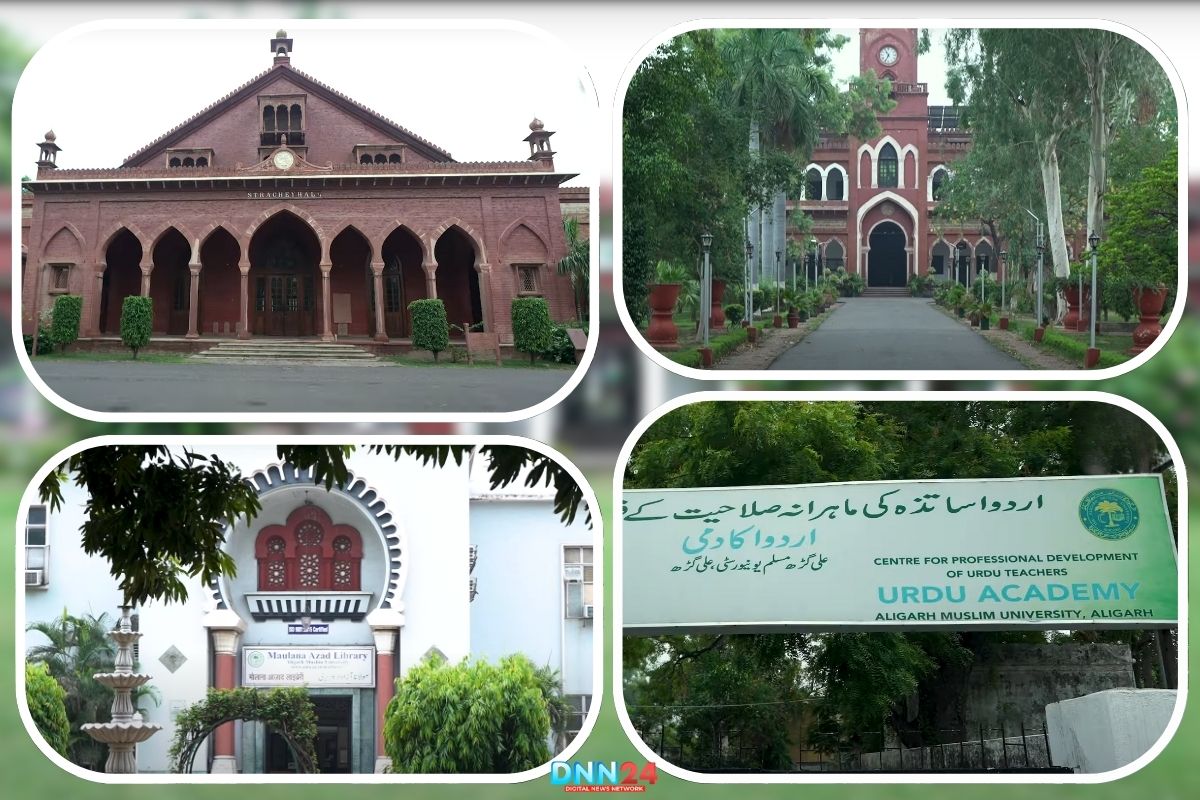
The twist happened in the year 1803 when the British replaced the Marathas. They found having two names confusing, so they dropped ‘Kol’ as the tehsil name and made ‘Aligarh’ the official city name. Before 1803, the city was known as Kol, but Najaf Ali Khan’s fort had given the area the name Aligarh.
Irfan Habib on Sir Syed’s Vision: Beyond Just English Education
Contrary to popular belief, Sir Syed Ahmad Khan didn’t establish a university—he founded MAO College, which later became a university in 1921. His vision was clear yet limited by his time’s social context. He noted that Muslims did not have an English education and could not thus excel in the British administration and secure appointments in government jobs.
He mainly aimed at establishing a school and then a college where English would be taught. However, his vision had significant limitations that seem problematic by today’s standards. Women’s education wasn’t part of his agenda – effectively excluding half the population. He was also of the view that education should be given to the wealthy people only and not the poor people because there were no reasons to educate the poor.
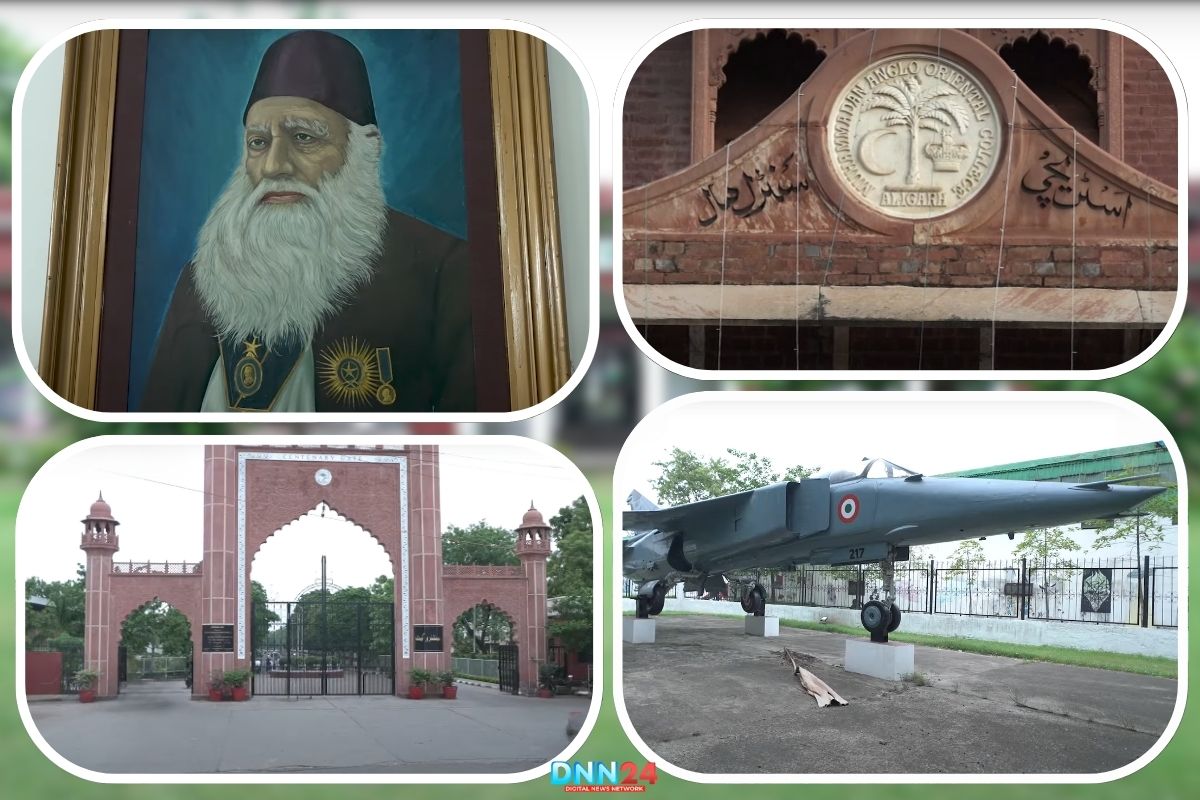
However, one point of his vision that has never been out of date is his focus on science and reason. He was quite convinced that modern knowledge was needed, especially that which could be attained through English education. Not only would this give scientific knowledge, but it would also facilitate access to British services.
Irfan Habib on The Social Response: The Pros and Cons
Society at the time was divided into different camps regarding Sir Syed’s educational mission. One group thought that the British were in power, and learning English would enable them to get jobs in their services. Even without the jobs in the government, knowledge of English would make life very easy. This was Sir Syed’s and his friends’ perspective.
The opponents also had valid reasons. They worried that English education would negatively impact their religion and that people wouldn’t be able to maintain their traditional faith. These opponents weren’t insignificant in number, and many of them were actually involved in India’s freedom struggle. They considered Sir Syed as a person who aspired to serve the British instead of serving independence.
The criticism wasn’t entirely unfounded. While Sir Syed’s emphasis on science and reason remains relevant today, his approach of seeking British favor to secure educational grants created lasting controversies. His hostility to the National Movement was partly tactical; to remain in favour with the government was to receive grants, however small, indefinitely.
Irfan Habib on The Growth from 800 to 20,000: AMU’s Transformation
Professor Habib witnessed the university’s remarkable transformation firsthand. When India became independent in 1947, the university had 800-1000 students, including school students registered. It currently has more than 20,000 students. The hostel facilities were very poor at that time, but the university has today turned into a huge institution.
This growth wasn’t accidental. Many subjects that are taught today weren’t offered back then. The engineering college, though established during Dr. Ziauddin’s time, was very small. The university has grown into a much bigger university with many departments and research facilities.
Credit must also be given to Pandit Nehru’s contribution to the university’s survival and growth. According to Professor Habib’s recollections, Nehru visited Aligarh three times after becoming Prime Minister in 1947. He would come, traveling by car with just one guard, reflecting a different era’s simplicity. Nehru’s significant contributions included saving the university, properly arranging grants, appointing Zakir Sahab as Vice-Chancellor, and ensuring that Aligarh Muslim University’s name was included in the Constitution alongside Banaras University.
Irfan Habib on Secular Spirit: Knowledge Beyond Religions
One of AMU’s greatest contributions has been strengthening secularism and Ganga-Jamuni tehzeeb in India. Professor Habib tells us that as you disseminate knowledge, you realize that none of human being can be divided by religion, caste or race. Knowledge is everybody’s right. When Muslims believe that only Muslims can give knowledge, then nothing would be left; there would be no Einstein and other geniuses.
Religion has nothing to do with the boundary of knowledge. Therefore, no university—whether it’s the Hindu University of Banaras or Aligarh Muslim University—can remain limited to its particular religion. Even madrasas or pathshalas cannot be limited to a single religion since everyone contributes to the knowledge of the whole of India and the world. Religion has its own domain, whereas knowledge and education have their own domains.
This philosophy has made AMU a true center of learning where students from all backgrounds come together, creating a unique blend of cultures and ideas that embodies India’s composite culture.
Irfan Habib on Contemporary Problems and Prospects of the Future
Considering the modern situation in education, Professor Habib was afraid of ideological tendencies in the field of teaching history. He emphasized that while some ideological bias is inevitable in social science subjects due to human limitations and backgrounds, historians must resist excessive nationalism that leads to unfair praise of one’s own country.
The government’s attempt to introduce a syllabus claiming that Aryans spread from India and that the caste system came due to Muslims was strongly opposed by academic organizations like the Indian History Congress. Intellectuals and universities dismissed these historically inaccurate claims, which demonstrated the significance of academic opposition to historically constructed politics.
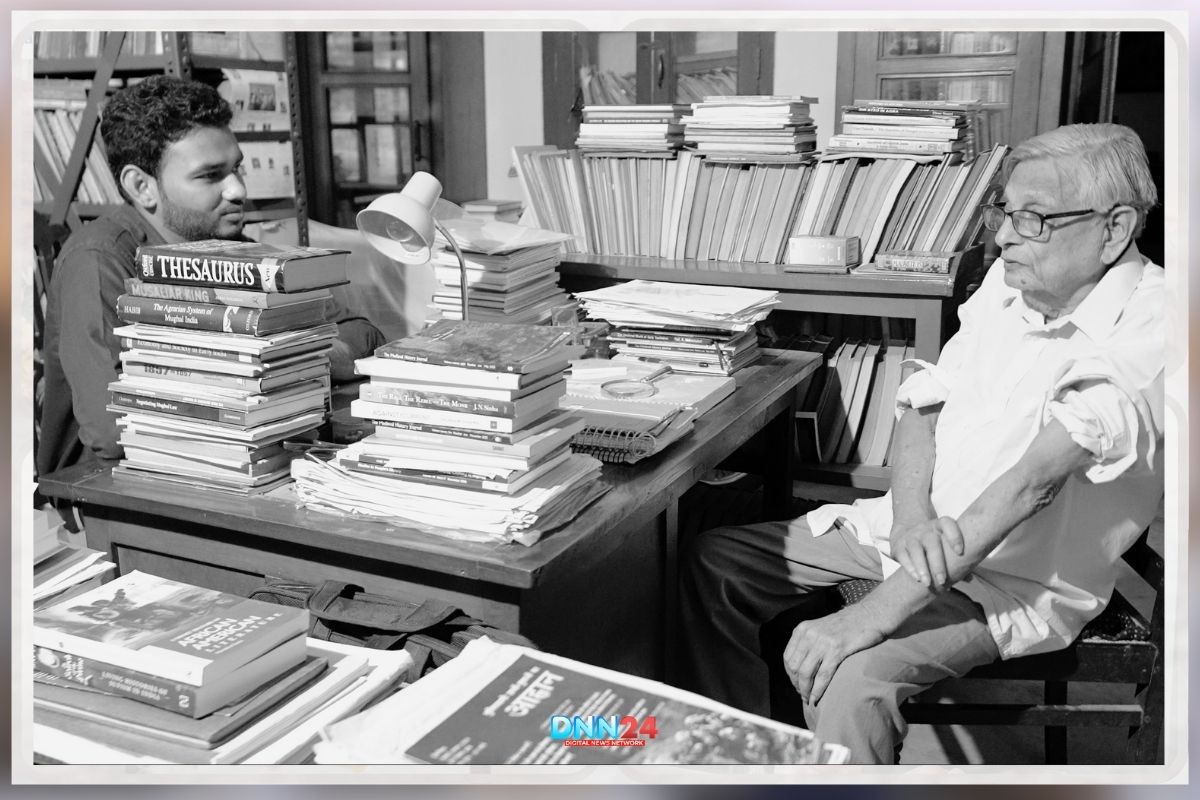
The challenge of preserving Persian manuscripts and documents at AMU remains critical. The History Department has a number of valuable private collections and manuscripts in the university, but these are largely in Persian and Shikast script. With fewer people able to read these scripts, there’s a real danger of losing access to 600 years of Indian history.
Conclusion: A Living Legacy
Our stroll talk with Professor Habib was like time had wings, and it flew without us noticing it. His lack of pretense is to be saluted; he walked himself to the gate to see us off. This wasn’t just an interview but a fascinating tale filled with knowledge and memories.
The journey from MAO College to Aligarh Muslim University represents more than institutional growth – it embodies the evolution of educational thought, the struggle between tradition and modernity, and the ongoing quest to balance religious identity with secular knowledge. As Professor Habib’s insights reveal, understanding this history isn’t just about the past – it’s about comprehending the challenges and opportunities that lie ahead for Indian education and society.
In the era of artificial intelligence and modern technology redefining the education sector, Sir Syed’s principles of focusing on science, reason and modern knowledge are as timely as ever. The challenge lies in maintaining this vision while preserving the rich cultural heritage that makes institutions like AMU unique in India’s educational landscape.
Also Read: A Memorable Meeting with The Famous Historian Professor Irfan Habib
You can connect with DNN24 on Facebook, Twitter, and Instagram and subscribe to our YouTube channel.