
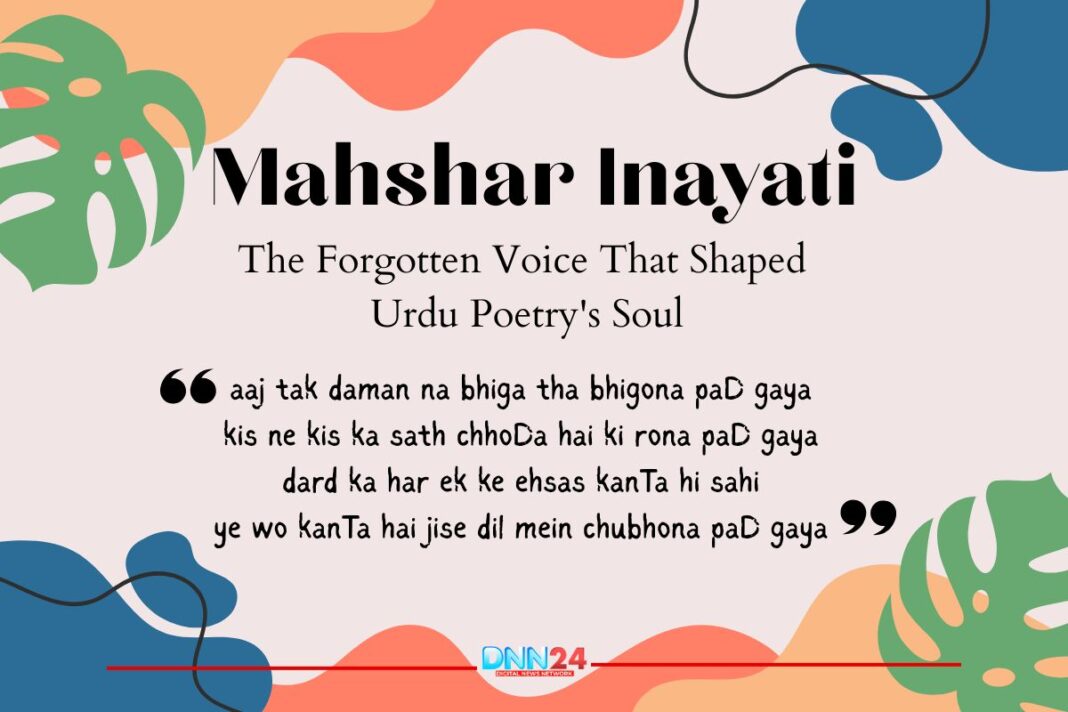

What happens when a genius lives in shadows, writing verses that could move hearts yet remaining unknown to most? Mahshar Inayati’s story is one such mystery, a tale of brilliance hidden beneath layers of silence and struggle.
na ghair hi mujhe samjho na dost hi samjho
Mahshar Inayati
mere liye ye bahut hai ki aadmi samjho
The Rampur Boy Who Found Poetry in Poverty
Mahshar Inayati was born in 1909 as Sabir Raza Khan in Rampur, Uttar Pradesh. The city breathed poetry through its streets, where classical Urdu traditions flourished like jasmine in the monsoon. Yet for young Sabir, life presented no grand welcome. His family lived without wealth or connections that opened doors in literary circles. Where other poets enjoyed comfortable drawing rooms and generous patrons, Mahshar knew the weight of empty pockets and uncertain tomorrows.
main rah raha hun zamane mein sae ki surat
Mahshar Inayati
jahan bhi jao mujhe apne sath hi samjho
Still, something inside him burned bright. Poetry was not a hobby or a fashionable pursuit. It became his oxygen, the language through which he understood existence itself. He absorbed the musical rhythms of ghazals while navigating daily survival, creating an unusual foundation for his distinctive voice. Friends from those early years remember a quiet boy who observed everything, storing impressions like treasures to be later transformed into verse.
har ek baat zaban se kahi nahin jati
Mahshar Inayati
jo chupke baiThe hain kuchh un ki baat bhi samjho
His education came not from expensive institutions but from listening, reading whatever manuscripts he could find, and practising his craft in solitude. This hunger for poetry, born from deprivation rather than privilege, gave his work an emotional truth that formal training rarely produces. The cultural richness of Rampur fed his imagination even as economic hardship tested his resolve.
guzar to sakti hain raaten jala jala ke charagh
Mahshar Inayati
magar ye kya ki andhere ko raushni samjho
Every couplet he composed carried the fingerprints of real struggle, fundamental longing, and real hope struggling against difficult odds. This combination of cultural inheritance and personal battle shaped a poet whose words would eventually whisper truths that louder voices often missed.
wo sher kahne lage ho tum ab to ai ‘mahshar’
Mahshar Inayati
na koi aur hi samjhe na aap hi samjho
Words Dipped in Life’s Bitter and Sweet Waters
Mahshar Inayati’s poetry stands apart because it refuses to hide behind decorative language. His ghazals and nazms carry the elegance expected from the Rampur school, but underneath that polished surface runs something raw and immediate. He wrote about love not as romantic fantasy but as the ache of separation. He explored spiritual themes not through abstract philosophy but through the confusion and yearning of someone genuinely searching for meaning.
hum se gumrah zamane ne kahan dekhe hain
Mahshar Inayati
hum ne miTte hue qadmon ke nishan dekhe hain
Each verse feels like a window into his private thoughts, yet speaks to universal human experiences. What many readers miss is how cleverly he wove his autobiography into traditional forms. The longing in his poetry mirrors his own isolation from mainstream literary success. The pain of unfulfilled desires reflects his struggle to make ends meet while pursuing his art.
aap ne dekh ke har ek ko nazar pheri hai
Mahshar Inayati
aap ne sahib-e-ehsas kahan dekhe hain
The spiritual questioning arises from someone who has endured enough hardship to wonder about life’s deeper purpose. Unlike poets who crafted beautiful illusions, Mahshar offered honest reflections. His language maintained classical refinement because he respected the craft, but his subjects came directly from lived reality. He believed poetry should connect hearts, not just impress minds.
zindagi sidhi si ek rah nahin hai ai dost
Mahshar Inayati
is mein jo moD hain wo tu ne kahan dekhe hain
This philosophy meant he never chased trends or wrote to please critics. His verses aimed for something more challenging: genuine emotional resonance. The result is a body of work that feels both timeless and deeply personal, traditional yet surprisingly intimate.
dil jahan larze umidon ka tasawwur kar ke
Mahshar Inayati
main ne ummid ke aasar wahan dekhe hain
Reading his ghazals today, one encounters a voice that sounds familiar despite the decades that separate us from his era. This accessibility comes from his commitment to emotional truth over stylistic showmanship, making his poetry a bridge between classical excellence and human vulnerability.
uTh gai aankh agar meri to jam jaegi
Mahshar Inayati
aap ne dida-e-har-su-nigran dekhe hain
The Silent Battles Behind Every Couplet
Most admirers of Mahshar Inayati’s work know his verses but not his struggles. Behind those carefully crafted lines lived a man fighting battles that would have crushed lesser spirits. Money remained scarce throughout his life, forcing him to write under conditions that would discourage most creative minds. There were nights when lamp oil was a luxury, yet he wrote anyway, composing verses by whatever light he could manage.
be-rang the aarzu ke KHake
Mahshar Inayati
wo dekh rahe hain muskura ke
No wealthy patron supported his work, no institution offered him security. Poetry brought respect but rarely bread, leaving him to balance artistic passion against practical necessity. These material struggles pale in comparison to his emotional losses. Life dealt him personal tragedies that appear in his poetry as themes of separation and grief. He understood pain not as a literary concept but as a lived experience, which is why his sad verses cut so deep.
ye kya hai ki ek tir-andaz
Mahshar Inayati
jab take hamare dil ko take
Friends describe him as someone who carried sorrows quietly, never complaining but transforming hurt into artistic expression. This dignity in suffering adds weight to every word he wrote. Another overlooked aspect of his life involves his generosity toward younger poets despite his own difficulties. He mentored aspiring writers, including Azhar Inayati, who would later gain recognition. Mahshar freely shared his knowledge, helping others refine their craft even when he received little recognition himself.
ab soch rahe hain kis ka dar tha
Mahshar Inayati
hum sambhle hi kyun the Dagmaga ke
These acts of quiet mentorship show a man who valued poetry beyond personal achievement, seeing it as a tradition to be nurtured and passed forward. Such selflessness rarely makes headlines, yet it reveals a depth of character that enriches our understanding of his work. The poetry becomes more powerful when we know the circumstances under which it was created, each ghazal a small victory over circumstance, each nazm a testament to persistence.
ek ye bhi ada-e-dilbari hai
Mahshar Inayati
har baat zara ghuma phira ke
A Whisper That Still Echoes Through Time
Mahshar Inayati never achieved the fame that grabs attention or fills auditoriums. His legacy operates differently, moving through quiet channels that value substance over spectacle. His poetry continues to find readers who appreciate emotional honesty and classical craftsmanship. Platforms like Rekhta preserve his work, introducing new generations to verses that still speak to contemporary hearts.
farebon se na bahlega dil-e-ashufta-kaam apna
Mahshar Inayati
ba-zahir muskura kar dekhne wale salam apna
His influence appears in poets who learned from his example, carrying forward his belief that poetry should touch souls rather than chase applause. The Rampur literary tradition remembers him as someone who embodied its highest values while adding personal dimensions that breathed new life into the classical form. What survives beyond his published verses is the model he provided for living as a poet.
mughanniyon ko bulao ki nind aa jae
Mahshar Inayati
kaho wo git sunao ki nind aa jae
He showed that artistic integrity matters more than recognition, that emotional truth outlasts temporary trends, that dedication to craft can sustain a life even when material rewards remain elusive. These lessons resonate with anyone pursuing creative work against difficult odds. His story offers hope that genuine expression eventually finds its audience, even if not immediately or dramatically. The poetry itself remains his most incredible legacy, waiting for readers who seek depth rather than flash, who value feeling over fashion.
KHush hain bahut mizaj-e-zamana badal ke hum
Mahshar Inayati
lekin ye sher kis ko sunaen ghazal ke hum
Every ghazal invites us into a conversation about love, loss, faith, and the mysterious beauty of human existence. These conversations continue because Mahshar wrote from places inside himself that connect with places inside us all. His journey from the modest households of Rampur to a respected position in the history of Urdu literature proves that greatness needs neither wealth nor fame to flourish, only honesty, dedication, and the courage to keep writing when everything else suggests stopping.
Also Read: Tomb of Sher Shah Suri: An Emperor’s Dream Palace Floating On Water
You can connect with DNN24 on Facebook, Twitter, and Instagram and subscribe to our YouTube channel.