
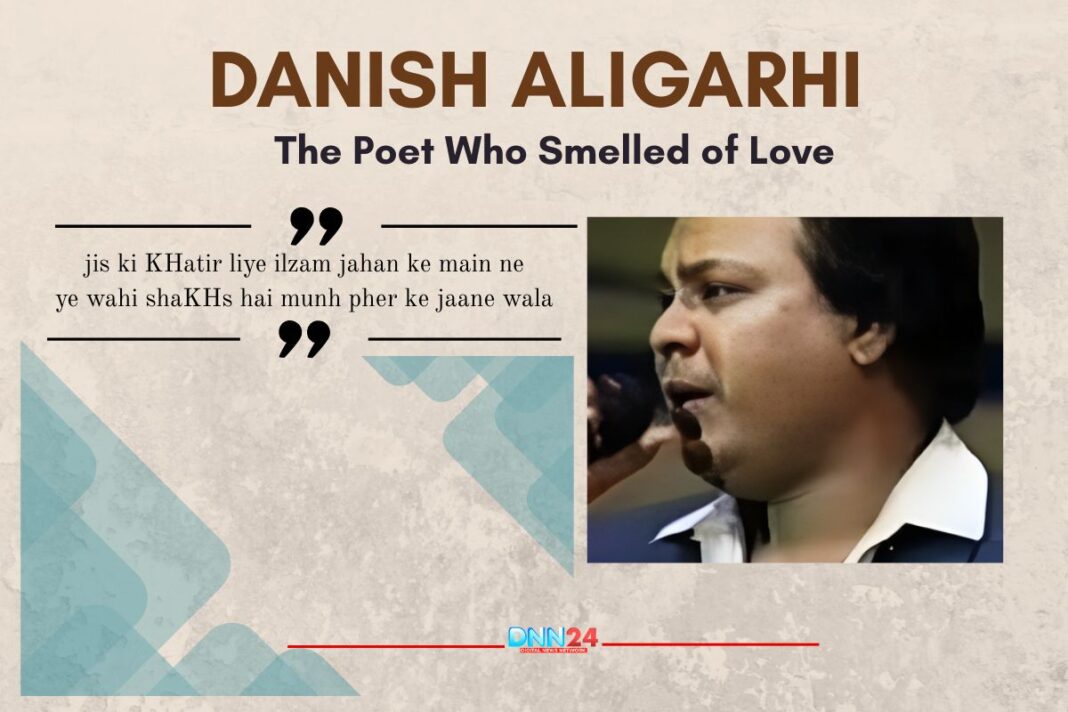

Danish Aligarhi, born as Muhammad Usman Khan in Aligarh, grew up amidst the mingling sounds of azaan and temple bells. His childhood was marked by modest comfort, his world small but rich in rhythm and reflection. The air of Aligarh, thick with history and scholarship, seemed to whisper verses into his young ears. In those narrow lanes, a boy was quietly learning how to feel deeply and write truthfully.
tum ne jab zulf-e-pareshan ko sanwara hoga
Danish Aligarhi
sadqa-e-husn ghaTaon ne utara hoga
Books were his escape and his promise. While others chased games and gossip, he sat under flickering lamps, reading poets who spoke of love as though it were faith. His first poem, inspired by falling leaves, came not from ambition but from wonder. Even as a child, he seemed to understand that beauty was never permanent, only felt.
aap ki chashm-e-karam ka jo ishaara hoga
Danish Aligarhi
auj par mere muqaddar ka sitara hoga
When he moved to Tamil Nadu, life took on a new colour. The southern land welcomed him with unfamiliar words and a new rhythm. The warmth of the people eased his loneliness, and soon his poetry began to carry the fragrance of two worlds, North and South, Urdu and Tamil, tradition and modernity. Danish found in this blending a new voice, one that spoke of togetherness without borders. Tamil Nadu did not just become his home; it became his muse.
sang-dil tere bhi aansu nikal aae honge
Danish Aligarhi
Dubne wale ne jab tujh ko pukara hoga
Shadows and Struggles: The Unheard Stories
Behind the calm elegance of his verses lay a life of quiet battle. Danish’s story was never easy. His father’s early death left the family adrift, and survival became a test of endurance. Yet, he refused to surrender to despair. He often said he wrote to stay alive, not just in body, but in spirit as well.
main ne ilzam KHushi se liye sab apne sar
Danish Aligarhi
aap badnam hun ye kis ko gawara hoga
He worked by day and wrote by night, his lantern burning longer than his meals lasted. Hunger, exhaustion, and uncertainty became companions he knew by name. Still, his pen did not falter. Once, on his way to a poetry gathering, his shoe tore apart, but he wrapped his foot in cloth and kept walking. That evening, he recited a verse that would echo for years: “Till the end, only darkness accompanied me; the world’s brightness never suited me.” Those who heard it said the hall fell silent before applause filled the air.
zarre zarre mein mahak pyar ki Dali jae
Danish Aligarhi
bu tassub ki har ek dil se nikali jae
His challenges were not just material. Writing Urdu poetry in Tamil Nadu meant facing misconceptions and language barriers. Yet, Danish’s response to hostility was always affection. He believed poetry could wash away misunderstanding. His lines often spoke like gentle rebukes to hatred: “In every particle let us pour love’s fragrance; let every heart be free of the smell of intolerance.” His work was not born from anger, but from hope, a belief that even broken bridges can be rebuilt with words.
apne dushman ko bhi KHud baDh ke laga lo sine
Danish Aligarhi
baat bigDi hui is tarah bana li jae
The Poet of Unity: Danish Aligarhi’s Writings
Danish Aligarhi’s poetry became the meeting place of hearts. His ghazals and nazms were not written for applause; they were written for remembrance. Every word he crafted carried the simplicity of village life and the depth of sacred philosophy. His verses urged people to love across language, faith, and history.
kya KHabar thi munharif ahl-e-jahan ho jaenge
Danish Aligarhi
hote hote mehrban na-mehrban ho jaenge
He often said poetry should not be divided by meaning but unite through feeling. His most loved lines, “Let every grain of earth breathe love’s perfume, let every heart forget the scent of prejudice,” captured this vision. The people of Tamil Nadu, who once viewed Urdu as distant, began to see its beauty through him. His mushairas became celebrations of cultural unity where Tamil and Urdu, like two rivers, flowed into one sea.
muskura kar un ka milna aur bichhaDna ruTh kar
Danish Aligarhi
bas yahi do lafz ek din dastan ho jaenge
He mentored young writers, not with lectures but with quiet encouragement. Many remember him sitting under a tree, discussing poetry as if it were conversation, not craft. He built friendships with poets from other languages and cultures, believing that words had no religion. His gatherings were filled with laughter, tea, and the unspoken understanding that art was a sacred bond.
ishq sadiq hai to apne azm-e-manzil ki qasam
Danish Aligarhi
har qadam par sath lakhon karwan ho jaenge
Beyond his celebrated works lay the softer poems, the ones written about ordinary people. He wrote of jasmine sellers, street children, and nameless travellers. In giving them voice, he gave dignity to simplicity. He never saw poetry as mere decoration; he saw it as a reflection of truth. His words, humble and pure, became his form of prayer.
ye maal-e-ishq hoga ye kise malum tha
Danish Aligarhi
dil ke naghme ek din aah-o-fughan ho jaenge
Lasting Legacy: Lessons from Danish Aligarhi’s Life
Danish Aligarhi’s life ended quietly, without the grand farewell that fame often demands. But his words live on, carried in the voices of students and sung in the courtyards of Tamil Nadu. His poems are quoted not just for their beauty, but for their wisdom.
ab nahin koi mere dil ko dukhane wala
Danish Aligarhi
yaad aata hai bahut ruTh ke jaane wala
He left behind no wealth, no monuments, only verses that continue to heal. His true legacy lies in the hearts he touched, in the small reconciliations he inspired between people who might never have spoken to each other otherwise. Every time a young poet in Aligarh or Chennai writes of unity, a little of Danish lives again.
gardish-e-waqt miTa mujh ko magar yaad rahe
Danish Aligarhi
phir nahin koi tera naz uThane wala
His life teaches one enduring truth: that art has the power to outlast pain. He demonstrated that greatness is not measured by applause, but by empathy. In a world growing more restless by the day, his poetry reminds us to slow down, to listen, to forgive. Reading him today feels like standing before a still pond, quiet on the surface, yet full of reflections that stir the soul.
jab bhi aaegi meri yaad taDap jaega
Danish Aligarhi
apni mahfil ko mere ba’d sajaane wala
Those who knew him often said he never wrote with his hand alone. He wrote with the ache of his past and the promise of his faith. Danish Aligarhi was not merely a poet; he was a bridge between people, between words, between hearts. His story reminds us that even in silence, love can be loud enough to change the world.
Also Read: Bahadur Shah Zafar: The Emperor Who Lost Everything But Refused to Stop Writing Poetry
You can connect with DNN24 on Facebook, Twitter, and Instagram and subscribe to our YouTube channel.