
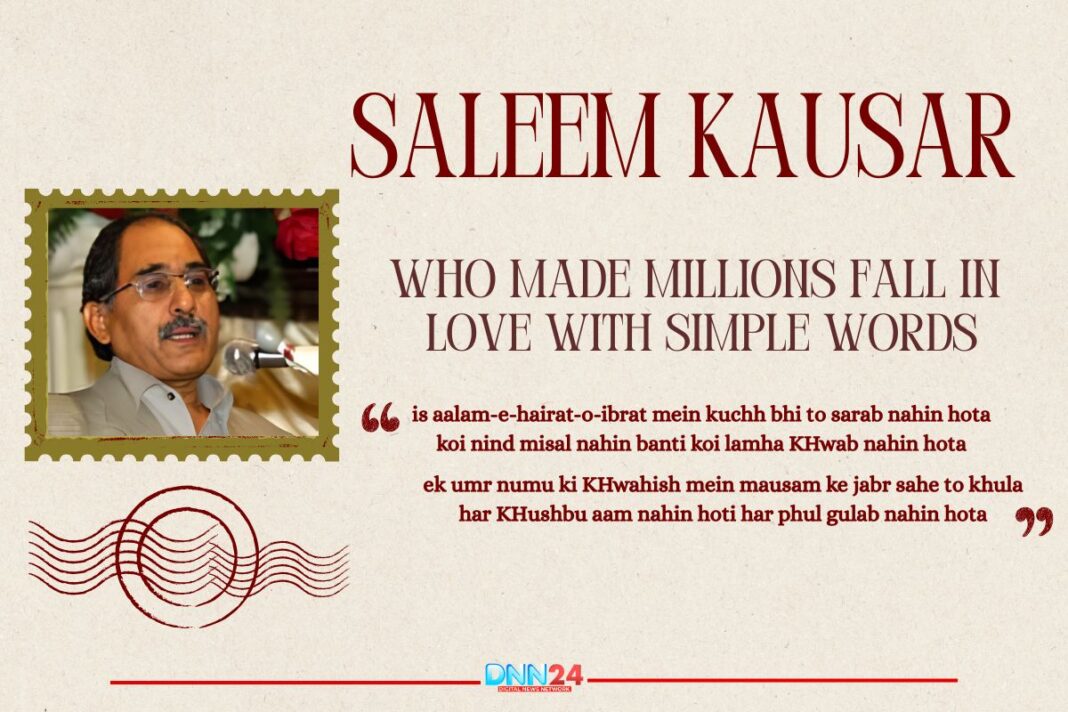

Most poets build their legacy on complexity. Saleem Kausar built his own clarity. Born in the chaos of 1947, when India was splitting into two nations and families were being torn apart, this man would grow up to become one of Urdu poetry’s most beloved voices. But his story is not what you might expect. There are no grand libraries or privileged beginnings here. Just a boy, a pen, and a determination to speak the language of the heart in words everyone could understand. What he achieved with this simplicity remains nothing short of remarkable.
main KHayal hun kisi aur ka mujhe sochta koi aur hai
Saleem Kausar
sar-e-aina mera aks hai pas-e-aina koi aur hai
Roots of a Poet: From Panipat to Pakistan
Saleem Kausar was born in October 1947 in Panipat, India, during one of history’s bloodiest migrations. The Partition was not just a political event for his family. It was the loss of home, the beginning of survival mode. They crossed into Pakistan and settled in Khanewal, a small town in Punjab, where life moved slowly and dreams felt distant. His family had no literary background, no connections to the world of letters.
qurbaten hote hue bhi faslon mein qaid hain
Saleem Kausar
kitni aazadi se hum apni hadon mein qaid hain
They were ordinary people dealing with extraordinary loss, trying to rebuild what the Partition had shattered. Young Saleem grew up watching this struggle, absorbing the pain and resilience that would later fill his verses. Despite the economic hardships that came with being refugees in a new country, education became his refuge. He pursued a Fazil in Urdu, a degree that required dedication even when circumstances could have easily pulled him away from books.
kuchh bhi tha sach ke taraf-dar hua karte the
Saleem Kausar
tum kabhi sahab-e-kirdar hua karte the
His first poem appeared in print during his school days, a moment that planted a seed of possibility. Could words become more than just an expression? Could they become a lifeline? In 1972, he moved to Karachi, where newspapers and television offered new platforms. The city’s energy and diversity shaped his perspective, adding layers to his craft while keeping his voice refreshingly simple.
kahani likhte hue dastan sunate hue
Saleem Kausar
wo so gaya hai mujhe KHwab se jagate hue
The Unheard Struggles Behind the Verses
Success in poetry rarely comes without sacrifice, and Saleem Kausar paid his dues quietly. While audiences applauded his ghazals for their emotional honesty, few knew about the financial instability that shadowed his creative journey. Supporting a family while pursuing poetry in a country still finding its footing was no small challenge. Many nights, the practical demands of survival threatened to silence the poet within him.
tujh se baDh kar koi pyara bhi nahin ho sakta
Saleem Kausar
par tera sath gawara bhi nahin ho sakta
But he refused to let circumstances dictate his passion. There is a story from his early days in Karachi that speaks volumes about his character. At a local mushaira, a poetry gathering where established names drew thunderous applause, Kausar recited his work to a distracted audience. People were there for the spectacle, the grandeur of elaborate metaphors and dramatic delivery.
kahin tum apni qismat ka likha tabdil kar lete
Saleem Kausar
to shayad hum bhi apna rasta tabdil kar lete
His simple, heartfelt ghazal barely registered. A lesser spirit might have given up, convinced that poetry required showmanship to succeed. Instead, Kausar returned. Month after month, he stood before audiences, refining his expression while staying true to his style. Gradually, something shifted.
tum ne sach bolne ki jurat ki
Saleem Kausar
ye bhi tauhin hai adalat ki
People stopped merely hearing his words and started listening. They recognised something rare: a voice that did not demand attention but earned it through genuine emotion. This quiet perseverance became his signature, proving that authenticity eventually finds its audience.
A Poet for the People
What makes Saleem Kausar special is his democratic approach to poetry. Urdu verse has a reputation for being dense, filled with references that require scholarly knowledge to appreciate fully. Kausar rejected this elitism without rejecting the language’s beauty. His poetry speaks about love, heartbreak, loneliness, and strength using words that need no translation of spirit. Anyone who has felt deeply can connect with his work immediately.
dil tujhe naz hai jis shaKHs ki dildari par
Saleem Kausar
dekh ab wo bhi utar aaya adakari par
This accessibility is not a limitation but a strength. Take his famous ghazal “Main Khayal Hoon Kisi Aur Ka” as an example. The melancholy and longing in these lines touch something universal in the human experience. You do not need a literature degree to feel the weight of unrequited love or the ache of being forgotten. His verses belong to college students nursing their first heartbreak, to older listeners remembering lost years, to anyone who has ever felt the bittersweet nature of memory.
main KHayal hun kisi aur ka mujhe sochta koi aur hai
Saleem Kausar
sar-e-aina mera aks hai pas-e-aina koi aur hai
This simplicity brought him massive popularity, especially among young people discovering Urdu poetry for the first time. They found in Kausar a gateway, proof that profound emotion does not require complicated language. His work democratised a literary tradition, making it accessible while maintaining its artistic integrity and emotional depth.
milna na milna ek bahana hai aur bas
Saleem Kausar
tum sach ho baqi jo hai fasana hai aur bas
Life Lessons in Poetry
Saleem Kausar’s journey offers inspiration beyond his verses. His life demonstrates that staying true to your voice matters more than chasing trends or approval. Born into uncertainty, shaped by displacement, he could have chosen bitterness or given up on his dreams when reality demanded compromise. Instead, he found a way to transform struggle into beauty, to channel personal and collective pain into words that heal.
tujh se baDh kar koi pyara bhi nahin ho sakta
Saleem Kausar
par tera sath gawara bhi nahin ho sakta
One aspect of his character that deserves recognition is his humility. Fame and recognition did not inflate his ego. At mushairas, he often advised younger poets to focus on honest expression rather than clever wordplay or performative flourishes. He understood that poetry’s real power lies in its ability to connect human beings through shared emotion, not in displaying technical mastery. This approach created ripples in the literary community.
wo jo aae the bahut mansab-o-jagir ke sath
Saleem Kausar
kaise chup-chap khaDe hain teri taswir ke sath
Aspiring writers saw in him a different model of success, one measured not by awards alone but by the number of hearts touched. His influence helped preserve Urdu poetry as a living, breathing art form rather than an academic curiosity. He showed that tradition and accessibility could coexist, that honouring your heritage did not mean alienating contemporary audiences.
tu suraj hai teri taraf dekha nahin ja sakta
Saleem Kausar
lekin dekhne walon ko roka nahin ja sakta
The Continuing Echo of His Words
Today, Saleem Kausar’s poetry continues to find new listeners. In an age of rapid communication and short attention spans, his verses still command moments of stillness and reflection. People share his ghazals on social media, recite them at gatherings, and find comfort in them during personal struggles. His work has transcended the printed page, becoming part of everyday cultural expression. What makes his legacy endure is its foundation in genuine human experience.
wahan mahfil na sajai jahan KHalwat nahin ki
Saleem Kausar
us ko socha hi nahin jis se mohabbat nahin ki
He did not write to impress critics or secure literary prizes. He wrote because he understood pain, hope, love, and loss, and he wanted to share that understanding. This authenticity gives his poetry a timeless quality that fashion and trends cannot diminish. From the dusty lanes of Panipat to the vibrant streets of Karachi, Saleem Kausar’s journey embodies resilience and artistic integrity.
lau ko chhune ki hawas mein ek chehra jal gaya
Saleem Kausar
shama ke itne qarib aaya ki saya jal gaya
He remained a humble figure whose greatness came not from pedigree or privilege but from an unwavering commitment to emotional truth. His life reminds us that art’s highest purpose is not to dazzle but to connect, not to elevate the artist but to touch the audience. In choosing simplicity over complexity, accessibility over exclusivity, he created something rare: poetry that truly belongs to the people.
Also Read: Tomb of Sher Shah Suri: An Emperor’s Dream Palace Floating On Water
You can connect with DNN24 on Facebook, Twitter, and Instagram and subscribe to our YouTube channel.