
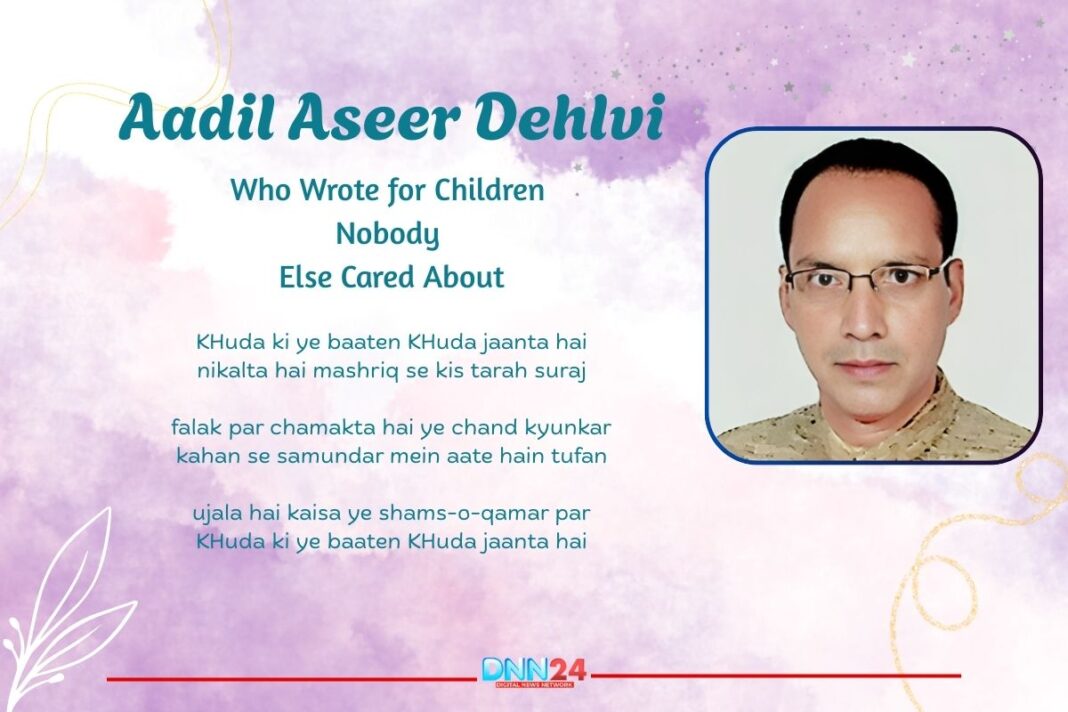

What makes a man spend his entire life writing poems for children when everyone told him it was foolish? Aadil Aseer Dehlvi did precisely that. Born in September 1959 in Delhi as Aadil Rasheed, he wrote over two dozen books of Urdu poetry and stories for young readers before he died in 2014.
mere jine ki saza ho jaise
Aadil Aseer Dehlvi
zindagi ek KHata ho jaise
His life was a mixture of beautiful victories and crushing defeats. While most poets chased fame in adult literature, Aadil chose the more challenging path. He wrote for tiny hearts, turning simple Urdu words into treasures that children still remember. This is the story of his silent battles, his incredible determination, and the legacy he left behind most unexpectedly.
When Dreams Began in Old Delhi’s Narrow Lanes
Aadil Rasheed grew up in the crowded streets of Old Delhi, where he attended Anglo-Arabic School. The year was 1959, and the city smelled of kebabs and history. His family was not wealthy. Books were expensive, and siblings had to share whatever they could find. Yet something stirred inside young Aadil when he heard Urdu poetry recited at home. The language felt like music to him. He started writing small poems on any scrap paper he could find. His teachers noticed something special about this quiet boy who loved words more than cricket.
dil ke gulshan se guzar jati hai
Aadil Aseer Dehlvi
yaad ek baad-e-saba ho jaise
One teacher, though, made fun of his handwriting. The mockery stung deeply. Aadil went home and cried, but he did not give up. Instead, he promised himself that his words would one day matter. He would write for children who felt small and unimportant, just like he did. Getting his MA in Urdu and honours in Arabic was not easy. Money was always tight. He took tuition classes and sold handmade greeting cards to pay for his education. Some nights, he studied until dawn broke over the Yamuna River.
yun KHayalon mein chale aate ho
Aadil Aseer Dehlvi
koi paband-e-wafa ho jaise
The worst moment came when a local poetry gathering rejected him. They said his work was too childish. He walked to the riverbank alone and wept. Talking to the flowing water, he whispered that his words would find their home someday. That rejection became his fuel. He started experimenting with Rubaiyat and Naat explicitly written for children, something almost no one had tried before. His family worried about his choices.
yaad hai tujh se bichhaDne ka saman
Aadil Aseer Dehlvi
shaKH se phul juda ho jaise
Poetry for children seemed to them like a waste of talent. But his mother believed in him. During exam nights, when fever burned his forehead, her cool hand gave him strength. By the time Aadil graduated, he had become more than a scholar. He was a storyteller with a mission to reach the hearts that society often forgot.
The Books That Became Medicine for Scared Children
Aadil’s writing carried a gentle power that could calm frightened minds. During the terrible riots of the 1980s in Delhi, he gathered scared children in a community centre. While violence raged outside, he told them stories of clever Birbal. His voice shook with emotion because he had lost friends in those riots, too. But he hid his pain and gave the children something to smile about. From such raw moments came his most loved books.
apni baaton pe guman hota hai
Aadil Aseer Dehlvi
tu ne kuchh mujh se kaha ho jaise
Nanhi Munni Nazmen appeared in 2004, followed by Pyare Pyare the same year. Then came Birbal Ki Kahaniyan in 2008 and Bachchon Ke Iqbal in 2009. Each book was born from real struggles. Publishers kept saying no. They told him that children’s Urdu literature would not sell. So Aadil printed his first books himself.
us se mil kar hua mahsus ‘asir’
Aadil Aseer Dehlvi
wo mere sath raha ho jaise
He stood outside the school gates, selling them from a cloth bag. His pockets stayed empty, but his spirit remained full. One stormy night, he ran out of ink while writing a poem. Rather than stop, he dipped a feather in tea and continued writing. Later, he laughed about it, even though tears had mixed with that laughter.
apne hi dil ki baat se mahka gaya hun main
Aadil Aseer Dehlvi
apne hi ruh-o-jism mein ghulta gaya hun main
When a family member fell seriously ill, medical bills drained every rupee he had saved. During those desperate hospital visits, he wrote Ganja Nama in 2005. The book told funny stories about a bald hero, turning his grief into something children could giggle about. His most significant innovation was creating Rubai and Naat for young readers. He mixed faith with fun, teaching good values through simple couplets.
aisi hi kuchh kashish hai jo hun farsh-e-KHak par
Aadil Aseer Dehlvi
warna bulandiyon se bhi uncha gaya hun main
One famous line went like this: the good path is where goodness walks, carefully avoiding the bad that talks. Urdu academies began giving him awards slowly. But his real reward came differently. A shy girl once thanked him, tears in her eyes, because his story had helped her feel better. For Aadil, that moment mattered more than any trophy. His books were not just entertainment. They were lifelines thrown to children drowning in confusion and sadness.
The Pain He Carried While Making Others Happy
Aadil always smiled during his poetry readings, but few people knew what he suffered privately. His health started failing early because he would write through entire nights. Doctors warned him about burnout. He ignored them, saying that stories could not wait. In the early 2000s, a painful family conflict arose over his career choice. When his father became ill, Aadil sold his only gold ring to buy medicines. Even while dealing with that heartbreak, he composed lullabies to comfort his father.
ai ‘ishq rah-e-dost hai dushwar-tar bahut
Aadil Aseer Dehlvi
ya’ni nigah-e-naz mein aaya gaya hun main
Recognition came in small bursts. When Pyare Pyare won an Academy Award, crowds celebrated him. But at home, doubt ate at his confidence. He burned rejected manuscripts in his backyard, watching the ashes fly away. Once, on a train to a literary festival, thieves stole his bag containing a critical manuscript. He felt destroyed. Then he did something incredible. He rewrote every single line from memory. Those recreated verses about Mahiye and Paheli became even stronger than before. Children loved trying to solve his riddles.
har chehra aaina hai nigahon ke samne
Aadil Aseer Dehlvi
har aaine ke qalb mein dekha gaya hun main
After 2010, his eyesight began to fade from overreading. He could no longer write, so he dictated his poems to a young neighbour girl. Her laughter became his new inspiration. While other poets gained fame writing sophisticated ghazals for adults, Aadil faced mockery. People called him a kiddie writer. Some thought he was wasting his talent. Yet he stayed true to his purpose. He once wrote these lines: the paper ends, the pen ends, and I will end too, but the story of passion has no ending.
maqsad har ek nigah ka meri nazar mein tha
Aadil Aseer Dehlvi
kya kya fareb-e-dost hain batla gaya hun main
His most emotional work happened quietly. He taught street children how to write Urdu rhymes. One poor boy’s first poem reminded Aadil of his own childhood hunger for expression. Scholar Feroz Muzaffar wrote a whole study called Adil Aseer Dehelvi: Aik Mutaleya about his dedication. Aadil proved that real courage happens when nobody is watching.
What He Left Behind for Tomorrow’s Children
Aadil Aseer Dehlvi died in 2014, but his words refuse to die. Just before his final days, something beautiful happened. He lay in bed, too weak to move. Children gathered around him. He recited his last Kah Mukarniyan poems from memory, his voice barely a whisper. The children’s eyes went wide. Some cried, some laughed. He gave them his words as final gifts.
phir koi baat meri saba le ke uD gai
Aadil Aseer Dehlvi
KHushbu ki tarh phulon se uDta gaya hun main
His persistence despite poverty and rejection eventually earned him honours from Urdu academies. His family stood by him through everything. His wife supported him during the hardest years when money disappeared. His children felt proud calling him Abbu, the man with magic words. Now they continue sharing his work.
ya to tere shabab ko pahunchi nahin nazar
Aadil Aseer Dehlvi
ya wus’at-e-KHayal se ghabra gaya hun main
Something interesting happened after his death. One verse from Nanhi Munni became so popular in schools that Hindu and Muslim students started performing plays together based on his unity stories. His work brought children of different faiths closer, just as Delhi’s best spirit always intended.
har ibtidai marhala pesh-e-nazar bhi tha
Aadil Aseer Dehlvi
kya hai maal-e-‘ishq ye samjha gaya hun main
The health problems that plagued him actually led to innovation. He created extraordinary stories for children with disabilities, though these remained unpublished until friends compiled them after his passing. He excelled at mixing old folktales with modern lessons. His story about walnuts teaching cleverness, called Akhrot Aur Ek Nadaan, is still recited in classrooms.
jahan sharab ka main ne gilas dekha hai
Aadil Aseer Dehlvi
gham-e-hayat tujhe bad-hawas dekha hai
Aadil lived and donated his book earnings to libraries in poor areas. He believed words should be free for everyone. Today, new poets call him their inspiration. One of his students says that Uncle Aadil taught him that dreams do not need grand stages, just honest hearts.
jo inkisar hai mera hijab-aluda
Aadil Aseer Dehlvi
tere ghurur ko bhi be-libas dekha hai
Feroz Muzaffar’s detailed study of his life shows a man who transformed personal suffering into joyful rhymes for children. Walk into any playground today, and you might hear kids reciting his verses. Aadil Aseer Dehlvi lives on in those moments. He showed that one humble voice from Delhi can echo across generations. His message remains clear: follow your passion no matter what others say, because the best stories never truly end. They find new hearts to call home.
Also Read: Tomb of Sher Shah Suri: An Emperor’s Dream Palace Floating On Water
You can connect with DNN24 on Facebook, Twitter, and Instagram and subscribe to our YouTube channel.