
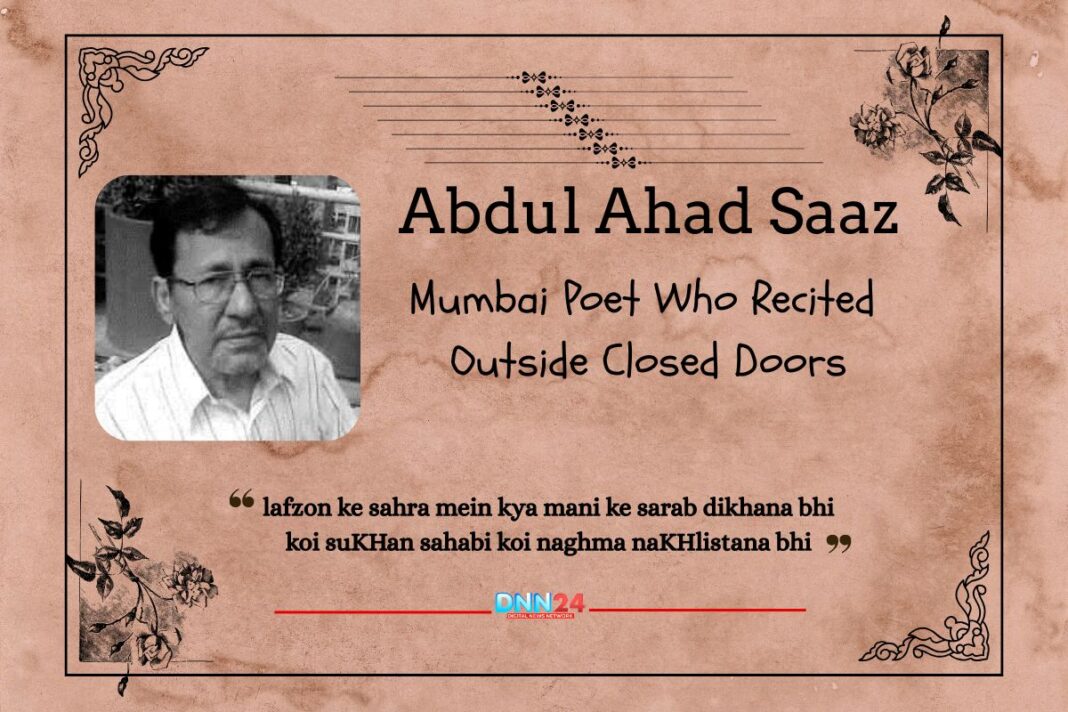

Picture a poet standing outside a grand hall, rejected from the stage inside, choosing instead to share his verses with strangers on the street. This moment captures the essence of Abdul Ahad Saaz, a man whose literary brilliance grew not from acceptance by elite circles but from his deep connection with ordinary people.
sawal ka jawab tha jawab ke sawal mein
Abdul Ahad Saaz
giraft-e-shor se chhuTe to KHamushi ke jal mein
A Poet’s Early Path: Mumbai’s Influence
Abdul Ahad Saaz was born on October 16, 1950, in Mumbai, a city where wealth and poverty coexist, and languages blend on crowded streets. This environment became the soil from which his poetry would grow. Young Saaz spent his formative years observing life in its rawest form. The city taught him about contrast, about resilience, about finding beauty in unexpected places.
soch kar bhi kya jaana jaan kar bhi kya paya
Abdul Ahad Saaz
jab bhi aaina dekha KHud ko dusra paya
His early education was modest, yet his hunger for literature was immense. He would often read under dim streetlights when his home had no electricity, absorbing the works of established poets while developing his own voice. The sea-facing promenades of Mumbai became his sanctuary, where he watched waves crash against rocks and found metaphors for human struggle. Unlike many poets who emerged from privileged backgrounds, Saaz remained rooted in the everyday experiences of ordinary people.
abas hai raaz ko pane ki justuju kya hai
Abdul Ahad Saaz
ye chaak-e-dil hai use hajat-e-rafu kya hai
Mumbai underwent rapid transformation during the 1960s and 1970s. Saaz witnessed this transformation through the lens of those who were often left behind by progress. The textile mill workers, the street vendors, and the struggling families in cramped apartments all found their way into his consciousness.
main ne apni ruh ko apne tan se alag kar rakkha hai
Abdul Ahad Saaz
yun nahin jaise jism ko pairahan se alag kar rakkha hai
These observations would later surface in his poetry, giving voice to experiences that mainstream literature often ignored. His childhood was not filled with luxuries or formal literary training, yet it provided something more valuable: an authentic understanding of human emotion in all its complexity.
azdawaji zindagi bhi aur tijarat bhi adab bhi
Abdul Ahad Saaz
kitna kar-amad hai sab kuchh aur kaisa be-sabab bhi
Writings and Emotional Resonance
Saaz’s literary contributions primarily came through his collections, “Khamoshi Bol Uthi Hai”, published in 1990, and “Sargoshiyan Zamanon Ki”, released in 2003. These works showcased his mastery of ghazals and nazms, traditional Urdu poetic forms that he infused with contemporary sensibilities.
soch kar bhi kya jaana jaan kar bhi kya paya
Abdul Ahad Saaz
jab bhi aaina dekha KHud ko dusra paya
His poetry spoke about love without melodrama, about loss without despair, and about hope without pretence. Educational institutions across Maharashtra and West Bengal recognised his work, incorporating his poems into Urdu syllabi and honouring him with awards from state Urdu academies.
abas hai raaz ko pane ki justuju kya hai
Abdul Ahad Saaz
ye chaak-e-dil hai use hajat-e-rafu kya hai
What distinguished Saaz from his contemporaries was his refusal to romanticise suffering or glorify struggle. His verses acknowledged pain but always searched for meaning within it. Friends recall how he transformed personal setbacks into universal statements about the human condition. When he faced financial difficulties, he wrote about dignity in poverty. When he experienced rejection, he composed verses about finding self-worth beyond external validation.
aaj phir shab ka hawala teri jaanib Thahre
Abdul Ahad Saaz
chand mazmun bane sharh-e-kawakib Thahre
The emotional depth of his poetry stemmed from his lived experiences. There were years when publishers refused his manuscripts, when literary gatherings denied him a platform. Rather than becoming bitter, Saaz used these experiences as material for growth. His work gained recognition not through powerful connections or strategic networking but through genuine resonance with readers.
main ne apni ruh ko apne tan se alag kar rakkha hai
Abdul Ahad Saaz
yun nahin jaise jism ko pairahan se alag kar rakkha hai
People found themselves in his words and saw their own struggles reflected to them with compassion and understanding. His ghazals travelled through word of mouth, recited at small gatherings and chai stalls before they ever reached formal literary spaces. This organic spread of his work testified to its authenticity and emotional truth.
azdawaji zindagi bhi aur tijarat bhi adab bhi
Abdul Ahad Saaz
kitna kar-amad hai sab kuchh aur kaisa be-sabab bhi
Humanity, Humility, and Hardship
The most remarkable aspect of Saaz’s life remains largely unknown to many who admire his poetry. During periods of communal tension in Mumbai, when religious divisions threatened to tear communities apart, Saaz quietly organised literary circles that welcomed poets from all backgrounds. These gatherings were not grand events, but intimate sessions held in modest spaces, where the only requirements for participation were honesty in expression and respect for others.
meri jholi mein wo lafzon ke moti Dal deta hai
Abdul Ahad Saaz
siwae is ke kuchh mangun to hans kar Tal deta hai
He spent countless hours mentoring young poets, many of whom came from marginalised communities with no access to formal literary networks. Saaz would sit with them, helping shape their rough verses into polished work, never taking credit for his contributions. His students remember him as someone who listened more than he spoke, who found potential in the most hesitant voices.
khuli jab aankh to dekha ki duniya sar pe rakkhi hai
Abdul Ahad Saaz
KHumar-e-hosh mein samjhe the hum Thokar pe rakkhi hai
This mentorship was not motivated by building a following or creating disciples. It stemmed from his conviction that poetry belonged to everyone, that gatekeepers should not restrict artistic expression.The most telling story about his character involves a prestigious award ceremony where he was honoured.
zikr hum se be-talab ka kya talabgari ke din
Abdul Ahad Saaz
tum hamein sochoge ek din KHud se be-zari ke din
After the formal event, instead of attending the elite afterparty, Saaz returned to his neighbourhood tea stall, where he shared the news with residents who had supported his work through difficult years. He treated the award not as a personal achievement but as validation for the community that had nurtured him. His humility was not false modesty but genuine comfort with simplicity. Fame never changed his habits or his values.
hum apne zaKHm kuredte hain wo zaKHm parae dhote the
Abdul Ahad Saaz
jo hum se ziyaada jaante the wo hum se ziyaada rote the
Struggles, Triumphs, and Literary Legacy
Saaz’s journey was marked by obstacles that would have silenced lesser spirits. There were years when his poetry found no publishers, when literary critics dismissed his work as too simple or not innovative enough. Financial pressures forced him to take up jobs that left little time for writing. Yet, during these difficult periods, he continued to compose verses, refining his craft in the moments stolen between responsibilities.
maut se aage soch ke aana phir ji lena
Abdul Ahad Saaz
chhoTi chhoTi baaton mein dilchaspi lena
A severe health crisis in his middle years threatened to permanently end his literary career. Doctors doubted his recovery; friends feared his voice would be lost. But Saaz returned, his poetry enriched by the experience of facing mortality. The verses he wrote after this period carried a new depth, a clearer understanding of what truly matters in life. His themes of silence and renewal took on added meaning, born from actual confrontation with endings and new beginnings.
be-masraf be-hasil dukh
Abdul Ahad Saaz
jine ke na-qabil dukh
His legacy extends beyond his published collections. The young poets he mentored have gone on to create their own significant work, often crediting Saaz as the person who gave them the confidence to write. The literary circles he established continue to function, maintaining his vision of inclusive, accessible poetry. His work remains relevant because it addresses timeless human experiences through language that speaks directly to the heart.
manzar shamshan ho gaya hai
Abdul Ahad Saaz
dil qabristan ho gaya hai
Abdul Ahad Saaz proved that great poetry needs no grand stages. His verses resonated with people because they contained truth, reflecting real struggles and genuine hope. His life demonstrated that artistic integrity matters more than recognition, that serving others through your craft brings deeper satisfaction than personal glory. Today, his poems continue to be recited, studied, and loved, a testament to the enduring power of authentic expression rooted in shared humanity.
Also Read: Tomb of Sher Shah Suri: An Emperor’s Dream Palace Floating On Water
You can connect with DNN24 on Facebook, Twitter, and Instagram and subscribe to our YouTube channel.