

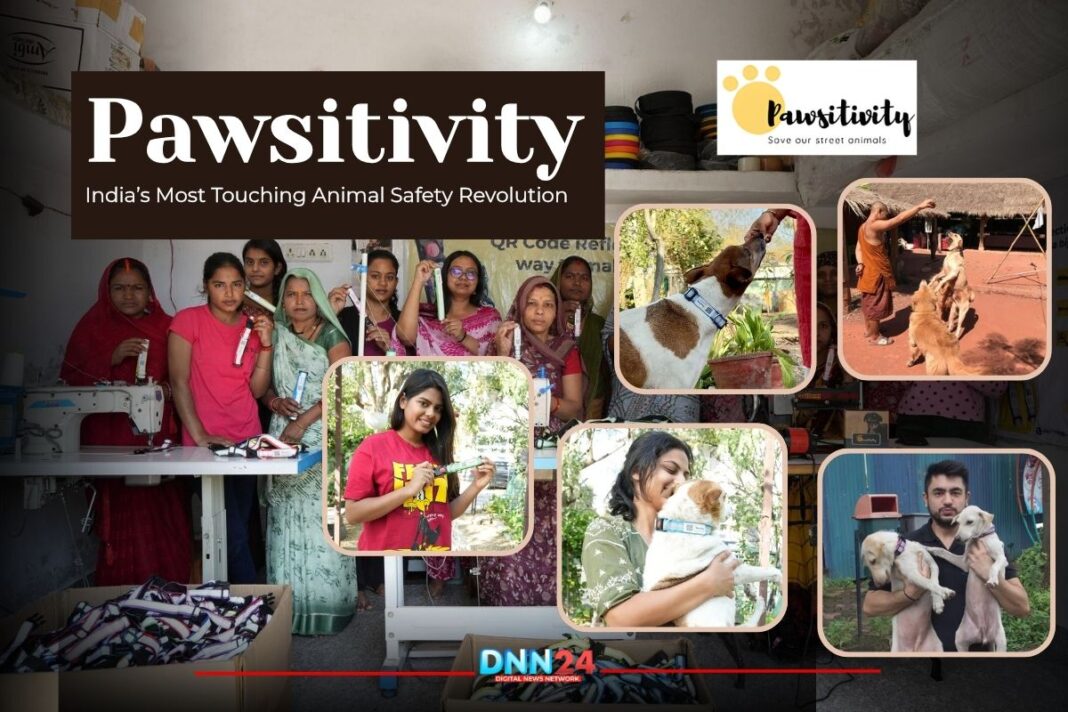

It started with a collision nobody stopped for. A small stray dog lay bleeding on a rain-soaked street while traffic rushed past. Aditi Sharma, returning home that evening, was the only one who noticed. She wrapped the injured pup in her dupatta and carried it to the nearest clinic. The dog survived, but something inside Aditi changed forever. “Nobody saw the dog because nobody could see the dog,” she remembers thinking. That simple realisation became the foundation of Pawsitivity, an organisation that would eventually save thousands of lives while changing hundreds more.
What began in a cramped corner of her Lucknow home has grown into something far bigger than reflective collars for street animals. Pawsitivity brought together two invisible communities: the women society overlooks and the animal traffic ignores. Today, the glowing collars stitched by marginalised women protect strays across Indian cities, turning tragedy into purpose and pain into protection. This is not a business success story. This is about what happens when empathy refuses to stay silent.
When Tragedy Becomes Purpose: The Moment Everything Changed
Aditi’s childhood was built on survival, not privilege. Her father passed away when she was seventeen, leaving her mother to raise two children on a tailor’s income. The sound of the sewing machine became the soundtrack of her youth. “Stitching kept us alive,” she says without drama, simply stating a fact. Her mother worked late into countless nights, her fingers moving steadily over fabric while her children studied under a single bulb.
Years later, while working at an NGO focused on women’s livelihoods, Aditi visited a rural shelter where women stitched school uniforms in mechanical silence. Their skill was evident, but their eyes held nothing. “They were talented but trapped in monotony,” she recalls. The question formed slowly: what if these women could create something that mattered beyond routine income? What if their craft could directly save lives?
The idea felt right, but the world disagreed. Investors called it confusing. Friends labelled it impractical. “You cannot mix animal welfare with women’s empowerment,” they said repeatedly. People wanted clear categories, single missions, and predictable models. But Aditi had seen too much suffering to separate pain into neat boxes. She understood that being unseen, whether as a woman without opportunities or an animal without visibility, created the same cruel outcome. So she moved forward alone, using savings from her NGO salary to buy fabric and reflective tape. The first collar was stitched on her mother’s old machine, the same one that had fed their family through grief.
The Women Who Stitch Light Into Darkness
Walk into Pawsitivity’s workspace, and the first thing you notice is not the equipment but the atmosphere. Women chat while working, their hands steady, their voices comfortable. This is not a factory floor. Meena, who once cleaned homes for minimal wages, now leads a team of eight artisans. “I used to make people’s houses shine,” she says. “Now I help animals shine on roads.” The shift in her tone when discussing her work is unmistakable. This is not just employment. This is ownership.
Each woman arrives with a history of being dismissed: widows, single mothers, women who left abusive homes, and women whose education stopped too early. Society had placed them in invisible corners, much like the street dogs they now protect. At Pawsitivity, they are artisans. Their names are on the collars they create. They select fabrics, offer suggestions for improvements, and take pride in the quality. When a collar fails inspection, they insist on redoing it themselves.
The wages are fair, but the transformation extends beyond money. “Many of our women did not know what respect felt like,” Aditi explains. She recalls Shanti, a widow who cried the first time someone called her work beautiful. Or Rekha, who brought her daughter to the workshop to show her that mothers can build things that matter. These women do not simply make products. They stitch dignity back into their own lives with every collar completed. The connection between their empowerment and animal safety is not accidental. It is the entire foundation.
Stories That Glow in Headlights: Lives Saved by a Simple Collar
The first time Aditi received a message from a stranger, she read it five times. A taxi driver from Jaipur wrote: “I was speeding through an empty road after midnight. A black dog ran across. I only saw her because something glowed. Your collar saved both of us.” The message sat framed on her desk for months. It represented everything Pawsitivity stood for: visibility creates safety, and safety creates peace.
Stories like this arrive regularly now. A biker from Pune avoided a street dog sleeping on warm asphalt because the collar caught his motorcycle’s headlight. A woman from Bangalore who adopted a stray after seeing it wearing a Pawsitivity collar, realising someone cared enough to protect it. A school bus driver started carrying extra collars to fit on strays near his route. These are not marketing testimonials. These are documents of compassion spreading through ordinary acts.
Pawsitivity runs an “Adopt a Collar” programme where anyone can sponsor reflective collars for their neighbourhood strays. Volunteers are trained to approach animals gently, fitting collars without causing fear. Local NGOs and municipal bodies partner during vaccination drives to distribute them widely. The organisation tracks impact not through sales figures but through volunteer reports and rescue stories. Numbers matter less than narratives. Aditi keeps handwritten letters from people who stopped their vehicles just in time, from those who found injured dogs because the collars made them visible, and from those who joined the movement after seeing one glowing collar on a dark street.
The Price of Building Something That Matters
Success stories rarely mention the years of doubt that came before. Aditi managed everything alone initially: social media posts were written at midnight, packaging was done on her floor, and deliveries were made on her bicycle. There were months when funds were depleted and production came to a halt. She remembers gifting a collar to a stray outside her college simply because she could not bear seeing it wander unprotected, even when she had only three collars left to sell.
Her family struggled to understand. A degree in social work seemed wasted on what they saw as a hobby. Her mother worried constantly about financial stability. “They were not wrong to worry,” Aditi admits. The path was uncertain, the income irregular, the future unclear. But everything shifted the day her mother stitched the hundredth collar herself and said quietly, “Your father would have supported this.” In that moment, Aditi realised her mission had become their mission.
The breakthrough came unexpectedly. A volunteer filmed a stray walking confidently through evening traffic, its collar glowing steadily in vehicle headlights. The video went viral. Donations arrived. Volunteers from different cities reached out. The media covered the story. What had been a lonely struggle became a collective movement overnight. The validation mattered less than the realisation that others had been waiting for precisely this kind of work. Kindness was not a niche interest. It was a widespread hunger searching for practical expression.
Where Pawsitivity Goes From Here: Lighting Up India’s Streets
Pawsitivity today employs over forty women across three cities. Plans include expanding to eco-friendly materials and launching “Collars of Hope” workshops where women learn stitching while adopting neighbourhood strays. Schools invite Aditi to speak about compassion translated into action. Children learn early that protecting the vulnerable is not sentimentality but responsibility.
The vision extends beyond collars. Aditi dreams of every Indian city where street animals move safely after dark, where drivers slow down because they can see lives in their path, where communities understand that caring for strays reflects their own humanity. “We want entire neighbourhoods to glow with protected animals,” she says. The goal is not just visibility, but a culture change: making animal welfare and women’s empowerment natural partners, rather than separate causes.
At its foundation, Pawsitivity teaches a single lesson. Small acts, done consistently with care, create massive change. One woman’s act of noticing an injured dog on a dark road sparked a movement that has protected thousands. The women stitching these collars are not just workers; they are artisans. They are proof that society’s discarded people, given opportunity and respect, become its most dedicated protectors. Every collar glowing in traffic is a reminder: we can choose to see, or we can choose to ignore. Pawsitivity decided to visit. And that choice lit up everything.
Also Read: Truly Tribal: Hidden Village Art Revolution That’s Quietly Changing India
You can connect with DNN24 on Facebook, Twitter, and Instagram and subscribe to our YouTube channel.