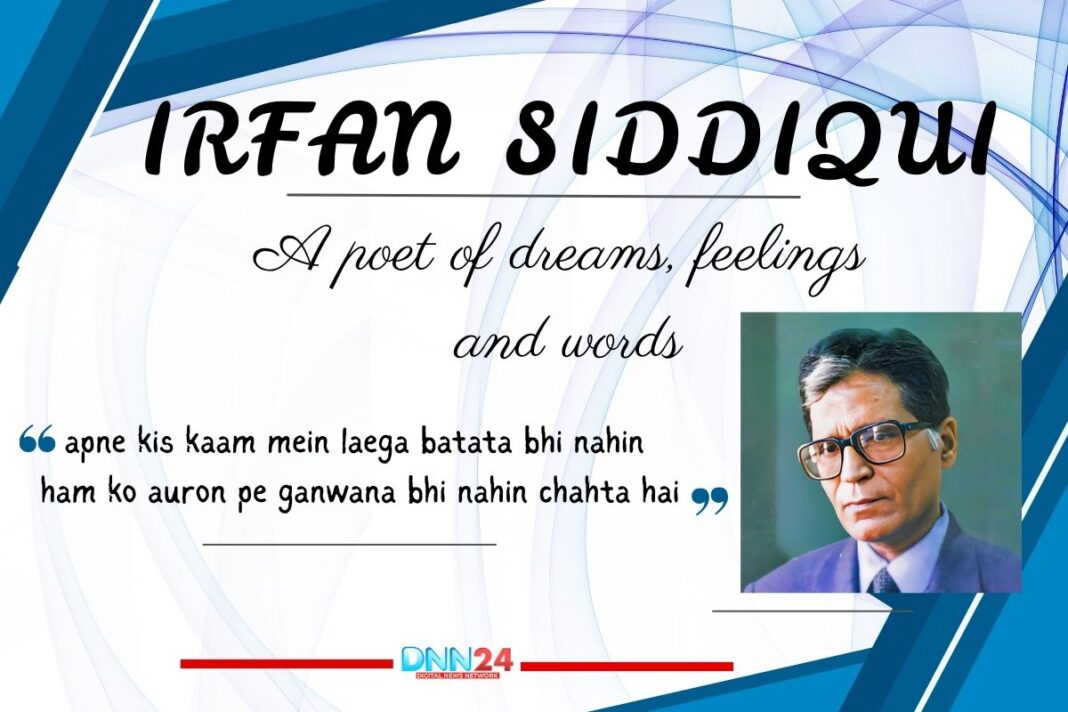

Irfan Siddiqui stands as one of the most respected names in Urdu poetry. Born on January 8, 1939, in Badayun, Uttar Pradesh, he grew up in a region famous for producing remarkable poets and writers. This cultural environment shaped his artistic sensibilities from an early age. Siddiqui completed his education in Badayun and Bareilly, earning a postgraduate degree in sociology.
utho ye manzar-e-shab-taab dekhne ke liye
Irfan Siddiqui
ki neend shart nahin khwab dekhne ke liye
His academic background in sociology gave his poetry a unique depth, allowing him to observe society through a lens that combined emotional sensitivity with intellectual understanding. His verses did not merely express personal feelings but also reflected the complexities of social realities and the changing times.
badan mein jaise lahu taaziyana ho gaya hai
Irfan Siddiqui
use gale se lagae zamana ho gaya hai
Through his work, readers found a mirror to their own experiences, discovering that poetry could capture both intimate emotions and broader human truths. His early years laid the foundation for a literary career that spanned several decades and left a permanent mark on Urdu literature. The combination of traditional poetic training and modern academic education created a distinctive voice that resonated with readers across generations.
raat ko jeet to paata nahin lekin ye charagh
Irfan Siddiqui
kam se kam raat ka nuqsan bahut karta hai
Balancing Government Service and the Call of Poetry
In 1962, Siddiqui joined the Central Information Service and was appointed to the Press Information Bureau. Many wondered if his official responsibilities would distance him from poetry. Instead, he demonstrated a remarkable ability to maintain both worlds without compromise. Throughout his career in government service, which lasted until his retirement in 1997 as Deputy Principal Information Officer, he continued to write with the same passion that defined his youth.
tum parindo se zyada to nahin ho azaad
Irfan Siddiqui
shaam hone ko hai ab ghar ki taraf laut chalo
His daily work in the information service enriched his understanding of communication and public discourse, elements that subtly influenced his poetic expression. He built a bridge between the bureaucratic world and the creative realm, proving that artistic dedication does not require abandoning practical responsibilities.
hoshiyaari dil-e-nadan bahut karta hai
Irfan Siddiqui
ranj kam sahta hai elaan bahut karta hai
His personal life reflected the simplicity and warmth found in his poetry. In 1964, he married Sayyida Habib, who became his lifelong companion. They shared a journey marked by mutual support and understanding. Siddiqui passed away on April 15, 2004, in Lucknow; however, his poetry continues to resonate with readers, carrying forward the emotions and insights he carefully crafted throughout his life.
badan ke donon kinaron se jal raha hoon main
Irfan Siddiqui
ki chhoo raha hoon tujhe aur pighal raha hoon main
The Literary Journey from Canvas to City of Sorrows
Siddiqui’s literary career began in 1978 with the publication of his first poetry collection, “Canvas.” This debut marked the opening chapter of a remarkable publishing journey. His pen remained active throughout the following decades, producing several significant collections. “Shab-Darmiyaan” appeared in 1984, followed by “Saat Samawat” in 1992, “Ishq-Nama” in 1997, and “Hawa-e-Dasht-e-Mariya” in 1998.
sar agar sar hai to nezon se shikayat kaisi
Irfan Siddiqui
dil agar dil hai to dariya se bada hona hai
Each collection revealed different facets of human experience, exploring themes ranging from the depths of love to the complexities of existence. His poetry touched readers because it spoke in a language they understood, addressing feelings they recognised but perhaps could not articulate. Two comprehensive collections brought together his life’s work. “Dariya” was published from Islamabad in 1999, and “Shahr-e-Malal” appeared posthumously from Delhi in 2016.
shaam-e-khema koi zanjeer nahin hum-safaran
Irfan Siddiqui
jis ko jaana hai chala jae ijaazat kaisi
These volumes represent the essence of his poetic evolution, showing how he allowed his art to flow naturally without confining it to rigid boundaries. His approach to poetry resembled a river that finds its own path, adapting to the landscape while maintaining its essential character. One of his memorable couplets captures the pain of separation with striking clarity, expressing how absence creates a physical ache that time cannot easily heal.
hum to raat ka matlab samjhein khwab, sitare, chaand, charagh
Irfan Siddiqui
aage ka ahwaal vo jaane jis ne raat guzari ho
More Than a Poet: Translator and Literary Bridge Builder
Siddiqui’s contributions extended far beyond his own poetry. He worked as a distinguished writer and translator, producing books on communication, including “Awami Tarseel” in 1977 and “Rabta-e-Aamma” in 1984. These works demonstrated his understanding of how messages travel between people and across cultures. However, his most significant achievement in translation involved bringing classical Sanskrit drama to Urdu readers.
jo kuchh hua vo kaise hua jaanta hoon main
Irfan Siddiqui
jo kuchh nahin hua vo bata kyun nahin hua
He translated Kalidasa’s renowned plays, rendering “Ritusamgharam” as “Rut-Singhar” and translating “Malavika Agnimitram” into Urdu. This work required not only linguistic skill but also cultural sensitivity, as he had to bridge two distinct literary traditions while preserving the essence of the original texts. Through these translations, Sanskrit literature became accessible to Urdu readers who might otherwise have never encountered these classical masterpieces.
ret par thak ke gira hoon to hawa poochhti hai
Irfan Siddiqui
aap is dasht mein kyun ae the vahshat ke baghair
Additionally, he translated an Arabic novel titled “For the Sake of Bread” into Urdu. His dedication to translation work revealed his belief that literature should cross boundaries and connect diverse audiences. Recognition came through several honours, including awards from the Urdu Academy of Uttar Pradesh and the Ghalib Institute in Delhi. Yet his most significant legacy remains the verses that people still recite and cherish today.
humein to khair bikharna hi tha kabhi na kabhi
Irfan Siddiqui
hawa-e-taaza ka jhonka bahaana ho gaya hai
Verses That Continue to Speak
Siddiqui’s poetry possessed an exceptional quality that made abstract emotions tangible and relatable. His couplets explore themes of freedom and responsibility, showing how humans remain bound to their duties even when they dream of liberation. One verse compares human liberty to that of birds, suggesting that as evening approaches, one must return home, acknowledging the limitations that define our existence.
tum suno ya na suno haath badhao na badhao
Irfan Siddiqui
doobte doobte ik baar pukaareinge tumhe
Another powerful couplet describes the intensity of love as a fire that consumes from within, capturing the paradox of how touching someone beloved can simultaneously feel like both pleasure and pain. His poetry also addressed the difference between superficial understanding and authentic experience. In one verse, he contrasts those who romanticise night with dreams and stars against those who have actually endured its darkness.
ajab hareef tha mere hi saath doob gaya
Irfan Siddiqui
mere safeene ko gharqab dekhne ke liye
This distinction emphasises that genuine knowledge comes only through lived experience rather than imagination. Through such observations, Siddiqui reminded readers that poetry serves as more than entertainment. It functions as a mirror reflecting our innermost feelings and unspoken truths. His work continues to inspire because it speaks to universal human experiences that transcend time and place. The power of his words lies in their ability to make readers feel understood, offering companionship through the written word. His legacy endures not through monuments but through the living presence of his poetry in the hearts and minds of those who read him.
Also Read: Tahzeeb Hafi: Simple Words, Deep Emotions, and the Modern Urdu Poetry Revolution
You can connect with DNN24 on Facebook, Twitter, and Instagram and subscribe to our YouTube channel.