
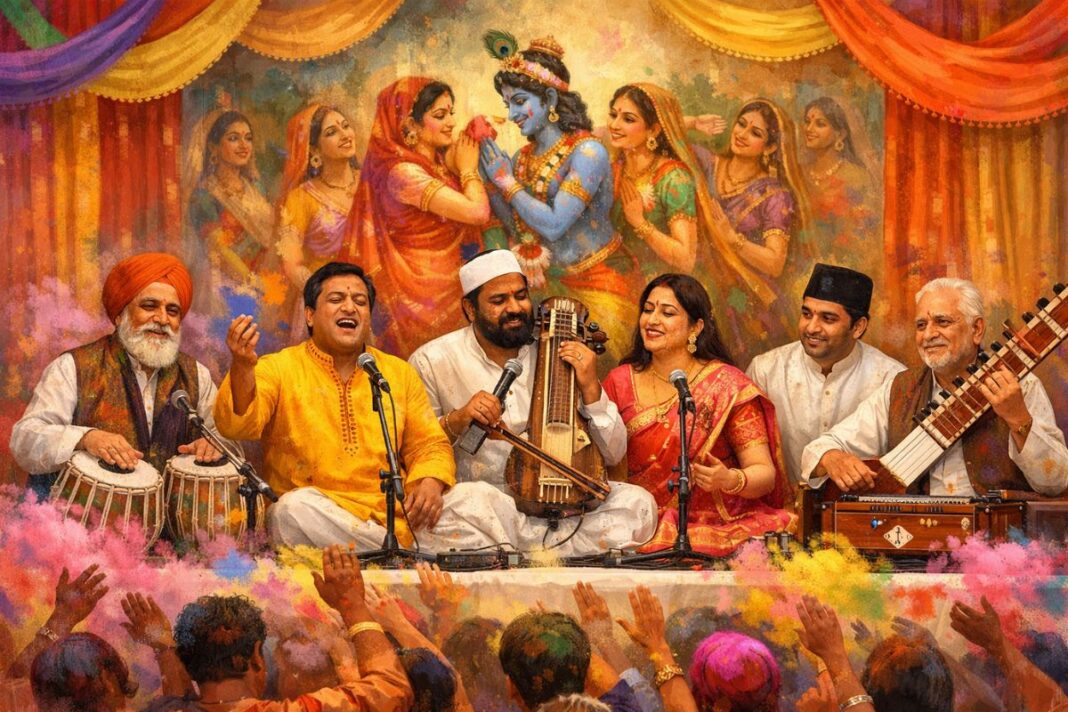

When the spring festival of Holi arrives each year, concert halls across India fill with the sounds of dhamar and hori, two musical forms that have survived centuries of political change and religious division. These compositions, deeply woven into Hindustani classical music, reveal something unusual about the art form itself. Musicians of every faith perform songs praising Krishna’s playful mischief with the gopis, and nobody questions the practice. This acceptance reflects a principle that has governed the tradition since Mughal times: religious neutrality stands at the core of musical excellence.
Origins in Devotional Poetry
The Holi repertoire traces its lineage to the Bhakti movement that swept across northern India between the 15th and 17th centuries. Temple musicians in Vrindavan composed kirtans in the dhrupad style, narrating stories of Krishna smearing colours on Radha and her companions. These devotional pieces were written in Brajbhasha, the regional language of the area, rather than Sanskrit.
From this foundation emerged dhamar, a lighter variant of dhrupad created specifically for spring celebrations. The form uses a 14-beat rhythmic cycle called dhamar taal and focuses on festive imagery. Poets described lovers drenched in coloured water, the chaos of public celebrations, and the holiday’s romantic undertones. The music matched this energy with compositions that began slowly before building to frenzied climaxes.
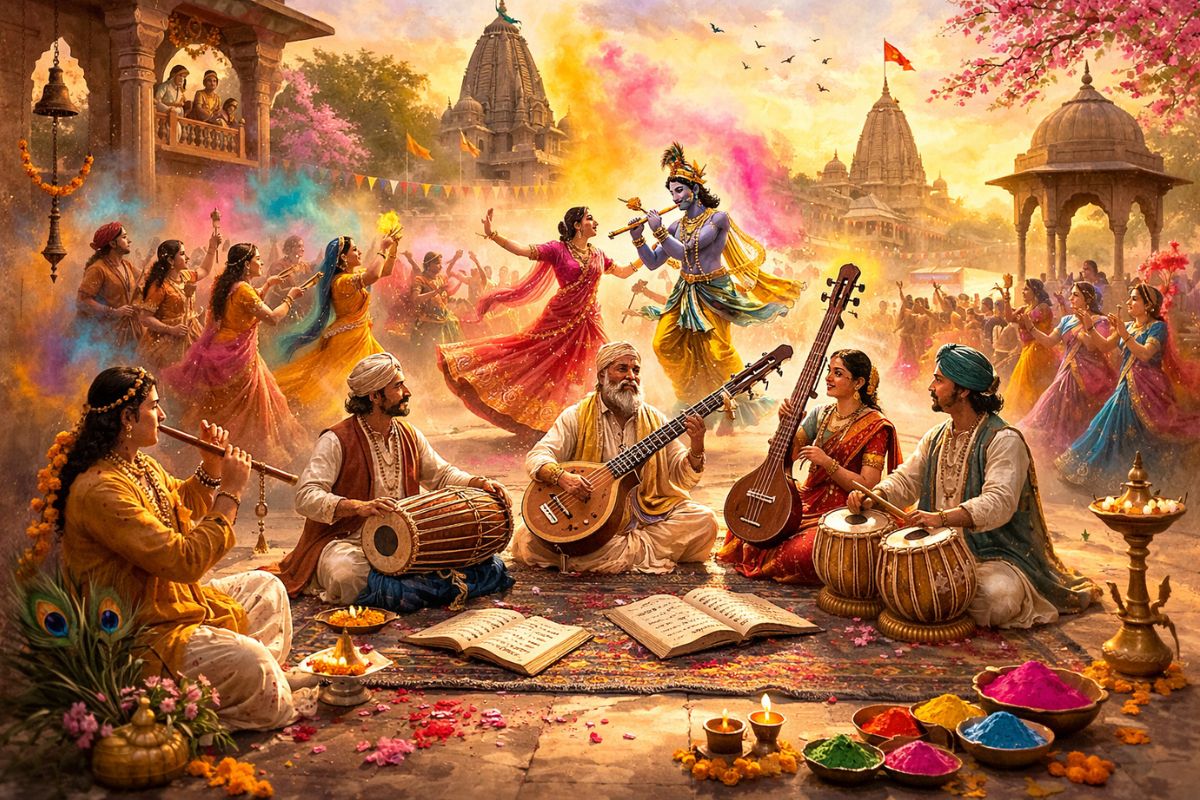
The Delhi Sultanate and later Mughal courts brought Persian musicians into contact with Hindu melodic systems. Sufi practitioners adopted local instruments and ragas, creating fusion styles that would define Hindustani music. Yet Holi themes persisted without alteration. Muslim court musicians learned the same bandishes as their Hindu counterparts, and the distinction between performer and material became irrelevant.
Tansen, who served at Emperor Akbar’s court in the 16th century, advanced the dhrupad form and included Holi compositions in his repertoire. The Gwalior gharana later formalised these pieces into teaching curricula. By the early 20th century, reformers like Vishnu Digambar Paluskar and Vishnu Narayan Bhatkhande had standardised raga classifications and opened music schools to the general public. Holi bandishes moved beyond royal patronage and became part of mass musical education.
Musical Structures and Forms
Dhamar serves as the primary vehicle for Holi performances. Musicians begin in vilambit laya, a slow tempo that allows for elaborate improvisation on individual syllables. The composition then shifts into jhaptal or sooltal, faster rhythmic cycles that increase intensity. Typical lyrics include phrases like “Chori chori maarata kumkuma,” which describe Krishna secretly throwing coloured powder. Raga Kedar frequently provides the melodic framework for these pieces.
Hori represents a semi-classical offshoot that combines folk elements with the flexibility of khayal and thumri. Composers set horis in various taals, including deepchandi, keherwa, dadra, and addha, each offering different rhythmic possibilities. The form permits greater freedom than strict classical structures, matching the playful disorder of the festival itself.
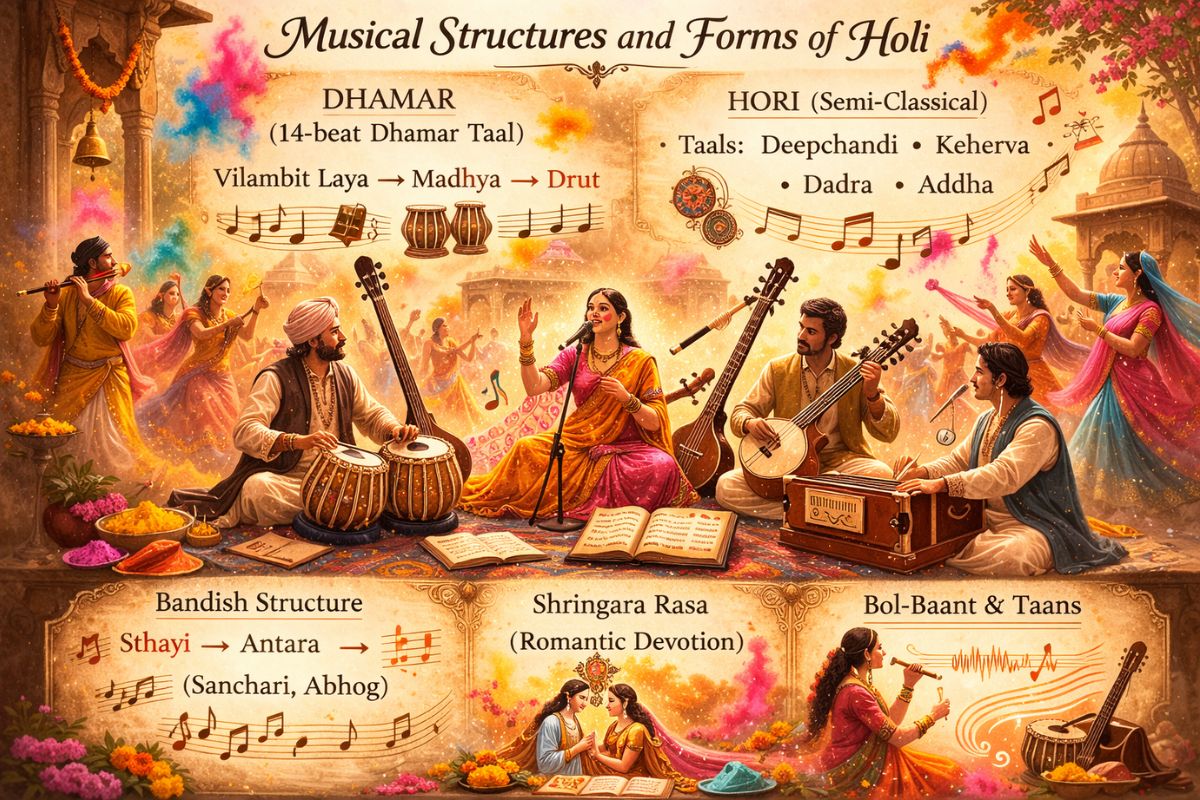
Thumri-style horis emphasise shringara rasa, the aesthetic mood of romantic devotion. Musicians use lighter ragas that suit emotional expression. The performance includes bol-baant, where singers improvise on individual words, and taans, rapid melodic passages that showcase vocal agility. The two-part bandish structure follows a pattern: the sthayi serves as the main refrain in the middle octave, while the antara explores higher registers. Some dhrupad variants include sanchari and abhog sections to provide additional narrative development.
Ragas and Rhythmic Cycles
Raga Kafi dominates hori and khayal compositions during the Holi season. The raga uses komal gandhar and nishad, flatted third and seventh scale degrees, creating a passionate quality suited to evening performances. Musicians also employ related ragas, such as Khamaj, Des, Pilu, Pahadi, Bhairavi, and Tilang, for thumris. These choices evoke the vibrancy of spring and the colours of the festival. A popular composition begins “Holi khelat nand lal” set in Kafi.
The dhamar taal follows a specific 14-beat pattern with distinct clap and wave positions. The structure mirrors the escalating energy of Holi celebrations, starting with restraint before building momentum. Thumri compositions use simpler taals, such as dadra (six beats) or keherwa (eight beats). Percussionists add laggis, decorative flourishes that build to a climactic climax near the end of performances.
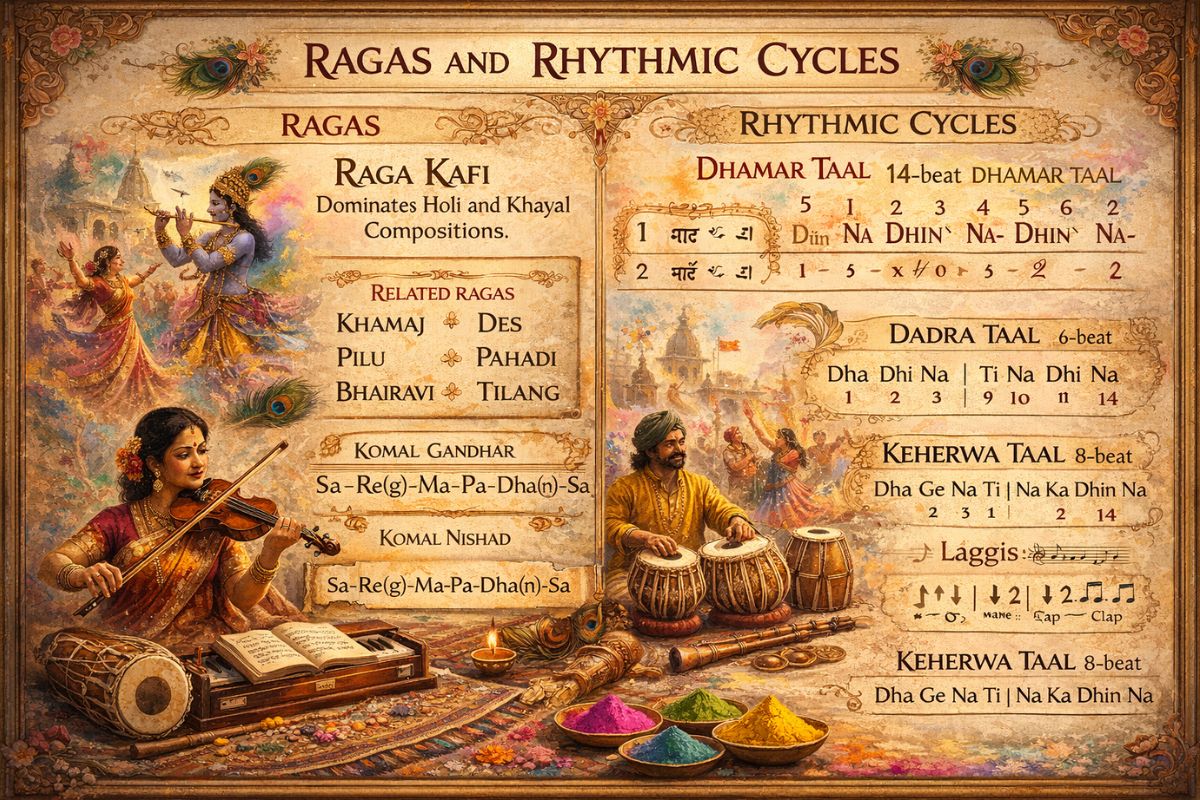
Certain ragas add dramatic intensity to Holi pieces. Dr N. Rajam’s violin rendition in raga Jog and Jhinjhoti demonstrates how instrumental performances can convey the festival’s spirit without words. The choice of raga determines the emotional character: Kedar brings gravitas, while Pilu offers lightness and charm.
Cross-Faith Performance Practice
Religious neutrality in Hindustani music ensures that Holi compositions thrive regardless of the performer’s background. Muslim ustads have mastered these forms since Mughal times, when court musicians served emperors who valued artistry over sectarian concerns. This tradition continues in modern gharanas without controversy or debate.
Begum Akhtar, who lived from 1914 to 1974, became known as the queen of thumri while training in the Patiala gharana. Her Holi recordings blend classical technique with emotional depth. She performed pieces like “Kaisi Ye Dhoom Machayi” and “Holi Mubarak,” bringing the same intensity to devotional material as to purely romantic compositions.
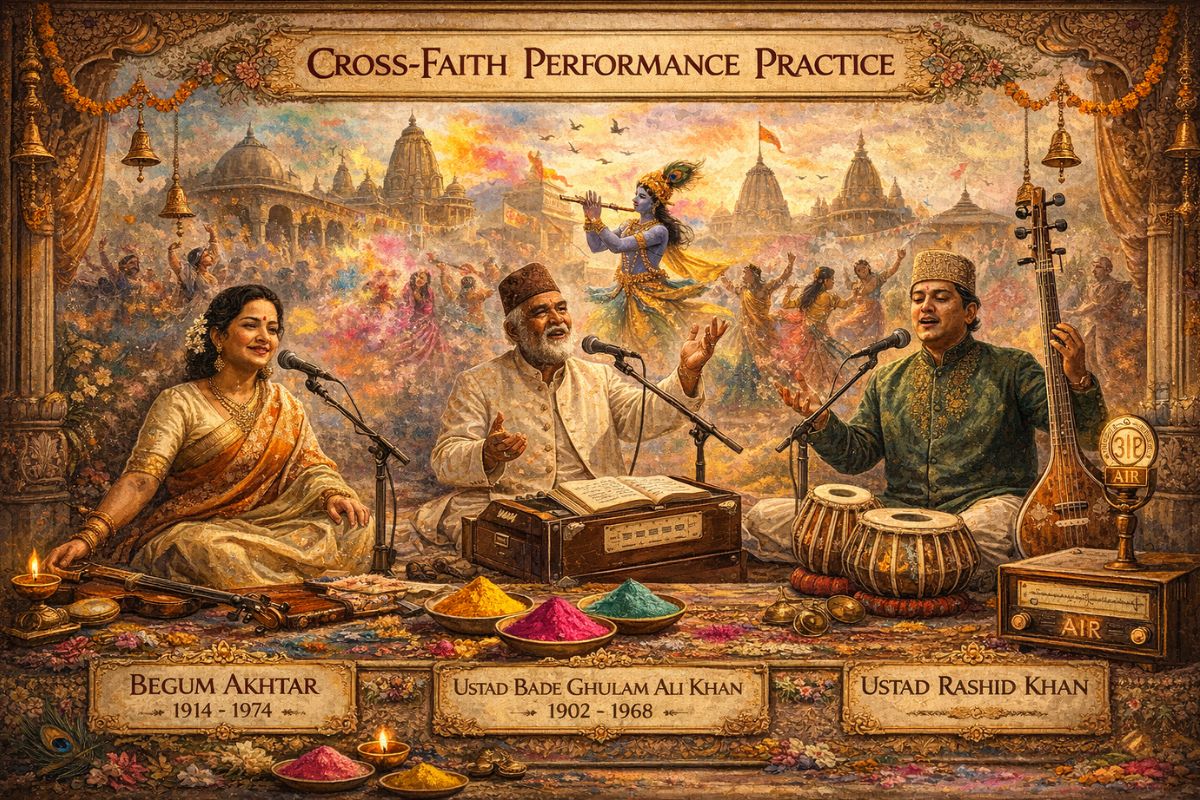
Ustad Bade Ghulam Ali Khan, another luminary of the Patiala gharana, revolutionised thumri performance between 1902 and 1968. While specific Holi dhamars appear less frequently in documentation of his repertoire, his thumris, such as “Aaye Na Balam,” embody the playful romantic essence central to hori. His mastery of bol and taan techniques set standards that later generations studied.
Ustad Rashid Khan performed “Holi Kini Sant Sev,” a composition from Guru Granth Sahib, proving that devotional themes cross religious boundaries in practice. His work in the Rampur-Sahaswan gharana showed how classical training applies equally to all repertoire. Other Muslim musicians, including the Dagar brothers, sustained dhrupad-dhamar traditions alongside Hindu colleagues.
All India Radio played a crucial role after independence by broadcasting performances that featured artists from different faiths sharing the same repertoire. Shobha Gurtu, a Hindu vocalist, and Begum Akhtar performed overlapping material without distinction. The gharana system treats Holi compositions as art rather than devotional practice, thereby eliminating sectarian concerns.
Contemporary Practice and Revival
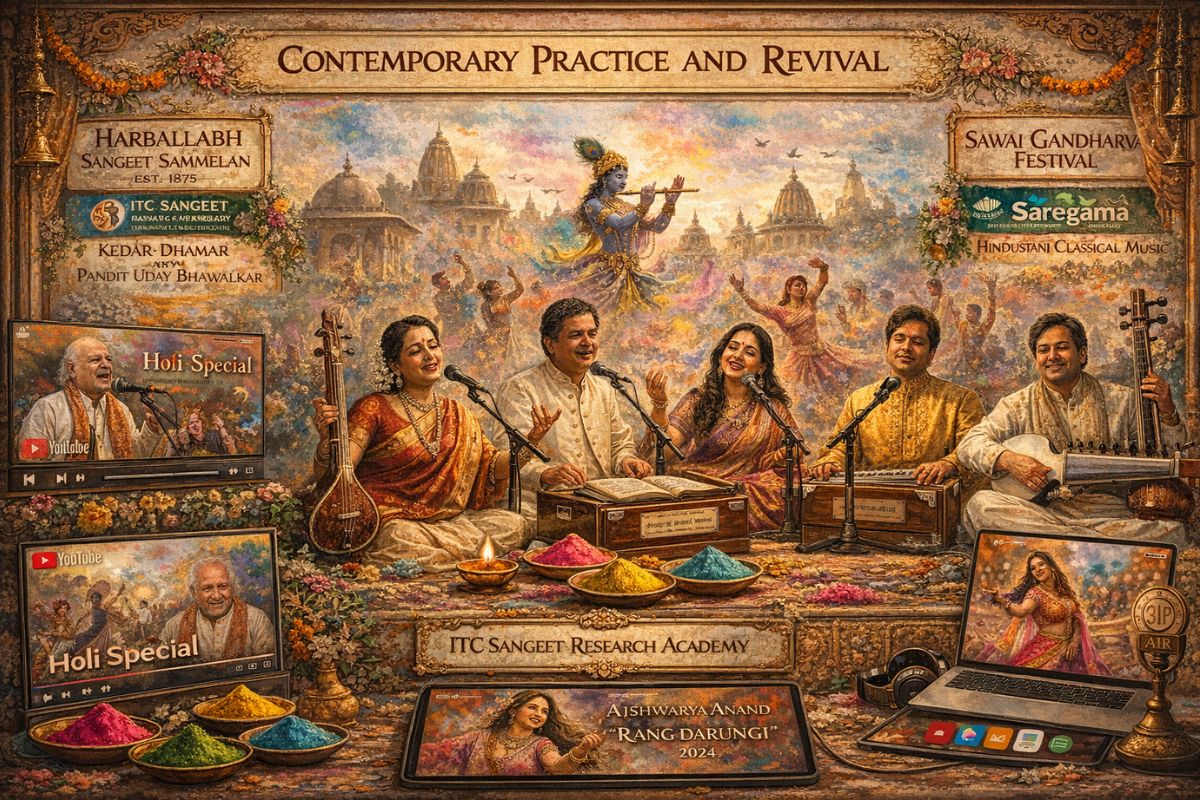
Modern concert series like Harballabh Sangeet Sammelan, which began in 1875, and Sawai Gandharva Festival continue to showcase Holi compositions each spring. Pandit Uday Bhawalkar performs “Chori Chori” in Kedar-Dhamar using traditional dhrupad technique. Girija Devi’s rendition of “Aisi Hori Na Khelo” in raga Pilu captivates audiences with her command of the Banaras gharana style.
The ITC Sangeet Research Academy trains musicians from diverse backgrounds, ensuring that gharana knowledge is passed down to new generations. Banaras and Seniya traditions blend artists regardless of religious identity. This approach maintains the secular spirit that defines Holi as a cultural celebration rather than a ritual observance.
Digital platforms have expanded access to the classical Holi repertoire. YouTube features compilations from artists including Kumar Gandharva, Shubha Mudgal, and Pandit Jasraj. Saregama’s Hindustani Classical channel offers Holi specials, while curated playlists combine historic recordings with contemporary performances.
Recent recordings show how artists preserve traditional forms while appealing to modern audiences. Sandipan Samajpati’s 2025 rendition of “Kaise Kheloon Hori” demonstrates intricate taans and bol-baant in classic Hindustani style. Pandit Sanjeev Abhyankar from the Mewati gharana delivers “Mohan Khelat Hori” in raga Tilang, emphasising descriptive lyrics about Krishna’s festival play.
Kaushiki Chakraborty reimagines “Rangi Saari Gulabi Chunariya Re” in raga Pahadi, adding signature vocal agility to the traditional framework. Pandit Veena Sahasrabuddhe from Gwalior gharana performs “Hori Hori Hori Khelat Nandalal” in raga Adana, showcasing expansive slow-tempo development.
Fusion approaches blend classical foundations with contemporary presentation. Aishwarya Anand’s 2024 interpretation of “Rang Darungi” modernises material learned from Pandit Bholanath Mishra. Shujaat Khan accompanies his sitar performances of Pahadi hori with instrumental improvisation that maintains the thumri character. Kathak dancer Tamanna Tiku pairs Holi thumri with abhinaya, using facial expressions and hand gestures to narrate a woman’s festive longing.
The sarod players Amaan and Ayaan Ali Khan released “Colours and Celebrations” in 2025, featuring Holi horis like “Hori Re Rasiya” that fuse classical technique with folk elements. Their work in the Senia Bangash tradition demonstrates how instrumental music conveys the festival’s spirit.
Enduring Secular Tradition
From Braj temples to international concert stages, Holi compositions unite musicians and audiences through shared cultural heritage. A Muslim violinist might perform Dr N. Rajam’s interpretation in raga Jog, while a Hindu vocalist channels Begum Akhtar’s thumri style. The music transcends boundaries precisely because the tradition treats it as art rather than worship.
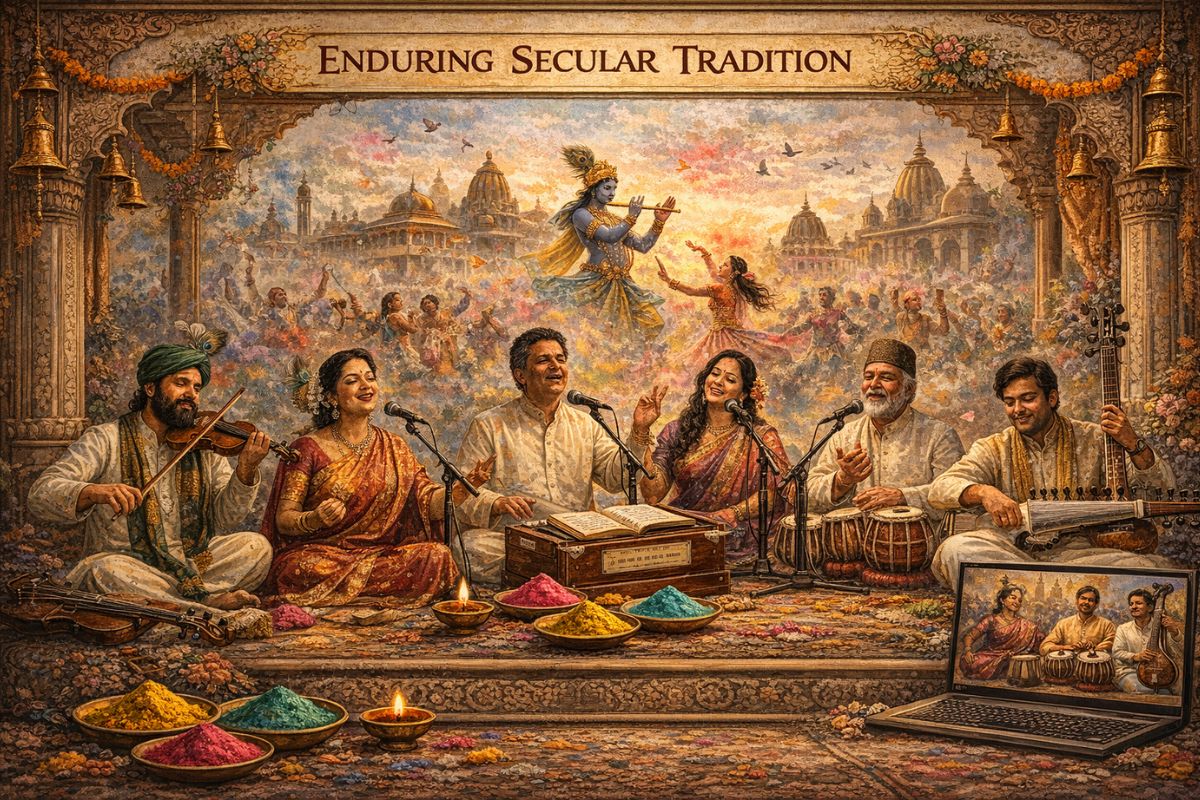
This principle, established during Sufi times and reinforced through gharana training methods, keeps the forms vital. Young musicians learn the same bandishes their teachers studied, and religious identity never determines repertoire. The result is a living tradition that maintains technical standards while remaining accessible to anyone willing to master the craft.
Hindustani classical music’s approach to Holi compositions offers a model of artistic neutrality that few other traditions match. The music survives because it belongs to everyone who learns it properly, regardless of background or belief.
Also Read:Malpua: India’s Ancient Dessert Unites Religious Festivals
You can connect with DNN24 on Facebook, Twitter, and Instagram and subscribe to our YouTube channel.