

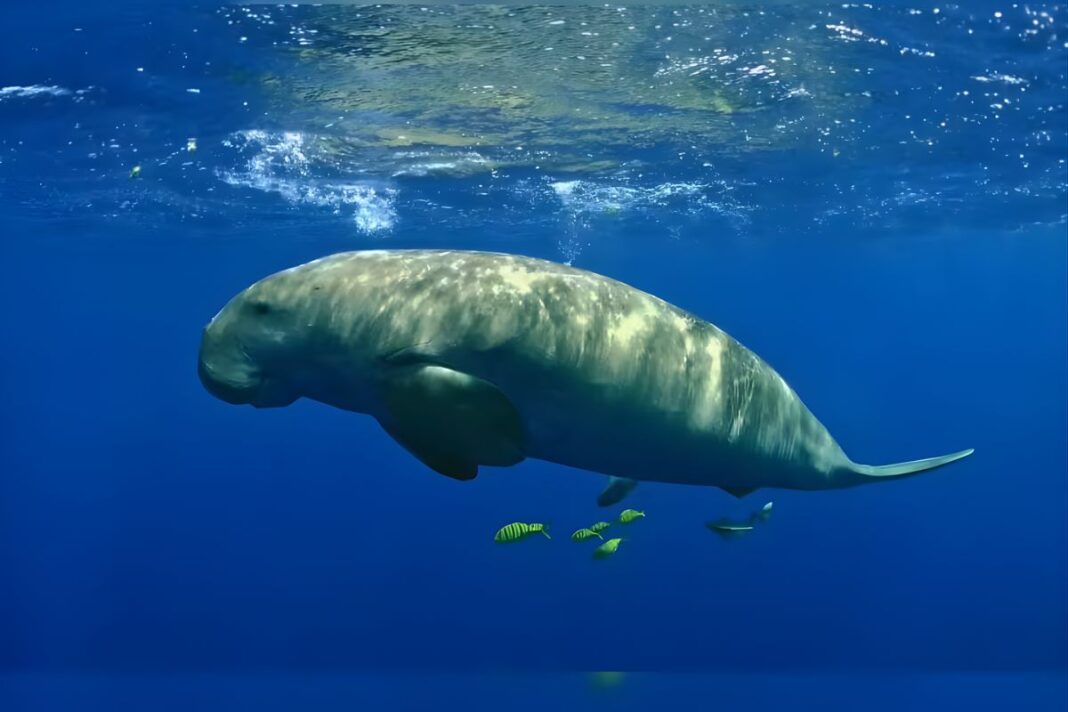

The gentle marine mammals that biologists once feared would vanish from Indian waters have made a comeback. Along the shallow coastal stretches of Tamil Nadu, dugongs have quietly multiplied to a stable number of 270, a number that represents both a fragile victory and a test of whether conservation can outpace extinction in the modern world.
These numbers were arrived at in early 2025 when Wildlife Institute of India researchers flew drones over the Palk Bay and Gulf of Mannar. The cameras captured what years of interviews and indirect surveys could not: actual animals surfacing to breathe, their grey backs breaking the surface in waters where they had become ghosts. The count revealed 158 dugongs in Palk Bay and 112 in the Gulf of Mannar. For a species that numbered fewer than 200 just over a decade ago, the new figures suggest the conservation efforts have made an impact.
What Dugongs Do
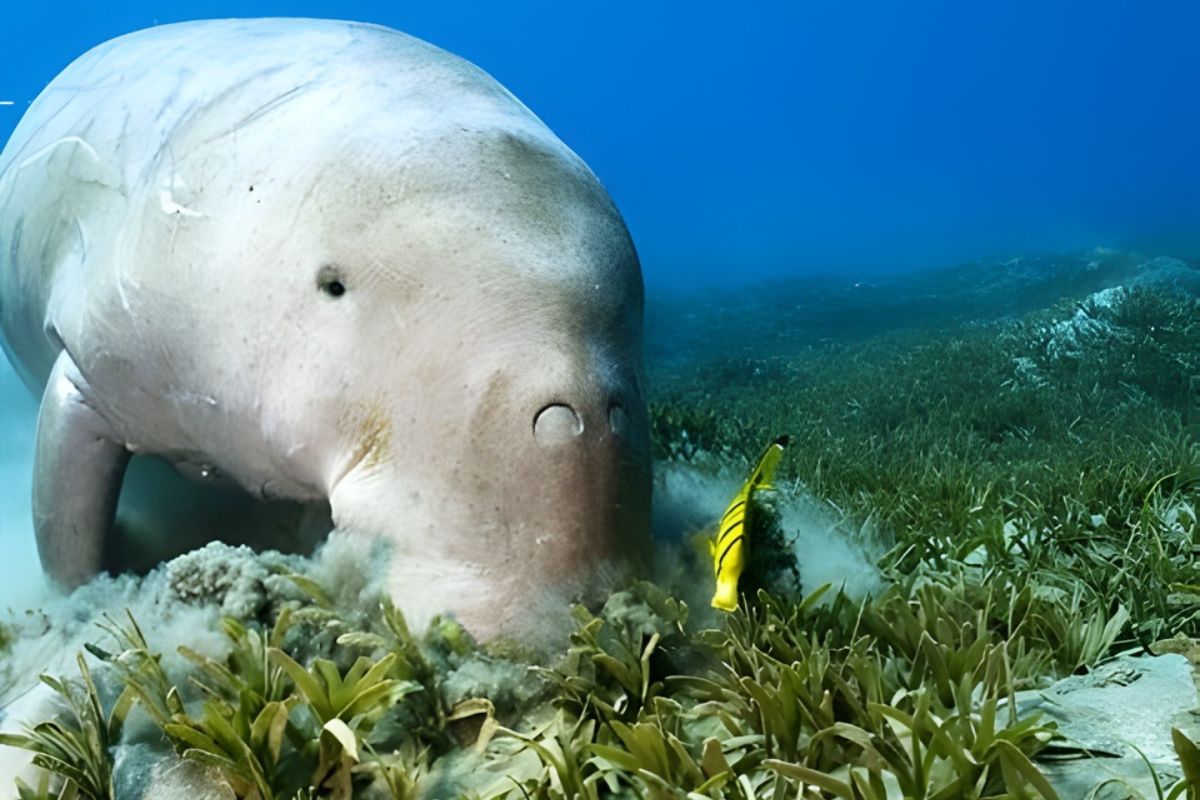
Dugong belongs to an unusual family of marine mammals. Adults stretch up to 3 meters long and weigh up to 400 kilograms. They live in shallow coastal waters where sunlight reaches the bottom, sustaining the seagrass meadows that form the basis of their diet. An adult dugong consumes between 30 and 40 kilograms of seagrass each day, grazing in patterns that prevent the beds from growing too thick and stagnant.
This feeding behaviour makes dugongs what ecologists call ecosystem engineers. Their grazing maintains habitat quality for fish and invertebrates, while the seagrass meadows themselves sequester carbon from the atmosphere. The International Union for Conservation of Nature lists dugongs as globally vulnerable. India’s Wildlife Protection Act places them in Schedule I, the same category as tigers and elephants.
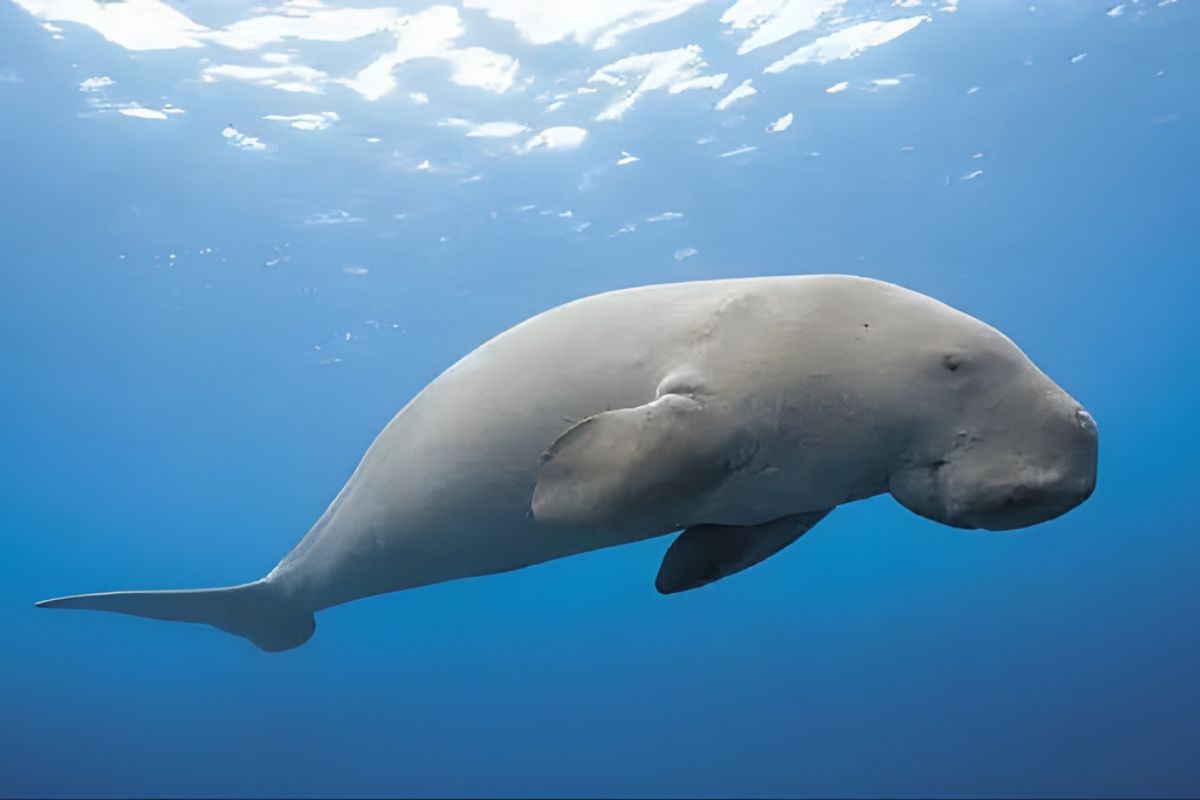
Reproduction happens slowly. Females give birth once every few years after long gestation periods, which means populations recover at a crawl even when conditions improve. In India, dugongs were once found along both coasts but are now concentrated in two locations in Tamil Nadu, where seagrass beds still cover more than 12,250 hectares.
The Decline
Dugongs nearly disappeared from India through a combination of direct killing and habitat destruction. Historical records document hunting for meat, extracting oil from blubber, and using hides for leather goods. By the middle of the twentieth century, sightings had become rare in regions like the Andaman Islands, where they once thrived.
During the 2010s, scientists estimated that India held between 200 and 450 dugongs. The Palk Bay and the Gulf of Mannar had the largest populations, but even there, they were shrinking. A 2012 report from the Ministry of Environment counted approximately 200 dugongs nationwide. Interviews with fishermen revealed how seldom they encountered the animals, a sign the populations had reached critical lows.
Several factors drove this decline. Port construction, dredging operations, land reclamation projects, and pollution destroyed seagrass meadows across India’s coastline. Agricultural runoff carried fertilisers and pesticides into coastal waters, while sewage and industrial waste increased turbidity and introduced toxins. The plants could not photosynthesise in murky water, and chemicals damaged their root systems.
Climate change added new pressures. Rising ocean temperatures stressed seagrass communities, and acidification weakened plant structures. Extreme weather events like cyclones tore up meadows, while prolonged low tides exposed roots to fatal desiccation.
Fishing nets killed more dugongs than any other single cause. The animals must surface every few minutes to breathe, and when they become entangled in gillnets or trawl gear, they drown. Boat strikes and occasional poaching added to the toll. In the Gulf of Kutch and the Andaman Islands, biologists classified the future as highly uncertain.
Conservation Response
India launched a national Dugong Recovery Programme after a 2010 task force assessment. The program brought together Tamil Nadu, Gujarat, and the Andaman and Nicobar Islands with federal agencies and research institutions. Tamil Nadu took the lead in 2022 by notifying India’s first Dugong Conservation Reserve in Palk Bay, a 448-square-kilometre protected area covering vital seagrass habitat under the Wildlife Protection Act.
Funding came from the Compensatory Afforestation Fund Management and Planning Authority and World Bank programs. Tamil Nadu’s Biodiversity Conservation Project allocated 1 million rupees for habitat restoration work. The Forest Department and OMCAR Foundation, a conservation organisation, developed community programs that included financial incentives, annual scholarships worth 18,000 rupees for children of fishermen who lost their parents, and solar lighting installations in 14 coastal villages.
The strategy recognised that fishing communities would determine whether dugongs survived. Between 2021 and 2025, trained fishers rescued 16 dugongs from nets and released them alive. The Forest Department paid 275,000 rupees to 62 fishers, with 116,000 rupees to compensate for damaged nets and 159,000 rupees to reward those who reported entanglements rather than conceal them.
More than 1,000 fishers joined a WhatsApp network coordinated by the Wildlife Institute of India, sharing real-time reports of dugong sightings and strandings. The data helped researchers understand where the animals moved and bred. Workshops reached fishers, naval personnel, coast guard officers, and tourism operators with information about safe boating practices and reporting protocols.
The New Numbers
The 2025 drone survey marked the first time India had obtained a reliable population estimate using direct observation rather than interviews or occasional beach strandings. The aircraft captured repeated images of individual dugongs surfacing to breathe, allowing researchers to verify their counts. The method proved far more accurate than earlier approaches, which recorded only 28 dugong sightings between 2017 and 2025.
The survey documented mother-calf pairs, providing evidence that reproduction continues in these waters. This breeding activity indicates the population has achieved some stability and possesses potential for further recovery. Additional Chief Secretary Supriya Sahu described the results as proof that sustained protection produces measurable outcomes.
Tamil Nadu plans to open a Dugong Conservation Centre in Manora, Thanjavur, with a budget of 409.4 million rupees. The facility will support research, monitoring programs, and public education about marine conservation.
Remaining Challenges
Despite recent gains, the population remains small enough that random events could cause significant damage. A severe cyclone, disease outbreak, or pollution might kill enough animals to reverse years of progress. Fishing nets remain the greatest direct threat, and boat traffic continues to grow each year in waters where dugongs feed.
Habitat degradation has not stopped. Coastal development along Tamil Nadu’s shoreline increases sedimentation and chemical runoff into nearshore waters. Climate change will intensify in the coming decades, placing additional stress on seagrass ecosystems that are already vulnerable to warming and acidification.
The Palk Bay connects the waters of India and Sri Lanka, allowing dugongs to move between the two countries. Effective protection requires cooperation across this international boundary, but such coordination remains limited. The International Union for Conservation of Nature has called for joint management of shared dugong populations.
Prospects
The increase from near extinction to 270 individuals demonstrates what targeted conservation can achieve when it combines legal protection, community engagement, and modern monitoring technology. Tamil Nadu’s approach offers a model for other regions where marine mammals face similar threats from human activity.
Success required changing how fishing communities viewed dugongs, transforming them from bycatch or curiosities into animals worth protecting. Financial incentives helped, but so did involving fishers directly in rescue operations and monitoring. The programs gave coastal residents a stake in dugong survival.
Technology played a crucial role. Drones provided accurate population data that earlier methods could not deliver, while smartphone networks turned hundreds of fishers into field observers. These tools made conservation more efficient and allowed rapid response to emerging threats.
The work continues. Tamil Nadu must maintain protection measures, expand habitat restoration, and address climate impacts that threaten seagrass meadows. The population needs to grow substantially before biologists will consider it secure. But the trajectory has shifted from decline to recovery. That shift carries significance beyond India’s coastline as a demonstration that marine conservation can succeed in crowded, developing regions where human needs compete with wildlife protection.
Also Read:Monpa Women Revive Ancient Himalayan Cuisine Traditions
You can connect with DNN24 on Facebook, Twitter, and Instagram and subscribe to our YouTube channel.