
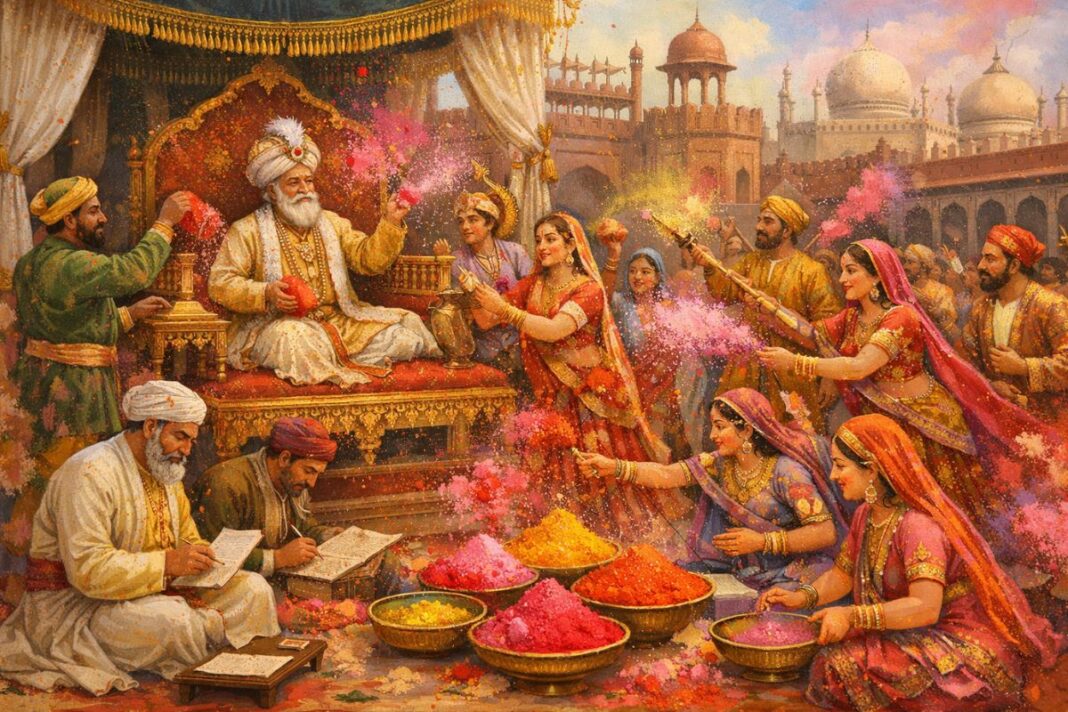

When Mughal emperor Bahadur Shah Zafar threw coloured powder during Holi celebrations at the Red Fort in the 1850s, he joined a tradition that was centuries old. The Urdu words for spring festivals- gulal, rang, basant- had long served poets as symbols of something larger than seasonal festivities. These terms carried meanings that crossed religious boundaries, appearing in verses from both Muslim Sufis and Hindu devotees, from courtly odes to street songs.
The persistence of this vocabulary in Urdu literature reveals a historical reality often obscured by modern divisions. For hundreds of years, poets writing in Urdu drew freely from the imagery of Holi and spring celebrations, regardless of their own religious background. The archive of this poetry, preserved in collections such as Rekhta and analysed by scholars of Indo-Islamic culture, documents a shared cultural imagination that thrived in the Indian subcontinent.
The Mughal Court and Festival Poetry
Holi arrived at Mughal courts under a different name. Records indicate that emperors referred to the festival as Gulabi Eid, the Pink Festival, and incorporated it into official palace celebrations. Shah Jahan participated in throwing abeer and gulal, while attendants sprinkled water infused with tesu flowers. These were not private matters. The celebrations became part of the courtly calendar, with poets commissioned to write verses for the occasion.
Bahadur Shah Zafar, the last Mughal emperor, gave particular attention to Holi poetry. He elevated Hori, a genre specifically dedicated to the festival, making it an official event at the Red Fort. This decision came despite opposition from religious clerics who questioned the propriety of Muslim rulers celebrating a Hindu festival. The emperor’s patronage ensured that poets continued producing Holi-themed verses, many of which survive in manuscript collections today.
Amir Khusrau and the Sufi Tradition
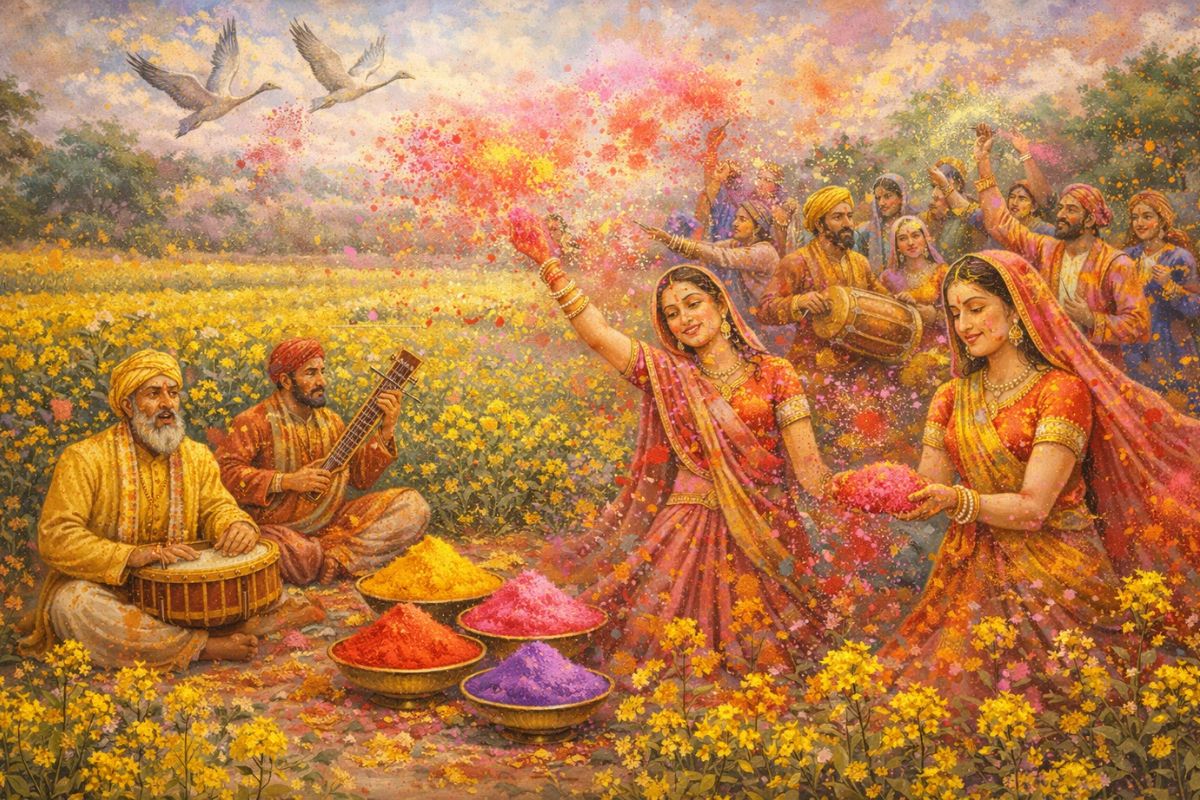
The deepest roots of this poetic tradition reach back to Amir Khusrau, the 13th-century poet and disciple of the Sufi saint Hazrat Nizamuddin Auliya. Khusrau composed qawwalis that have been sung at the Nizamuddin dargah in Delhi for over 700 years. His most famous Holi composition begins with the lines “Aaj rang hai hey maa rang hai ri / Moray mehboob kay ghar rang hai ri” (There is colour today at my beloved’s home).
According to tradition preserved at the shrine, Khusrau composed this piece after Nizamuddin Auliya requested a Hindavi poem to mark Holi. The qawwali merges devotional content with festival imagery, using rang as a metaphor for both the literal colours of Holi and the divine presence. This dual meaning allowed the verse to function in multiple contexts, sung at both spring celebrations and mystical gatherings.
The Nizamuddin dargah became a centre for these syncretic celebrations. Devotees began marking Basant Panchami, which signals spring’s arrival, with the same enthusiasm as they do for Holi. They threw gulal on each other and on the saint’s tomb, a practice that continues today. Other Sufi shrines adopted similar customs. At Dewa Sharif in Barabanki, the shrine of Haji Waris Ali Shah hosts annual Holi gatherings where Muslims, Hindus, Sikhs, and Christians participate in communal colour throwing.
Vocabulary of Shared Celebration
The three main terms that appear throughout this poetry carry specific associations. Rang, meaning colour, became shorthand for passion, divine love, and the vibrancy of existence itself. Poets used it to describe both romantic longing and mystical ecstasy. Gulal, the red powder central to Holi celebrations, evoked romance and festivity in equal measure. Basant, referring to spring and the festival of Basant Panchami, symbolised renewal and natural abundance.
Azhar Iqbal wrote in a qita, “Kahiin abiir kii khushbuu kahiin gulaal kaa rang / Kahiin pe sharm se simte hue jamaal kaa rang” (Somewhere the fragrance of abeer, somewhere the colour of gulal; somewhere the colour of shy beauty). The verse demonstrates how these festival terms could be woven into descriptions of human emotion and beauty, transcending their literal meanings.
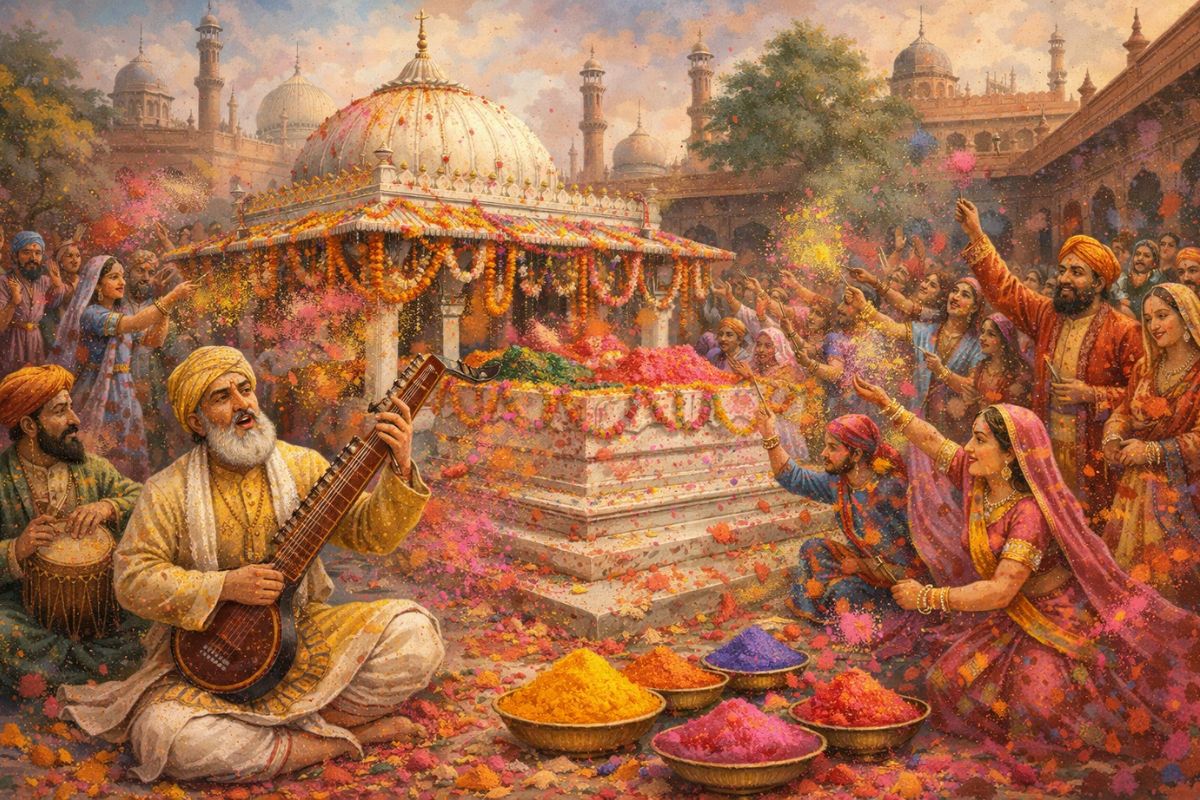
Faez Dehelvi celebrated spring with “Aaj hai roz-e-vasant ai dostaan / Sarv-qad hai bostaan ke darmiyaan” (Today is the day of spring, O friends, like tall trees amid the garden). The imagery draws on natural phenomena,blooming mustard fields, the arrival of migratory birds, that poets associated with Basant Panchami.
Eighteenth-Century Masters
The poets of the 1700s produced some of the most vivid Holi imagery in Urdu. Wali Uzlat (1692-1775) connected spring breezes directly to the festival: “Baad-e-bahar mein sab atish junun ki hai / Har saal avati hai garmi mein fasl-e-Holi” (The spring breeze fans the fire of passion; every year Holi’s season arrives in heat).
Rangin Saadat Yaar Khan (1756-1835) described how gulal clouds gathered in the sky, creating an image of the entire atmosphere transformed by festival colours. Ghulam Hamadani Mushafi (1751-1821) personified nature preparing for celebration: “Daal kar ghunchon ki mundri shakh-e-gul ke kaan mein / Ab ke Holi mein banaana gul ko jogan ai saba” (Put flower earrings on the branches; make the flowers into devotees this Holi).
Mir Taqi Mir (1722-1810), considered one of Urdu’s greatest poets, treated Holi as equivalent to Nauroz, the Persian New Year: “Jashn-e Nauroz Hind Holi hai / Raag-o rang aur boli tholi hai” (Holi is Hind’s Nauroz, full of song, colour, and playful speech). This comparison placed the festival within a broader Indo-Persian cultural framework.
The People’s Poetry
Nazeer Akbarabadi (1735-1830) earned recognition as the poet of common people, and his Holi verses reflect popular celebration rather than courtly refinement. He wrote, “Aa dhamke aish-o tarab kya kya jab husn dikhaya Holi ne / Har aan khushi ki dhuum hui yun lutf jataya Holi ne” (Holi displays what delights and beauty when joy and cheer arrive). His descriptions include drums, dancing, and the participation of all social classes.
Shah Hatim (1699-1783) captured the festival’s visual spectacle: “Idhar yaar aur udhar khuban saf-ara / Tamasha hai tamasha hai tamasha” (Friends here, beauties there—pure spectacle). These verses emphasised the communal aspect of celebration, where distinctions of rank and religion temporarily dissolved.
Religious Synthesis in Verse
Sufi poets explicitly merged Islamic devotion with Holi imagery. Bulleh Shah composed “Hori khelungi keh Bismillah” (I will play Holi saying Bismillah), urging believers to immerse themselves in divine colours: “Rang rangeeli ohi khilave, jis seekhi ho fanaa fi Allah” (Only one who has learned annihilation in Allah plays the true colours).
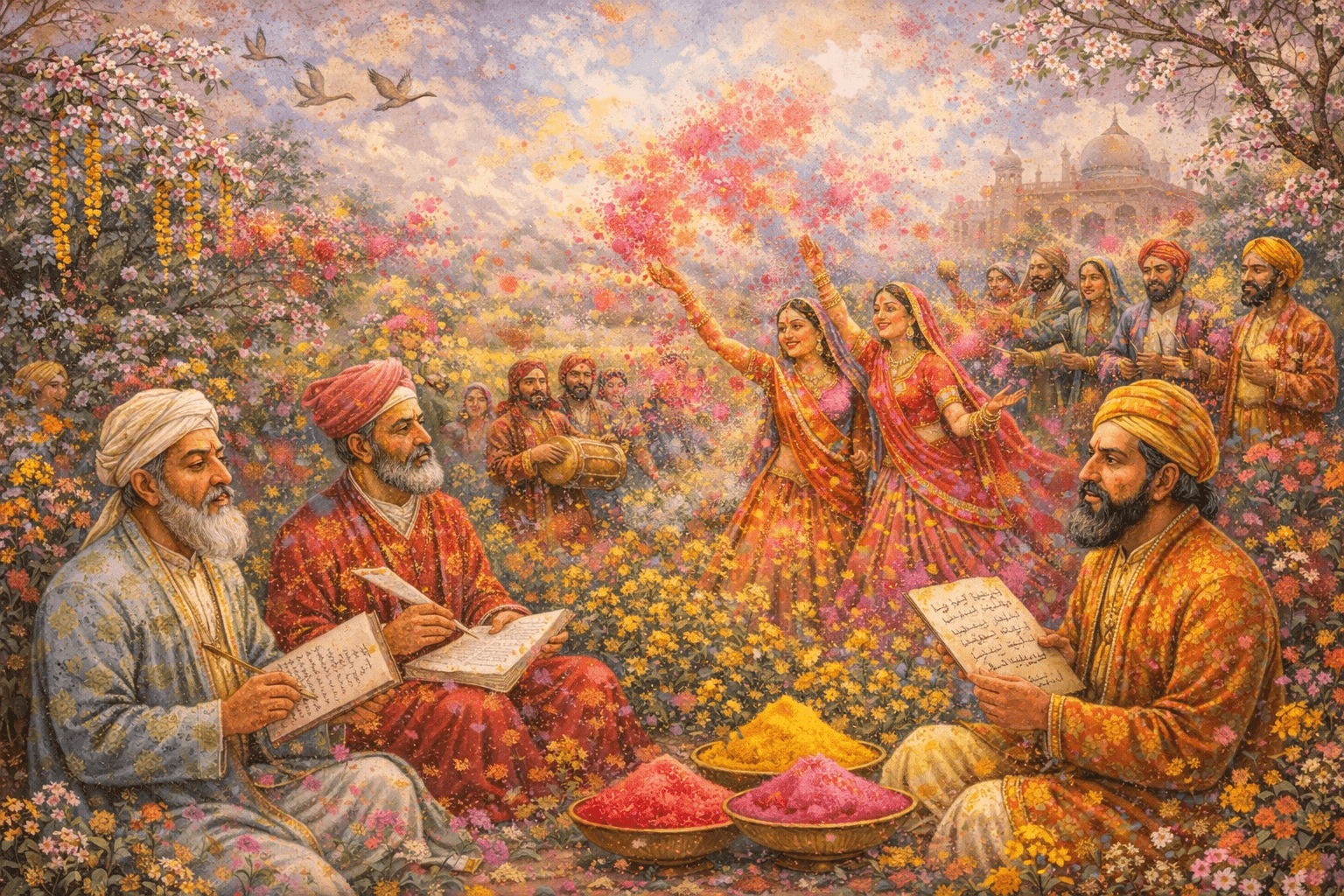
Shah Niyaz Bakhsh created kalaam that placed Islamic figures within the festival context: “Holi hoye rahi hai Ahmad jiyo ke dwaar / Hazrat Ali ka rang bano hai Hassan Hussain khilaar” (Holi happens at the Prophet’s door; Hazrat Ali becomes the colour, Hasan and Hussain the players). The singer Abida Parveen later popularised these verses, bringing them to modern audiences.
Modern Continuities
Twentieth-century poets maintained these traditions. Nazeer Banarsi (1909-1996) asked, “Yeh kis ne rang bhara har kali ki pyali mein / Gulal rakh diya kis ne gulon ki thali mein” (Who filled colour in every bud’s cup, who placed gulal on the flowers’ plates?). The questions frame natural beauty as divine artistry.
Saghar Khayami (1936-2008) argued for religious inclusivity: “Tyauhar to tyauhar hai Hindu na Musalman / Hum rang uchhalein to pakaiyen vo sivayyan” (Festivals are festivals, neither Hindu nor Muslim; if we throw colours, they cook sweets). The verse presents mutual celebration as the natural state of community life.
Documentary Evidence
Manuscript collections preserve illustrated pages of Khusrau’s poetry showing landscapes filled with spring colours. The Rekhta Foundation has catalogued thousands of verses containing rang themes and Holi references, demonstrating the breadth of this tradition across centuries and regions. Scholars of Persianate literature have documented how Mughal court records mention Holi celebrations alongside other official festivals.
The survival of these celebrations at Sufi shrines provides living continuity with historical practice. At the Nizamuddin dargah, devotees still sing Khusrau’s qawwalis during Basant Panchami and Holi. The white courtyards turn yellow, green, and pink with gulal, much as they did in medieval times. Similar gatherings occur at shrines throughout North India, maintained by communities that preserve both the poetry and the practices it describes.
This body of literature represents more than artistic achievement. The consistent use of Holi vocabulary across religious and social boundaries documents a cultural synthesis that shaped the subcontinent for centuries. The poets who wrote these verses, whether Sufi mystics or court laureates, drew from a common well of imagery and meaning. Their work remains in collections and in oral tradition, a testament to the possibility of shared celebration.
Also Read:Malpua: India’s Ancient Dessert Unites Religious Festivals
You can connect with DNN24 on Facebook, Twitter, and Instagram and subscribe to our YouTube channel.