
What happens when a Muslim emperor throws colored powder at his Hindu courtiers and calls it a national celebration? The Mughal courts from the sixteenth to the nineteenth centuries turned Holi into something unexpected: a symbol of political unity wrapped in clouds of pink and yellow dust.
The spring festival that fills Indian streets with colour today once occupied an unusual place in imperial politics. While Holi was a Hindu festival, celebrating Krishna’s playful dousing of Radha with pigments, the Mughal rulers adopted it wholeheartedly. They renamed it, reimagined its purposes, and made it central to court life for nearly three centuries.
Akbar’s Cultural Revolution
Emperor Akbar ruled from 1556 to 1605 and pursued what he called Sulh-e-Kul, universal peace among his subjects. This policy included marrying Hindu Rajput princesses and encouraging his wives to observe their own religious festivals within the palace. His wife Mariam-uz-Zamani, born a Hindu princess, organised Holi celebrations in the women’s quarters, and Akbar himself joined in.
The emperor went beyond token participation. Court chronicler Abul Fazl recorded in Ain-i-Akbari that Akbar collected ornate water guns throughout the year, specifically for Holi festivities. These gatherings represented rare moments when the emperor left his fortified residence to play with common people in Agra’s streets.
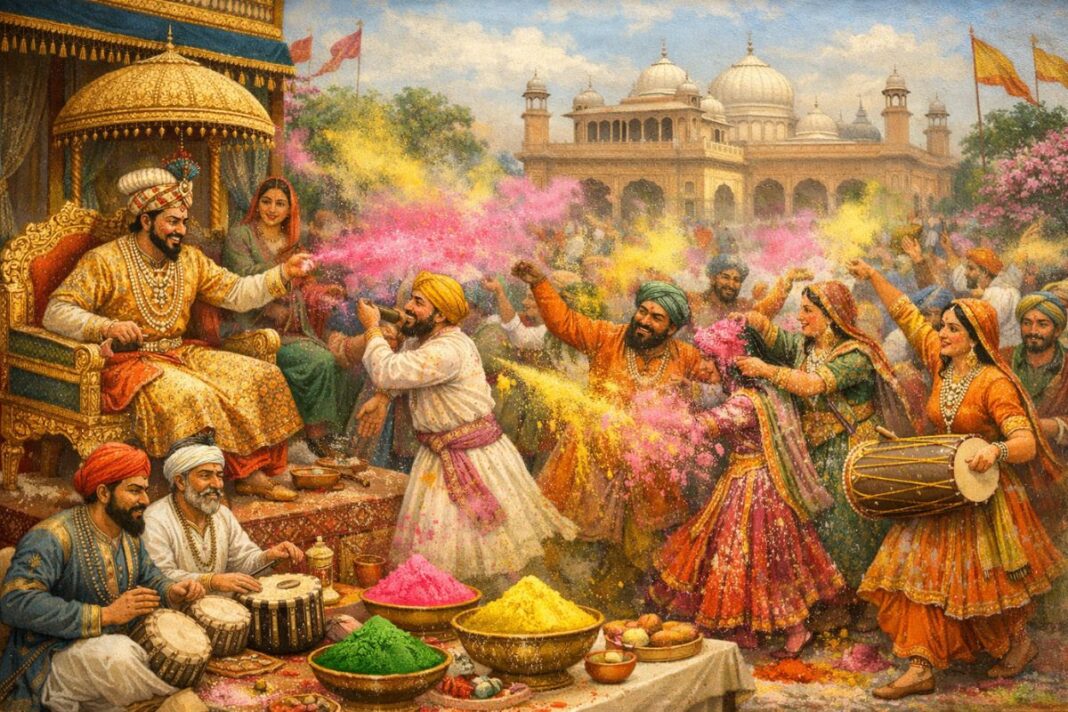
Persian chroniclers described palace courtyards drenched in colored powder, fountains spraying saffron water, and elephants with painted foreheads parading through the streets. The feasts prepared for these occasions followed Hindu dietary customs, underscoring Akbar’s commitment to religious accommodation.
Antonio Monserrate, a Jesuit priest who arrived at Fatehpur Sikri in March 1580, witnessed these celebrations firsthand. He described the festival as a time of boundary-less religious unity, noting that social hierarchies dissolved temporarily amid the chaos of flying colours.
The Transformation of a Festival
Under Mughal rule, Holi acquired a Persian identity and became known as Eid-e-Gulabi, the Festival of Roses, referring to the pink pigments that resembled rose hues. The name change reflected how thoroughly the festival had been absorbed into court culture. Later rulers called it Aab-e-Pashi, a shower of colourful flowers, further distancing it from exclusively Hindu associations.
This renaming mattered for political reasons. By giving Holi a Persian name and elevating it to the status of a festival alongside Muslim celebrations, the Mughals signalled their intention to rule a diverse empire rather than impose religious uniformity. Historical accounts suggest Holi was celebrated on the same scale as Eid in the Red Fort, with fairs on the Yamuna riverbanks and performances by travelling musicians.
The physical celebrations grew elaborate under imperial patronage. Natural dyes came from flowers and herbs, prepared in large vessels and splashed in courtyards. Musicians played Holi-themed ragas while dancers performed. The night before the colour throwing, bonfires were lit in observance of Holika Dahan, marking the end of winter.
Chronicles from the Court
Jahangir, who ruled from 1605 to 1627, extensively documented Holi in his autobiography, Tuzuk-e-Jahangiri. He explained that Hindus considered Holi the last day of their year, falling when the sun entered Pisces, and that they lit fires in lanes and streets the evening before. His description of the festival shows genuine interest rather than dismissive observation.
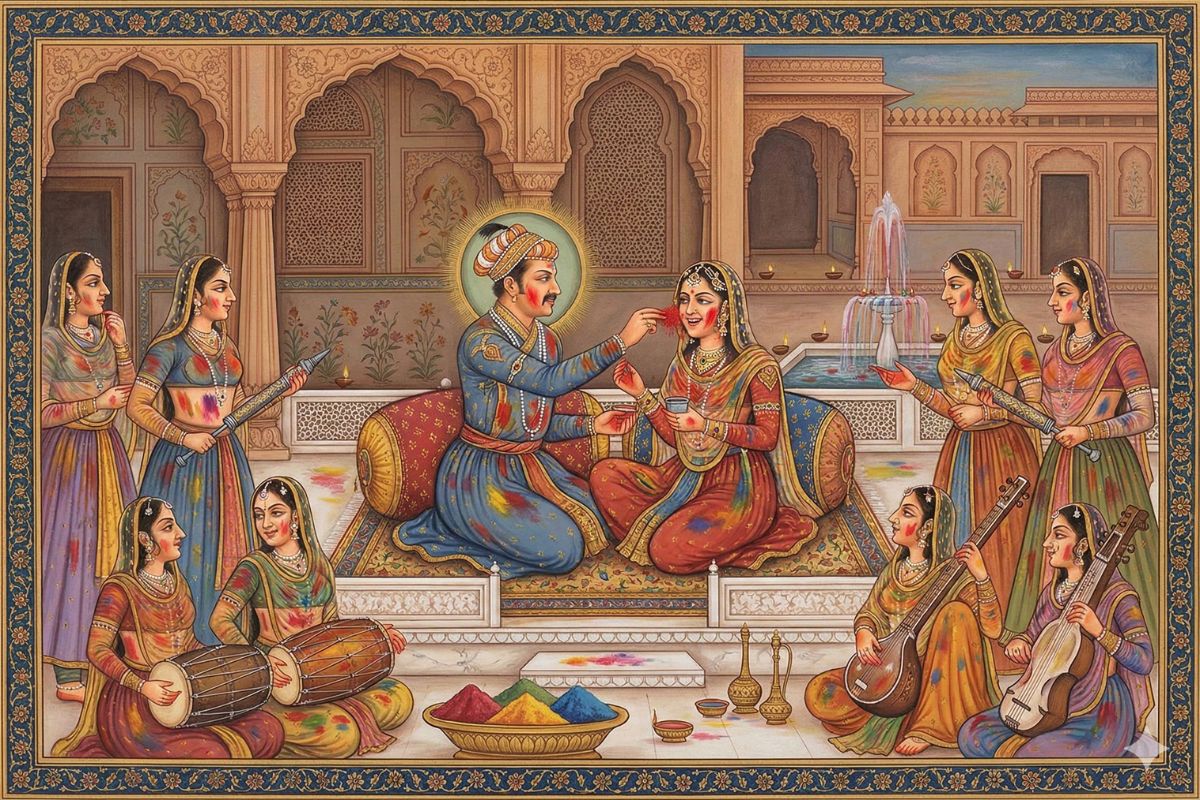
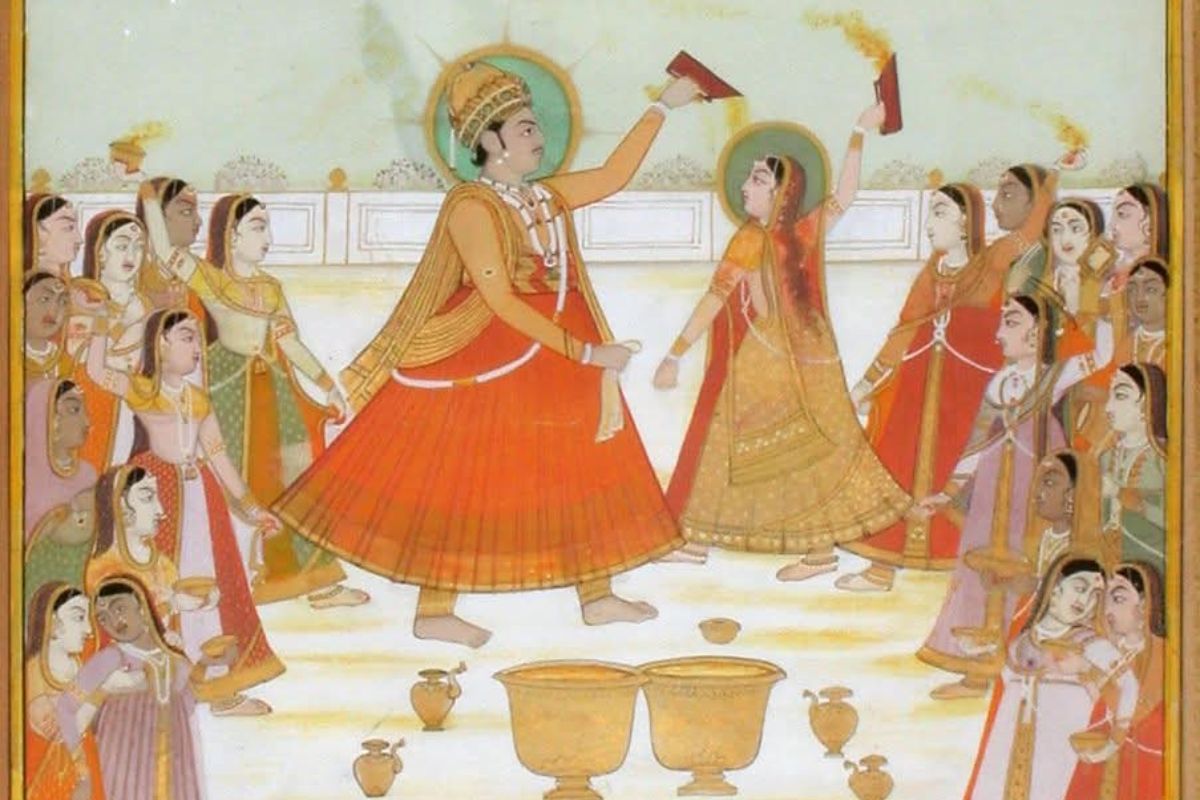
Jahangir actively organised gatherings known as Mehfil-e-Holi, and artists like Govardhan and Rasik painted him celebrating with his wife, Noor Jahan. These miniature paintings became important historical records once written documentation declined. They show emperors surrounded by musicians and courtiers in the zenana, all covered in powder, capturing the festival’s atmosphere.
Shah Jahan, ruling from 1628 to 1658, continued the tradition. Court records describe multi-day events featuring poetry sessions in which equal numbers of Hindu and Muslim poets recited. This careful balance reflected the empire’s composite culture in cities like Delhi, Agra, and Lahore.
The participation extended beyond the ruling family. Historian Ali Nadeem Rezavi notes the friendship between Surat Singh, a Hindu revenue officer, and Abdul Karim, a Muslim scholar, who were lifelong neighbours in Lahore. Such mixing of religious communities within the same neighbourhoods became common in major urban centres.
Later Emperors and Decline
Aurangzeb’s reign from 1658 to 1707 marked a shift. Often portrayed as religiously conservative, his relationship with Hindu festivals remains a matter of debate. Some historians claim he banned Holi celebrations not only at Agra Fort but throughout his domain, though other evidence contradicts this. His biographer Bhimsen recorded nobles and family members participating despite official restrictions.
Bahadur Shah I, Aurangzeb’s son, reportedly laughed when courtiers playfully doused him with colours during Holi and rewarded them rather than take offence. This anecdote suggests the festival persisted in court circles even during periods of supposed prohibition.
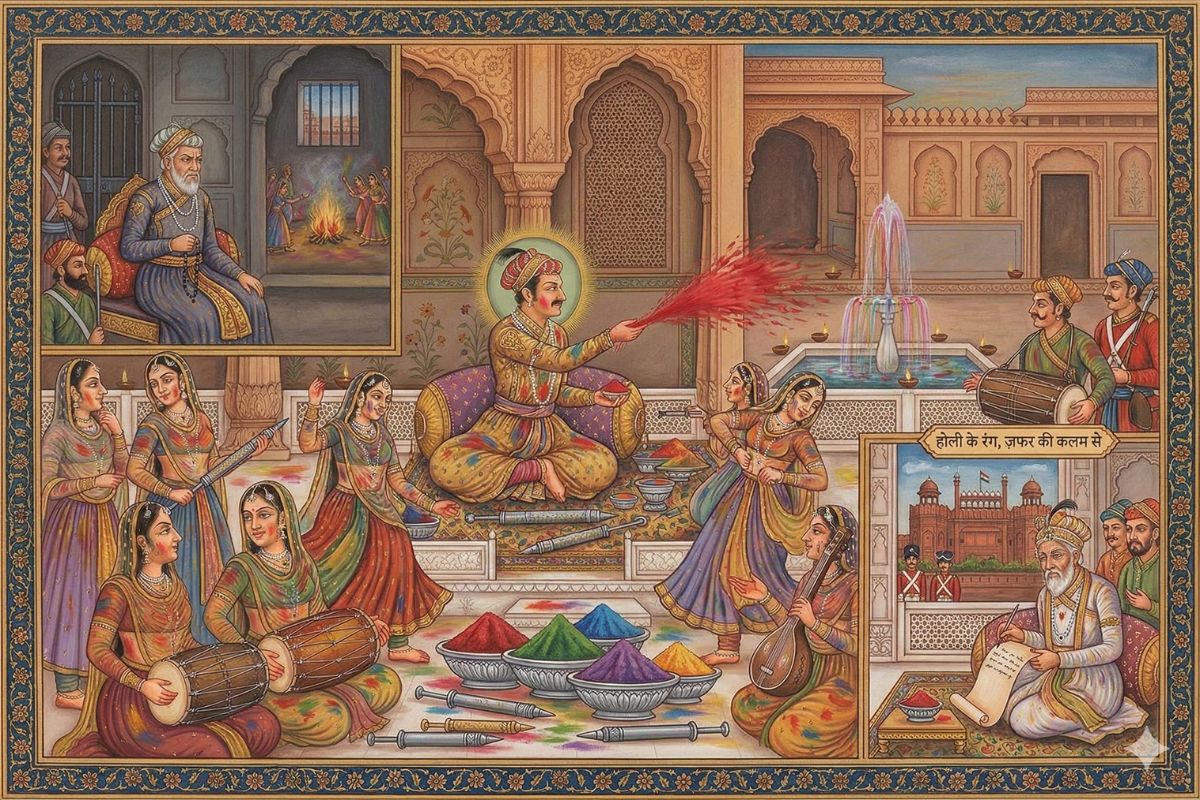
Muhammad Shah Rangeela, ruling from 1719 to 1748, revived Holi celebrations with renewed enthusiasm. He organised festivals featuring musicians, dancers, and courtiers, playing with colours, decorating his court with flowers, and holding poetry sessions. His patronage of the arts extended to making Holi a cultural event beyond its religious origins.
The last Mughal emperor, Bahadur Shah Zafar, ruled from 1837 to 1857 as British power grew. He reportedly allowed Hindu ministers to apply colored powder to his forehead each year during Holi. More significantly, he composed playful Holi poems in Urdu that expressed the festival’s spirit of temporary social inversion.
Legacy in Art and Literature
Mughal miniature paintings provide the most vivid records of imperial Holi celebrations. These artworks, produced in court workshops, show emperors in private spaces surrounded by women, musicians, and servants, all drenched in pigments. The paintings served both as documentation and as idealised representations of court life.
Poetry flourished around Holi throughout the Mughal period. The mystic poet Amir Khusrau, though he lived during the earlier Delhi Sultanate, wrote verses that influenced later Mughal celebrations, including lines about playing Holi when the beloved returns home. His poetry blended Persian and Hindavi, reflecting the cultural synthesis that the Mughals would later champion.
The Urdu newspaper Jam-e-Jahanuma reported in 1844 that special arrangements were made for Holi festivities during Bahadur Shah Zafar’s time, describing the exchange of colours made from teju flowers. These newspaper accounts show how deeply embedded the festival had become in Delhi’s urban culture.
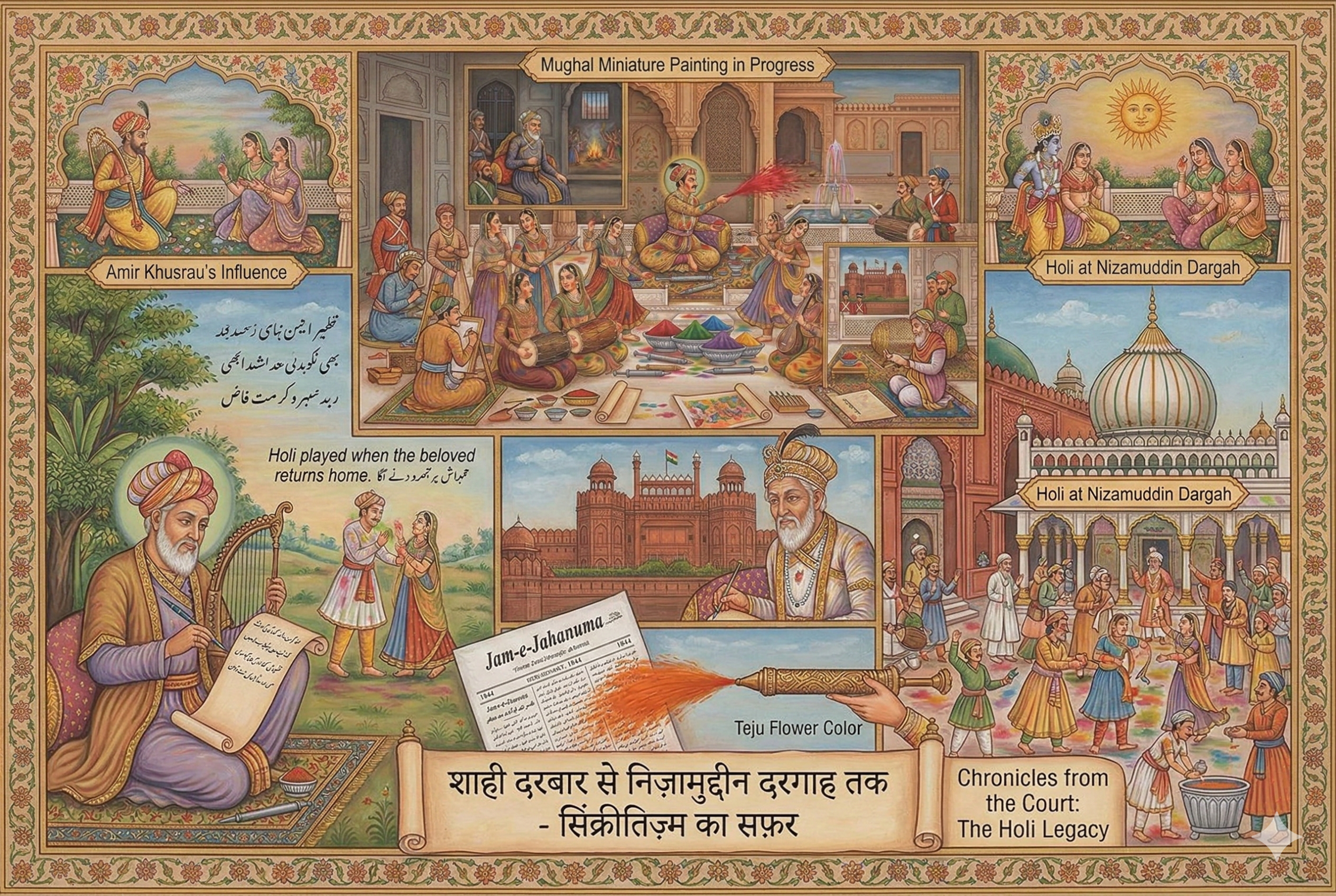
Even today, the Nizamuddin Dargah shrine in Delhi celebrates Holi annually, continuing the syncretic tradition established centuries ago. This persistence demonstrates how thoroughly the Mughals integrated Hindu practices into their cultural framework.
The Mughal embrace of Holi reveals how political power and religious identity interacted in early modern India. By adopting a Hindu spring festival and making it an imperial policy, the Mughals created a model of rule that prioritised accommodation over conversion. The colored powder thrown in palace courtyards served purposes beyond celebration, signalling to subjects that multiple traditions could coexist under one sovereign.
This legacy survived the empire’s collapse. The festival’s journey from regional Hindu observance to imperial spectacle to modern celebration shows how cultural practices transform through political patronage. What began as Krishna playing with colours in Vrindavan became, for a time, the business of emperors.
Also Read:Keep Your Living Space Cool with indoor plants
You can connect with DNN24 on Facebook, Twitter, and Instagram and subscribe to our YouTube channel.